AI Tools
DeepSeek V4 vs GPT-5.5: Is the 35x Price Gap Actually Worth It in 2026?
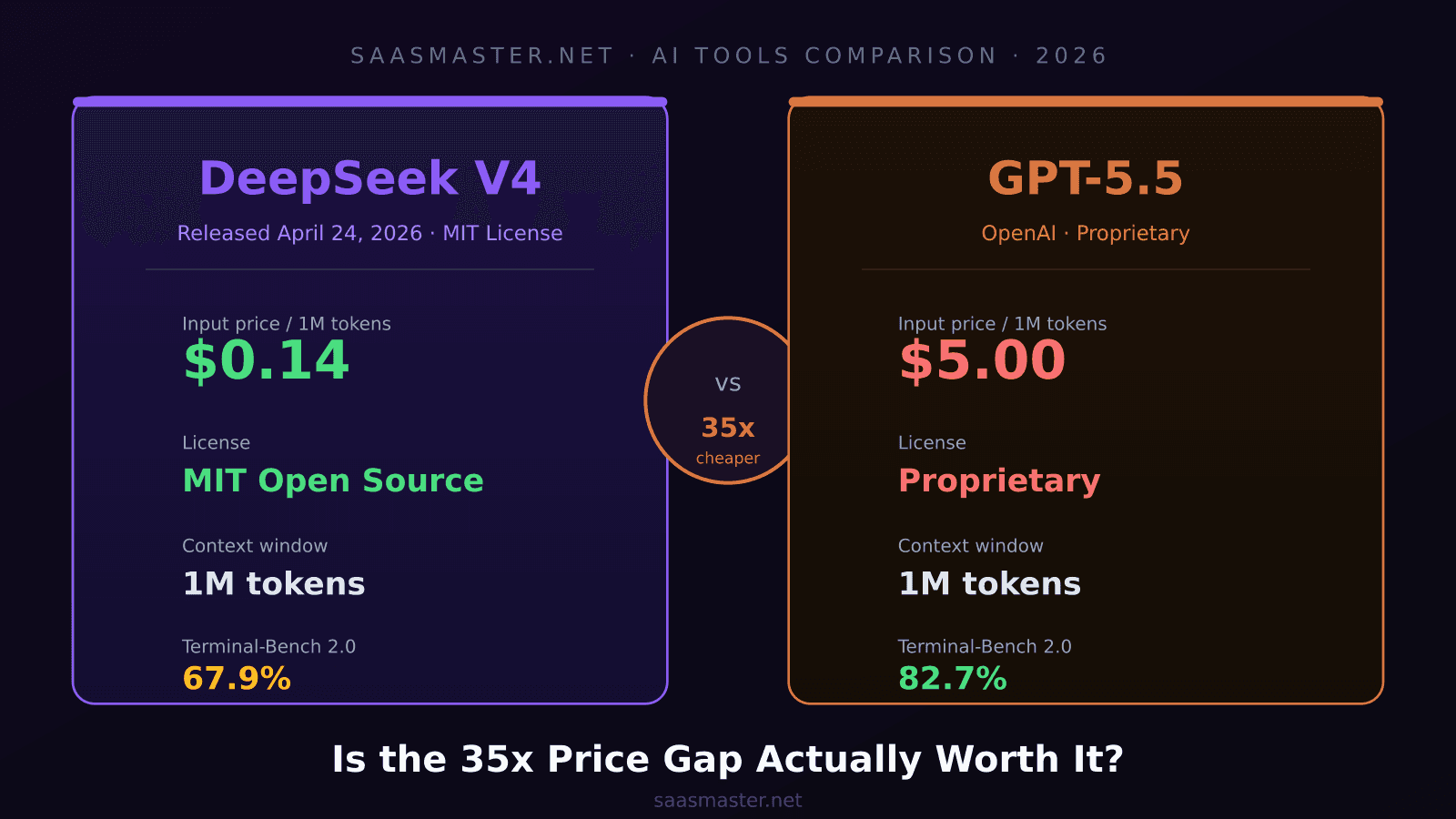
The most dramatic pricing story in AI right now isn't about a new model — it's about the gap between two that already exist. DeepSeek V4 Pro starts at roughly $0.14 per million input tokens via API. GPT-5.5 charges $5.00 per million. That's a 35x difference, and it's actively reshaping how SaaS builders pick their AI stack in 2026.
Key takeaways
- DeepSeek V4 costs $0.14/M input tokens vs GPT-5.5's $5.00 — up to a 35x pricing gap
- GPT-5.5 leads on raw coding benchmarks (Terminal-Bench 2.0: 82.7% vs 67.9%)
- DeepSeek V4 Pro is MIT-licensed, open-weights, and fully self-hostable
- Both models support a 1-million-token context window
- Lindy, a San Francisco AI platform, moved 100% of its agent traffic from Anthropic to DeepSeek V4, saving millions — though the migration took six to nine months
What actually changed in 2026?
A year ago, the conversation was: can Chinese models compete? Today the real question is: why are you paying premium prices for tasks where open models perform within 5%?
DeepSeek V4 Pro launched April 24, 2026, under an MIT license. You can download the weights, run the model on your own hardware, and pay nothing beyond compute costs. GPT-5.5, released around the same time by OpenAI, stayed fully closed and proprietary. Both target agentic coding and long-context reasoning as their flagship use cases.
What makes this moment different is scale. Vercel's AI Gateway tracked DeepSeek's share of token volume jumping from under 1% to 17% in a single month — while its share of actual spend stayed near 1%. That math tells the whole story: teams are processing enormous amounts of work on DeepSeek at a fraction of the cost.
The pricing breakdown — real numbers
Here's what running these models via API actually costs today.
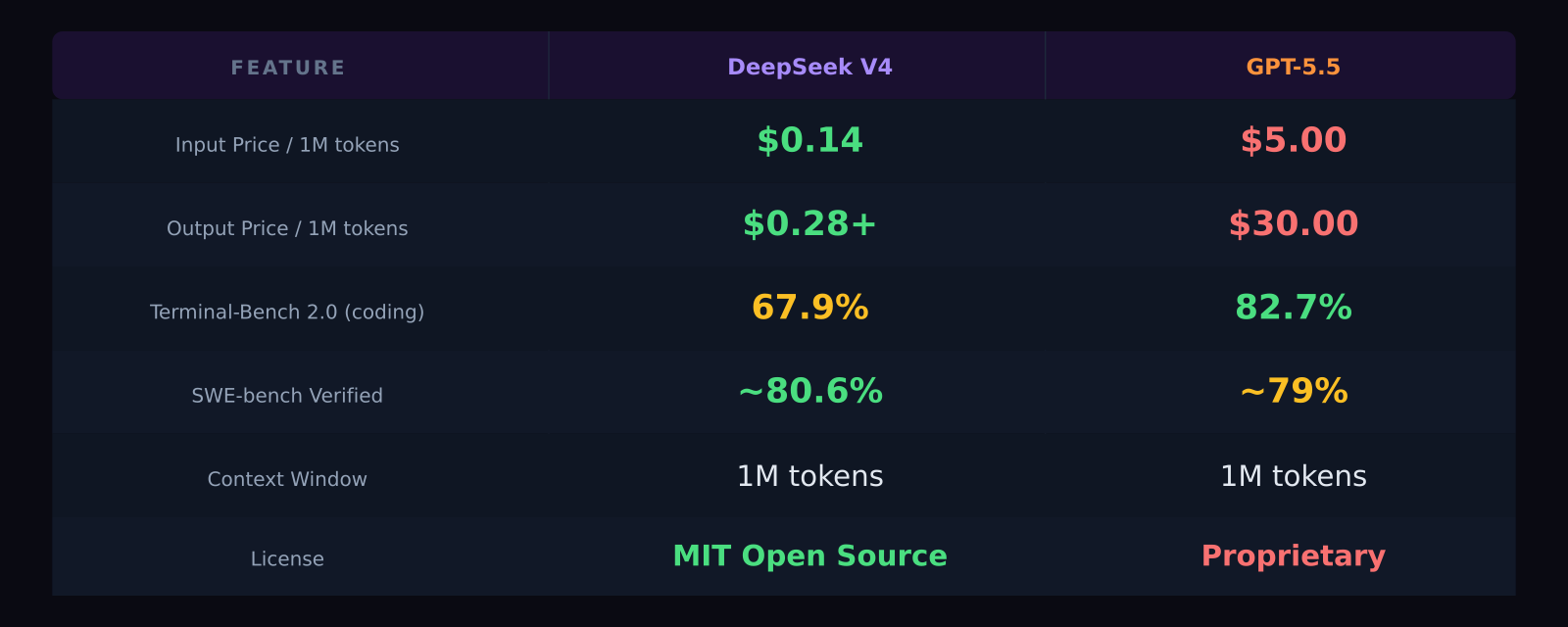
DeepSeek V4 Pro: $0.14 per million input tokens, starting at $0.28 per million output tokens depending on variant. GPT-5.5: approximately $5.00 per million input tokens, $30.00 per million output tokens on the standard tier.
For a SaaS product processing 100 million tokens per day — not unusual for a mid-size AI feature — that translates to $14/day on DeepSeek V4 versus $500/day on GPT-5.5. Monthly that's $420 versus $15,000. Annually you're looking at roughly $5,000 versus $182,500.
Lindy, a San Francisco-based AI agent platform, moved 100% of its traffic from Anthropic models to DeepSeek V4 and reports saving millions. Founder Flo Crivello said they're "actually seeing an increase in performance on many core use cases." The caveat: the migration took six to nine months of evaluation, gradual rollout, and extensive prompt re-engineering. His description: "100x more work than we thought."
That last part matters. Switching isn't just a line in a config file. System prompts and instructions written for one model don't always transfer cleanly to another. Budget time for it.
How do the benchmarks actually compare?
GPT-5.5 wins on pure coding benchmarks. On Terminal-Bench 2.0, which tests autonomous software engineering in a real terminal environment, GPT-5.5 scores 82.7% versus DeepSeek V4 Pro's 67.9%. That's a real, meaningful gap for complex code-heavy workflows.
On SWE-bench Verified, the picture changes. Claude Opus 4.6 actually leads that benchmark at 80.8%, with DeepSeek V4 Pro close behind at approximately 80.6%. GPT-5.5 sits slightly below both on SWE-bench.
On general reasoning, math, and knowledge tasks, the two models perform within a few percentage points of each other. BenchLM's current overall leaderboard puts DeepSeek V4 Pro Max at 87 out of 100 — the highest-ranked Chinese model in the field.
Which model is right for your use case?
When DeepSeek V4 makes sense
You are building a high-volume AI feature where per-token cost compounds at scale. You need self-hosting for data privacy, compliance, or latency reasons — the MIT license is the only path to that. Your tasks fall in the broad middle ground where quality differences are small: summarization, classification, Q&A over documents, content generation. You want room to experiment without burning budget.
When GPT-5.5 is worth the premium
Your product depends on top-tier coding quality and that 15-point margin on Terminal-Bench matters directly to users. You need OpenAI's enterprise ecosystem: compliance certifications, SLAs, guardrails, and Codex integration. Switching costs from the OpenAI API are real enough to outweigh the savings. You're building something where AI failure is immediately visible to end users.
Is this pricing gap sustainable?
DeepSeek's cost advantage comes from two things: architectural efficiency (their MoE design activates only a fraction of parameters per token) and lower compute infrastructure costs. OpenAI's pricing reflects capability leadership, heavy enterprise infrastructure, and the closed ecosystem they maintain.
For SaaS builders, the practical takeaway is this: if your AI feature runs in the background and users never see the raw output, V4 at $0.14/M is a hard case to argue against. If your AI output is the product itself — visible, evaluable, tied to your quality reputation — GPT-5.5's benchmark edge might still justify $5.00/M.
Frequently asked questions
Is DeepSeek V4 actually open source?
Yes. DeepSeek V4 Pro is released under an MIT license with weights publicly available on Hugging Face. Commercial use and fine-tuning are both permitted. This is meaningfully different from Western frontier models, which are API-only with no access to the underlying weights.
Which model is better for coding tasks in 2026?
For autonomous terminal-based coding, GPT-5.5 leads with 82.7% on Terminal-Bench 2.0 versus DeepSeek V4's 67.9%. On SWE-bench Verified, the gap narrows considerably and V4 is competitive. If complex coding is your core use case and budget allows, GPT-5.5 has a real edge. For most other tasks, the quality difference is small.
How hard is it to switch from GPT to DeepSeek V4?
Harder than it looks. Lindy's migration from Anthropic to DeepSeek took six to nine months of evaluation and extensive prompt re-engineering. System prompts written for one model often break on another. Budget time and a gradual rollout before committing production traffic.
Was this article helpful?
SaaS Master
Creator behind SaaS Master — tutorials, walkthroughs, reviews, and explainers that help SaaS, AI, and WordPress products get understood and chosen. Writing here about the tools, trends, and tactics that actually move the needle. Work with me →
Want your product explained this clearly — in video?
Tutorials, walkthroughs, reviews, and shorts for SaaS, AI, and WordPress products.
Work With SaaS Master