AI Tools
DeepSeek V4 vs Qwen 3.7 Max: Which Chinese Open-Source AI Should You Use in 2026?
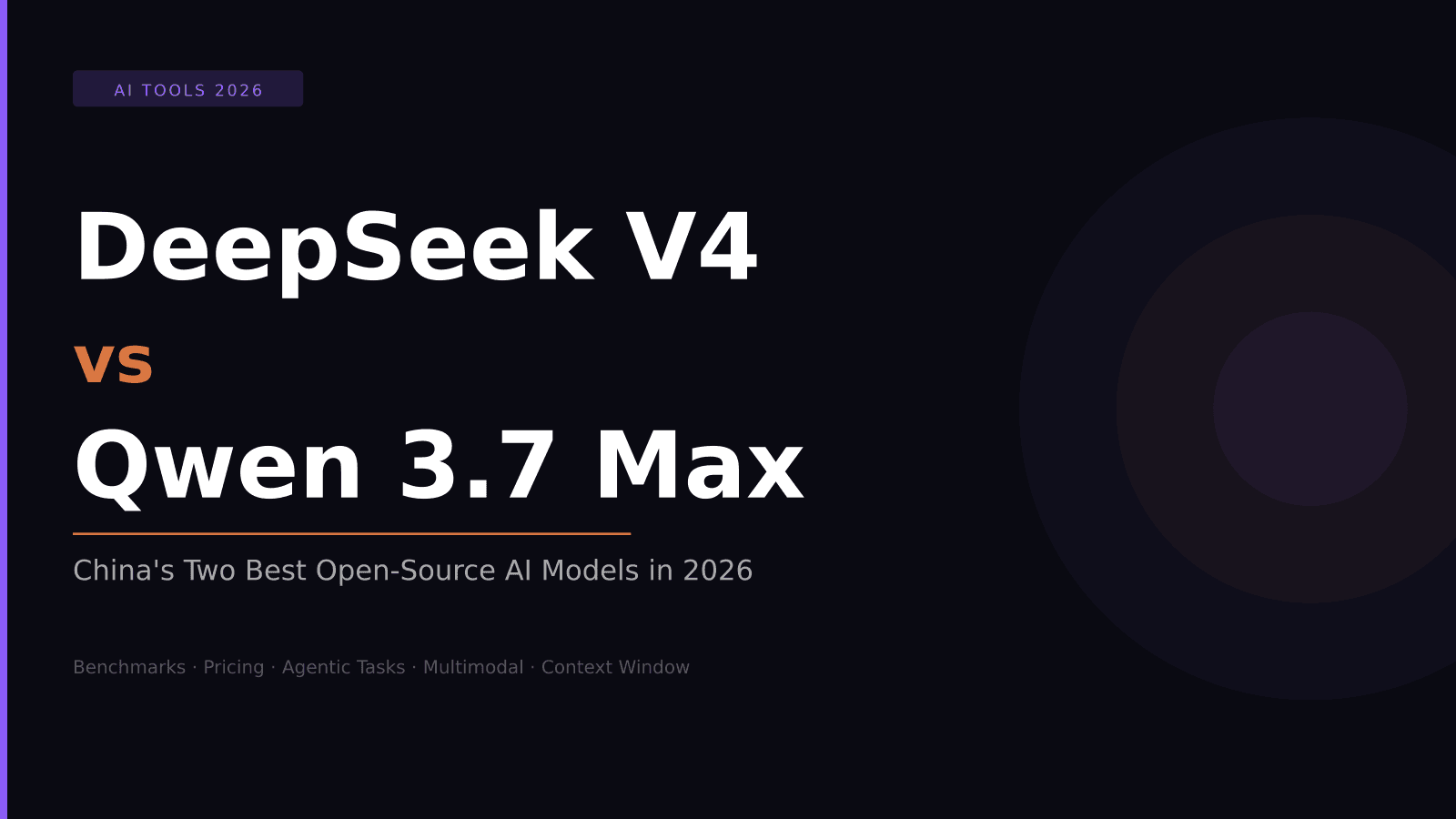
The two strongest open-source AI models in the world right now both come from China — and the gap between them is smaller than the marketing suggests. DeepSeek V4 Pro costs roughly six times less than Qwen 3.7 Max per token. Qwen wins on agentic tasks. DeepSeek wins on context length and raw coding benchmarks. If you have been defaulting to Claude Opus or GPT-5.5 for production workloads, the numbers in this comparison will make you rethink that decision.
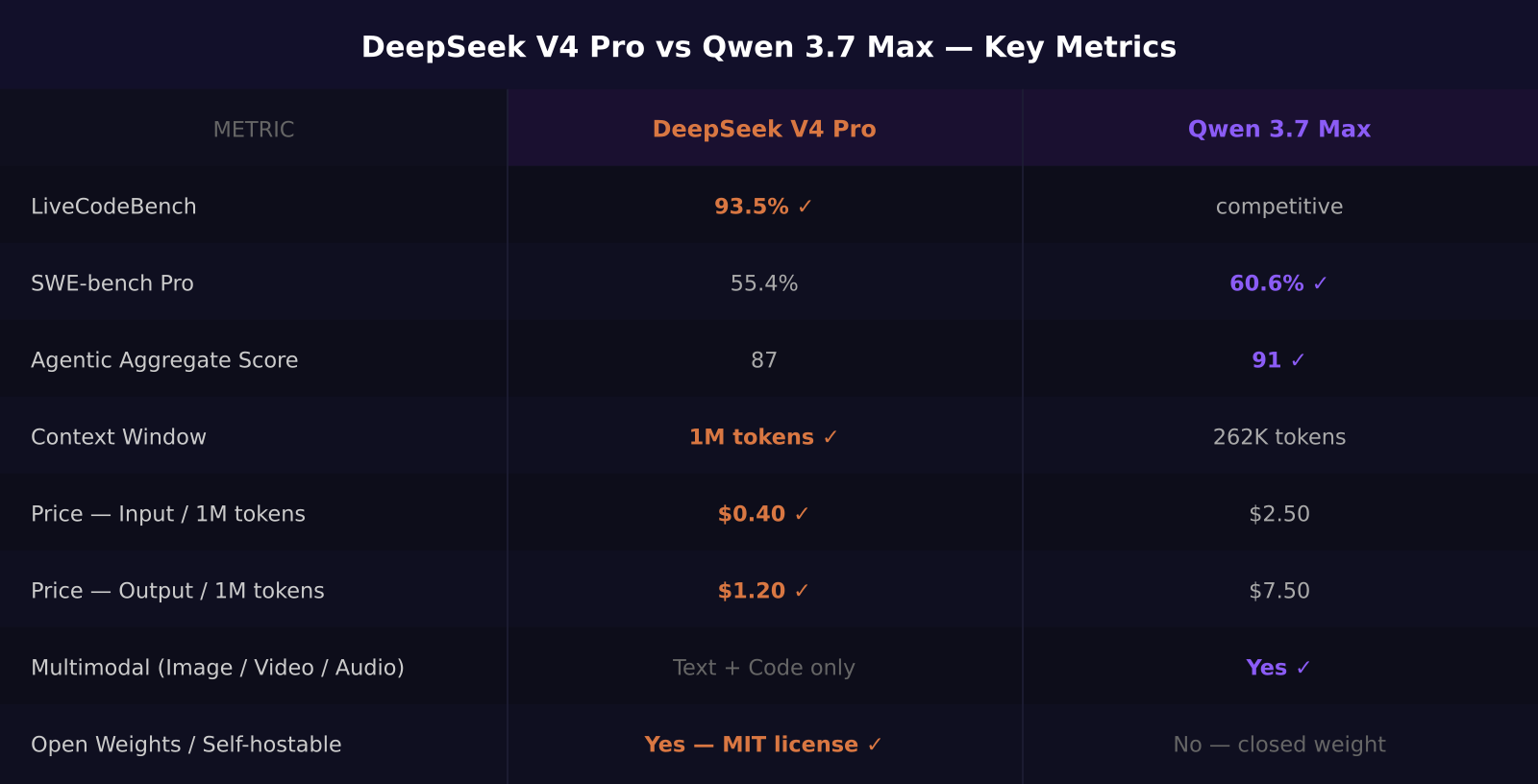
Key takeaways: - DeepSeek V4 Pro is MIT-licensed, self-hostable, and costs $0.40 per million input tokens vs Qwen 3.7 Max at $2.50 - Qwen 3.7 Max leads on agentic task benchmarks (91 aggregate score vs DeepSeek's 87) and is the better orchestrator model - DeepSeek V4 Pro beats Qwen on LiveCodeBench at 93.5% and offers a 1M-token context window vs Qwen's 262K - Qwen 3.7 Max is multimodal — it handles images, video, and audio natively; DeepSeek V4 Pro does not - Both demolish the cost structure of Western frontier models
What DeepSeek V4 Actually Is
DeepSeek V4 launched April 24, 2026, as the Chinese AI lab's fourth-generation flagship model. The architecture is a Mixture-of-Experts design at 1.6 trillion total parameters — but only a fraction of those parameters activate per forward pass, which is why inference stays cheap while benchmark scores stay high. Context window: 1 million tokens, maximum output 384,000 tokens, which puts it ahead of nearly every model in production for long-document and long-codebase tasks.
There are two variants that matter in practice. V4 Flash is the smaller daily-driver model at $0.14 per million input tokens and $0.28 output. V4 Pro is the full-capability version, priced at $0.40 input and $1.20 output per million tokens. Both are MIT-licensed and self-hostable, which matters significantly for privacy-sensitive teams or anyone who wants to keep inference on their own infrastructure.
The open-weights status is not an afterthought. Running DeepSeek V4 Pro locally via tools like Ollama or vLLM is a real option for teams with GPU budget, and at 1.6T parameters it is designed to benefit from distributed inference setups.
What Qwen 3.7 Max Actually Is
Qwen 3.7 Max reached general availability on June 1, 2026, as Alibaba's strongest released model to date. Where DeepSeek V4 Pro is open-source, Qwen 3.7 Max is closed-weight and proprietary — the tier below (Qwen 3.7 Plus) follows Alibaba's standard pattern of open-sourcing the second-tier model while keeping the flagship proprietary.
Context window is 262,144 tokens, considerably shorter than DeepSeek's 1M but longer than most real workloads require. API pricing is $2.50 per million input tokens and $7.50 output through the standard Alibaba Cloud API, making it more expensive than DeepSeek V4 Pro by a significant margin.
What Qwen 3.7 Max has that DeepSeek V4 Pro does not is genuine multimodality. Images, video, and audio all go into the same model natively. That is not a minor feature — it changes what the model can do in end-to-end SaaS and content workflows where visual context matters.
Qwen 3.7 Plus, the cheaper sibling at $0.40 input tokens, is worth mentioning separately. It delivers near-Max performance on many tasks at a price point that matches DeepSeek V4 Pro, and it is open-source.
How Benchmarks Break Down Between the Two
On BenchLM's aggregate 2026 leaderboard, Qwen 3.7 Max scores 91 versus DeepSeek V4 Pro's 87 across agentic, coding, multimodal, knowledge, and reasoning workflows. That seven-point gap sounds significant but it almost entirely comes from multimodal and agentic categories where Qwen has structural advantages.
Narrow it to coding benchmarks and the picture changes. On LiveCodeBench — competitive programming and real code generation tasks — DeepSeek V4 Pro reaches 93.5%, outpacing Qwen. On Codeforces, DeepSeek V4 Pro posts a rating of 3206, placing it in the elite competitive programming tier. The model was clearly trained heavily on code.
On SWE-bench Pro, which uses realistic software engineering tasks from actual GitHub repositories, Qwen 3.7 Max leads at 60.6% versus DeepSeek V4 Pro's 55.4%. This is the benchmark I would weight most heavily for SaaS teams writing production application code — it reflects actual debugging and feature work, not academic problem-solving.
For agentic tasks — multi-step tool use, autonomous research, long-horizon planning — Qwen 3.7 Max has a measurable edge. The model has demonstrated 35-hour autonomous kernel optimization runs and a 96% win rate on Kernel Bench. DeepSeek V4 Pro is strong at executing individual tasks; Qwen 3.7 Max is stronger at orchestrating sequences of them.
Which Is Cheaper, DeepSeek V4 or Qwen 3.7 Max?
At the flagship tier, DeepSeek V4 Pro costs $0.40 input and $1.20 output per million tokens. Qwen 3.7 Max costs $2.50 input and $7.50 output. On output tokens — which drive most API costs in real applications — DeepSeek is 6.25 times cheaper.
If you are running high-volume API workloads, that difference compounds fast. A workload generating 10 million output tokens per month costs $12 on DeepSeek V4 Pro and $75 on Qwen 3.7 Max. At 100 million tokens it is $120 versus $750.
DeepSeek V4 Flash lowers the floor further: $0.28 per million output tokens. For anything that does not require absolute top-of-chart reasoning, Flash is an extraordinarily cost-efficient option — near-frontier coding performance at a cost closer to a lightweight model.
Which One Should You Actually Use?
My recommendation depends entirely on what you are building.
For pure coding tasks — generating features, debugging, code review, building automation scripts — use DeepSeek V4 Pro or Flash. LiveCodeBench 93.5%, 6x cheaper than Qwen Max, self-hostable. This is the model to reach for when you want to keep API costs predictable as you scale.
For agentic pipelines — AI agents that need to plan, coordinate tools, and execute long autonomous workflows — Qwen 3.7 Max earns its premium price. The aggregate agentic score and the 35-hour autonomous task capability are not benchmark theater; they reflect genuine differences in how the models handle multi-step reasoning chains.
For multimodal workflows — anything involving image analysis, video understanding, or audio alongside text — Qwen 3.7 Max is the only option between these two. DeepSeek V4 Pro simply does not handle non-text inputs natively.
For teams with privacy requirements or GPU budget for self-hosting — DeepSeek V4 Pro on MIT license. Qwen 3.7 Max is closed-weight with no self-hosting option at the flagship tier.
A practical hybrid: use Qwen 3.7 Max as the planner model in agent architectures (better at deciding what to do), route coding subtasks to DeepSeek V4 Flash (cheaper and strong on code execution). This gives you near-Qwen agentic quality at DeepSeek pricing for the bulk of your token spend.
Frequently asked questions
Is DeepSeek V4 better than Qwen 3.7 Max for coding?
It depends on the type of coding task. DeepSeek V4 Pro leads on LiveCodeBench (93.5%) and competitive programming. Qwen 3.7 Max leads on SWE-bench Pro (60.6% vs 55.4%), which uses realistic software engineering tasks from real repositories. For building SaaS features and debugging production code, Qwen has a small edge. For writing algorithms and code challenges, DeepSeek wins. At DeepSeek's 6x lower price, the cost advantage may outweigh the benchmark difference for most teams.
Can Qwen 3.7 Max understand images and video?
Yes. Qwen 3.7 Max supports image, video, and audio inputs natively as part of its multimodal design. DeepSeek V4 Pro is a text and code model and does not process visual or audio inputs. If your workflow involves passing screenshots, product mockups, or video frames to the model, Qwen 3.7 Max is the only choice between these two.
Which Chinese AI model is cheapest to run at scale?
DeepSeek V4 Flash at $0.14 per million input tokens and $0.28 per million output tokens is the cheapest frontier-adjacent option from either lab. DeepSeek V4 Pro at $0.40 input and $1.20 output is the cheapest true-flagship option. Qwen 3.7 Plus — the open-source sibling of Qwen 3.7 Max — is priced near DeepSeek V4 Pro levels and worth evaluating for teams that want Alibaba's model quality without the Max tier's price tag.
Was this article helpful?
SaaS Master
Creator behind SaaS Master — tutorials, walkthroughs, reviews, and explainers that help SaaS, AI, and WordPress products get understood and chosen. Writing here about the tools, trends, and tactics that actually move the needle. Work with me →
Want your product explained this clearly — in video?
Tutorials, walkthroughs, reviews, and shorts for SaaS, AI, and WordPress products.
Work With SaaS Master