AI & SaaS
Supabase Just Hit $10.5B — Because AI Agents Are Building 60% of Its Databases
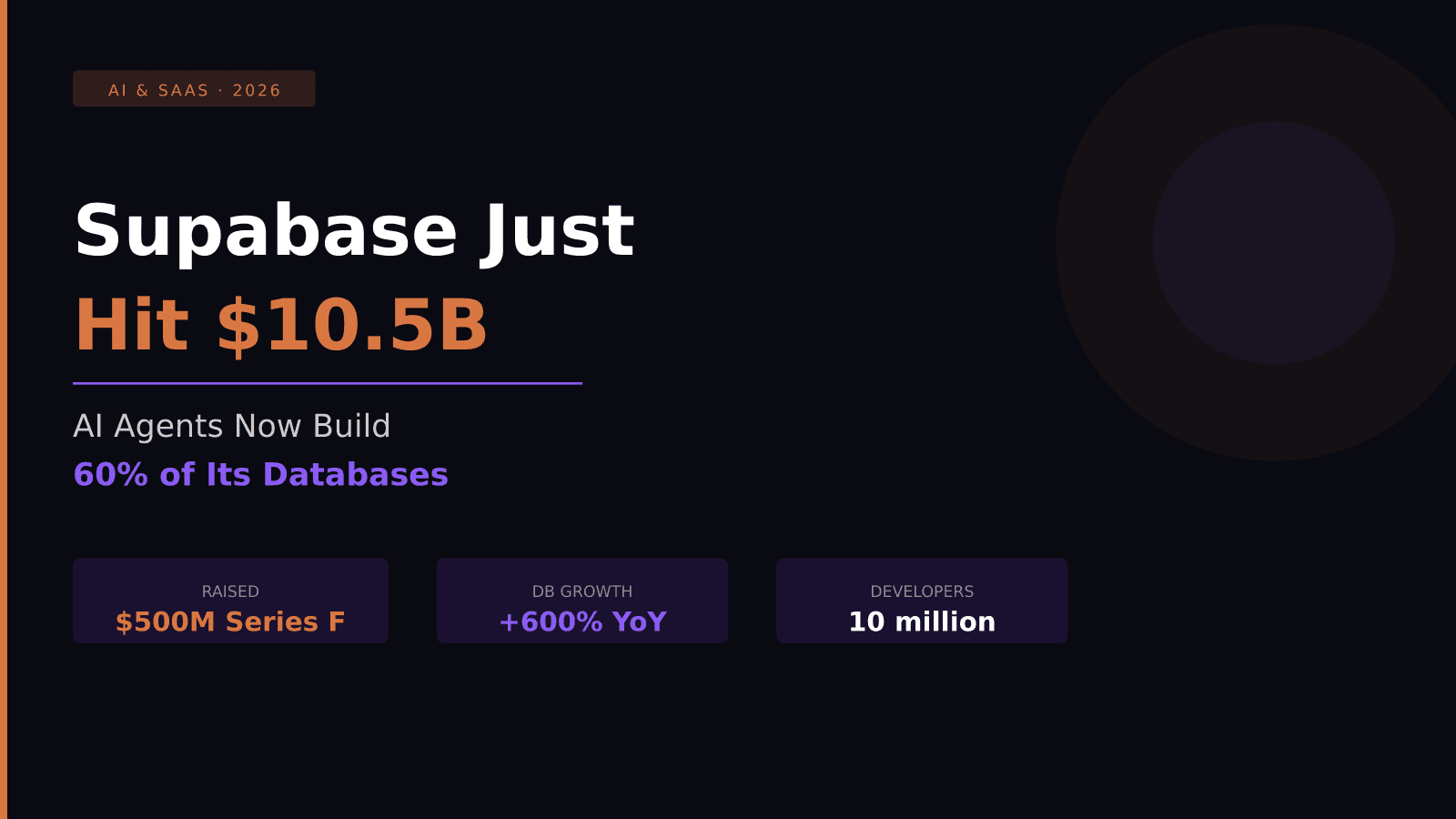
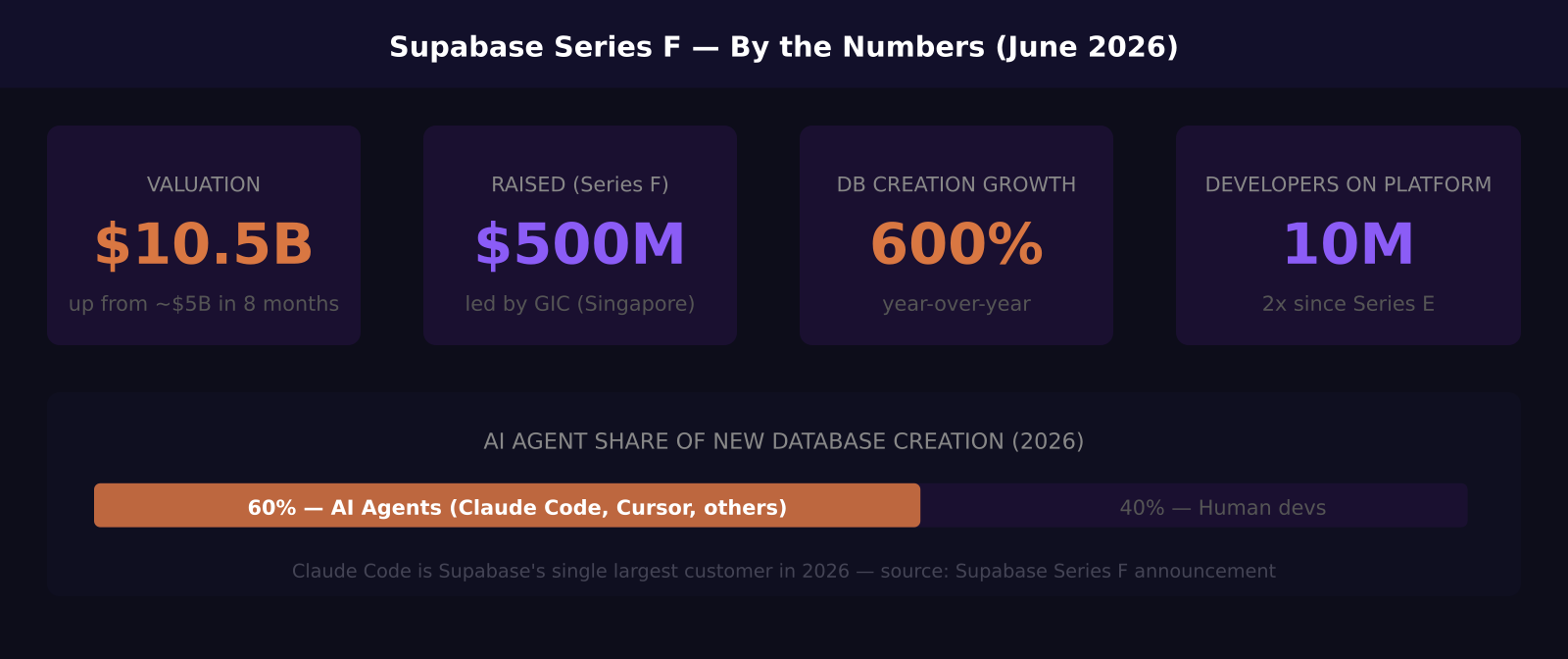
Over 60% of new databases on Supabase are now created by AI tools, not human developers. That single statistic — released alongside the company's $500 million Series F on June 4, 2026 — explains more about where software development is heading than any benchmark comparison. Supabase doubled its valuation from $5 billion to $10.5 billion in eight months. The engine is not a new product. It is AI agents spinning up Postgres databases at a rate no human-driven growth curve could produce.
Key takeaways: - Supabase raised $500M Series F led by GIC (Singapore) at a $10.5B valuation on June 4, 2026 - Claude Code is named as Supabase's single largest customer — AI agents now launch the majority of new databases - Database creation on the platform grew 600% year-over-year - The company launched Multigres: an open-source horizontal scaling layer for Postgres built by the co-creator of Vitess - Supabase now serves nearly 10 million developers and has raised over $1 billion total
What Actually Happened
On June 4, 2026, Supabase announced a $500 million Series F led by Singapore's sovereign wealth fund GIC, at a $10.5 billion valuation. That round closed just seven months after the Series E, which had valued the company at roughly $5 billion. Every major investor from prior rounds participated: Accel, Y Combinator, Craft, Felicis, Peak XV, and Coatue. New entrants included Salesforce Ventures. Stripe joined for a second time.
This puts total Supabase funding north of $1 billion — a milestone for a company that started as the open-source Firebase alternative built on Postgres.
The valuation spike is not purely a narrative bet. Supabase reported a 600% increase in database creation year-over-year, with nearly 10 million developers now on the platform — more than double the count at the time of the Series E.
The Real Story: AI Agents Are the Main Customer
The number that should matter to SaaS builders and founders is not the $10.5 billion figure. It is this: AI agents now create more than 60% of new Supabase databases. And Claude Code — Anthropic's terminal-based agentic coding tool — is specifically named as the single largest contributor to that growth since the start of 2026.
This is not a promotional statistic from a partnership deal. It is a structural shift in how software gets built. The term Supabase used in materials tied to this round is vibe coding — a phrase popularized by AI researchers to describe the pattern where a developer describes what they want and an AI agent writes, provisions, and deploys it end to end. Supabase is purpose-built for frictionless backend setup: spin up a Postgres database, enable auth, set up storage, and expose APIs in minutes with no server management.
In practice: a developer opens Claude Code, describes the app they want to build, and Claude writes the schema, applies migrations, creates the Supabase project, and returns a working database-backed application. The developer types a description. Everything else is agent work. Multiply that across hundreds of thousands of users building prototypes and production apps, and you get 600% database growth.
CEO Paul Copplestone has framed the company's positioning as agentic infrastructure — not just a database platform, but the default backend layer for the AI agent era.
What Is Multigres and Why Does It Matter?
Alongside the funding announcement, Supabase launched Multigres — an open-source horizontal scaling layer for Postgres. The stated goal: handle workloads up to the size of OpenAI or larger, according to Copplestone.
Multigres was built by Sugu Sougoumarane, co-creator of Vitess — the system Google built to scale YouTube's MySQL databases under extreme traffic. Vitess solved horizontal MySQL scaling at a time when database limits were one of the biggest ceilings on web-scale growth. Multigres applies the same architectural principles to Postgres.
The practical implication for SaaS teams: as AI agents spin up more databases and those databases grow under production workloads, Supabase now has a credible scaling story from day-zero prototype to enterprise load. Before Multigres, the question of whether Supabase could scale to serious production was a legitimate concern. The co-creator of Vitess building the scaling layer removes most of that concern.
For teams currently on Supabase and thinking about whether to migrate to a managed Postgres service as they grow — Multigres is a reason to stay.
What This Means for SaaS Builders
If you are building a SaaS product in 2026 and have not re-evaluated Supabase in the last twelve months, the platform has moved faster than most of its competitors combined. The free tier includes database, auth, storage, and edge functions. Paid plans start at $25 per month. The API surface area has expanded significantly with MCP support, making it directly accessible from agentic tools like Claude Code without manual configuration.
The investor thesis behind this round is not complicated. GIC and Salesforce Ventures are not betting on a better database. They are betting that the interface between AI coding agents and production infrastructure becomes one of the most valuable surfaces in software over the next five years. Right now, that interface is Supabase more often than anything else.
For content creators in the SaaS and dev-tools space, this funding round is worth covering for a specific reason: it validates what many have been observing anecdotally. The vibe coding wave is real infrastructure demand, not a demo pattern. Real applications with real users are running on databases that AI agents built without a human writing a single line of backend configuration.
Who Should Pay Attention Right Now
Development teams evaluating backend choices for new SaaS products should look at Multigres alongside the funding news. The combination of open-source Postgres, agent-friendly API design, MCP support, and now a credible horizontal scaling path removes most objections to choosing Supabase beyond early stage.
Founders who personally build with AI coding tools should understand that the infrastructure choices their agents make by default increasingly point to Supabase. Knowing that lets you make an informed choice rather than discovering it six months into production.
Non-technical founders are often surprised to find out that when they ask Claude Code to build them a prototype, the resulting backend is frequently a Supabase project. That is not an accident. Supabase has made itself the easiest backend target for AI agents — and this round suggests that strategy has worked.
The line I keep coming back to from the funding coverage: Claude Code is a company's biggest customer. That sentence would have sounded like science fiction in 2023. In June 2026, it is a lead item in a $500M fundraise announcement.
Frequently asked questions
Why did Supabase's valuation double so fast?
Supabase went from roughly $5 billion at Series E (late 2025) to $10.5 billion at Series F (June 2026) in approximately seven months. The driver is a 600% year-over-year increase in database creation, primarily from AI agents — Claude Code in particular — autonomously spinning up and deploying databases at scale. Investors are betting that agentic infrastructure captures outsized value as autonomous coding proliferates.
What is Multigres and is it available now?
Multigres is an open-source horizontal scaling layer for Postgres, announced alongside the Series F on June 4, 2026. It was built by Sugu Sougoumarane, co-creator of Vitess (the system that scaled YouTube). Multigres allows Supabase Postgres databases to scale horizontally without migrating to a different system. It was released as open source and is available on GitHub.
Is Supabase free to use for new projects?
Yes. Supabase offers a free tier that includes database, authentication, file storage, and edge functions. The free tier supports two active projects. Paid plans start at $25 per month for the Pro tier, which adds more compute, storage, and team features. Enterprise pricing is available for large-scale or compliance-sensitive deployments.
Was this article helpful?
SaaS Master
Creator behind SaaS Master — tutorials, walkthroughs, reviews, and explainers that help SaaS, AI, and WordPress products get understood and chosen. Writing here about the tools, trends, and tactics that actually move the needle. Work with me →
Want your product explained this clearly — in video?
Tutorials, walkthroughs, reviews, and shorts for SaaS, AI, and WordPress products.
Work With SaaS Master