Gemini 3.5 Flash vs Claude Haiku 4.5 vs GPT-5 Mini: Which Fast AI Is Worth Building On in 2026?
In short
Gemini 3.5 Flash, Claude Haiku 4.5, and GPT-5 Mini compared on real July 2026 pricing, speed, agentic benchmarks, and which one fits your SaaS workload.
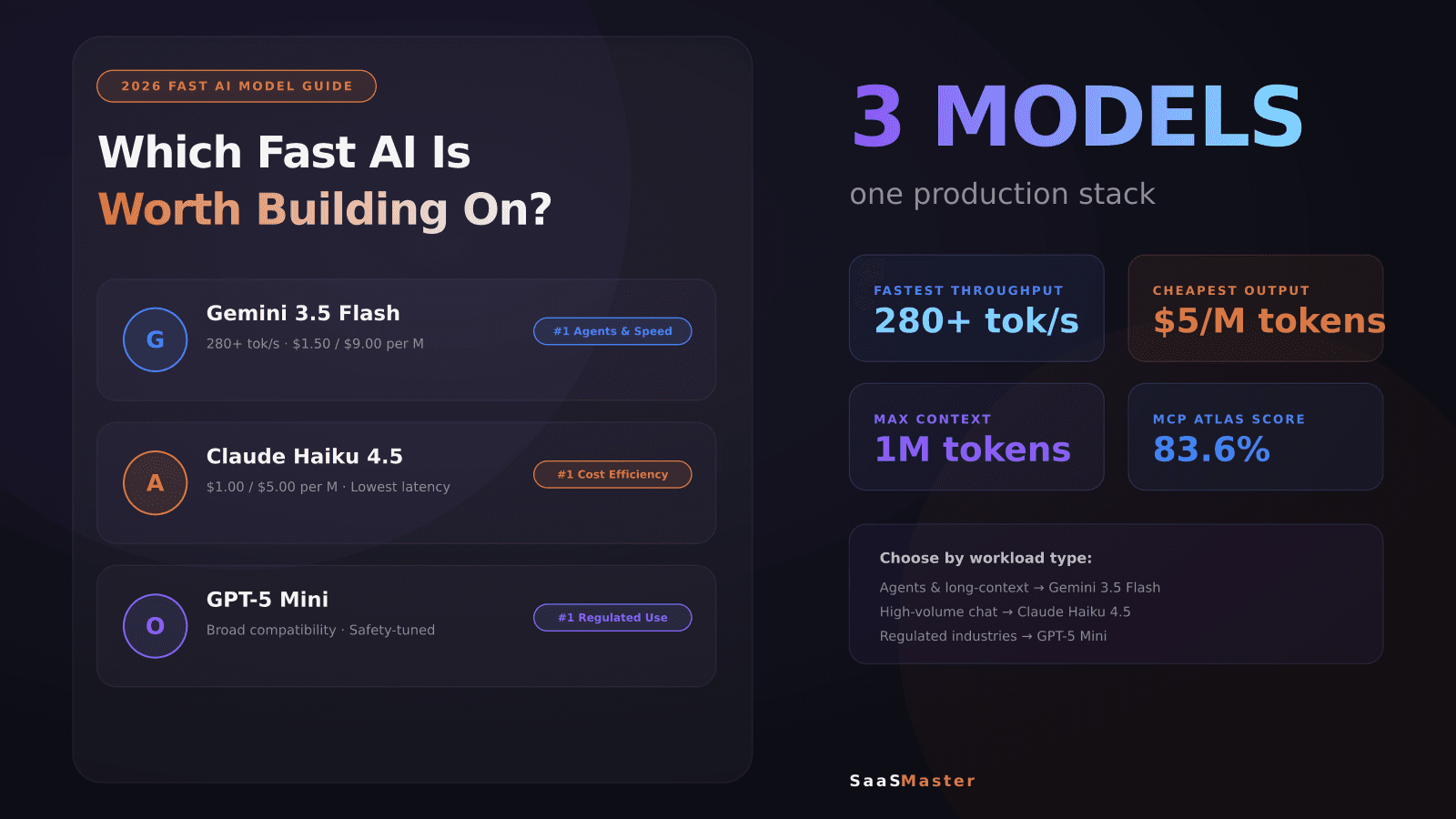
Google released Gemini 3.5 Flash in May 2026 and it immediately did something that surprised a lot of teams: a Flash-tier model outscored last year's Pro-tier models on agentic benchmarks — while costing three times as much as the Flash version it replaced. That price jump forced a real question for every SaaS team running high-volume AI workloads. Is Gemini 3.5 Flash worth the premium, or are Anthropic's Claude Haiku 4.5 and OpenAI's GPT-5 Mini better bets for production?
I ran all three through the numbers and tested them across different workload types. Here is the breakdown for July 2026.
Key takeaways
- Gemini 3.5 Flash leads on speed (280+ tokens per second) and agentic benchmarks (83.6% MCP Atlas, 84.2% CharXiv Reasoning) but costs $1.50 and $9.00 per million tokens — 3x its predecessor
- Claude Haiku 4.5 is 44% cheaper on output at $5 per million output tokens and delivers the lowest time-to-first-token in conversational flows
- GPT-5 Mini is the strongest pick for safety-sensitive or regulated industry use cases
- Gemini 3.5 Flash's 1 million token context window is 5x larger than Haiku 4.5's 200K — decisive for long-document pipelines
- For SaaS teams building agent-heavy products, Gemini 3.5 Flash's MCP Atlas score is the hardest production number to ignore right now
What each model actually is
These three are the workhorse models — not the frontier reasoning heavyweights, but the ones you'd actually deploy at scale in a production SaaS application. The right one depends less on benchmarks and more on the shape of your workload.
Gemini 3.5 Flash launched on May 19, 2026, as Google DeepMind's updated fast model. It's the default powering the Gemini app and AI Mode in Google Search for over 900 million monthly active users. The 3.5 version is a meaningful jump over 2.5 Flash — it surpasses GPT-5.5 on agentic benchmarks and beats Gemini 3.1 Pro on coding tasks despite sitting in the Flash tier.
Claude Haiku 4.5 is Anthropic's smallest current model, positioned as the fastest and cheapest in the Claude 4.x family. Despite the small label, Anthropic claims it matches Claude Sonnet 4 on coding benchmarks — a surprising ceiling for what's essentially the economy option.
GPT-5 Mini is OpenAI's high-volume production workhorse, optimized for general-purpose reasoning, chat, and tasks with high safety requirements. It's the logical successor to GPT-4o mini for most API use cases at scale.
Speed: Gemini runs laps, Haiku starts first
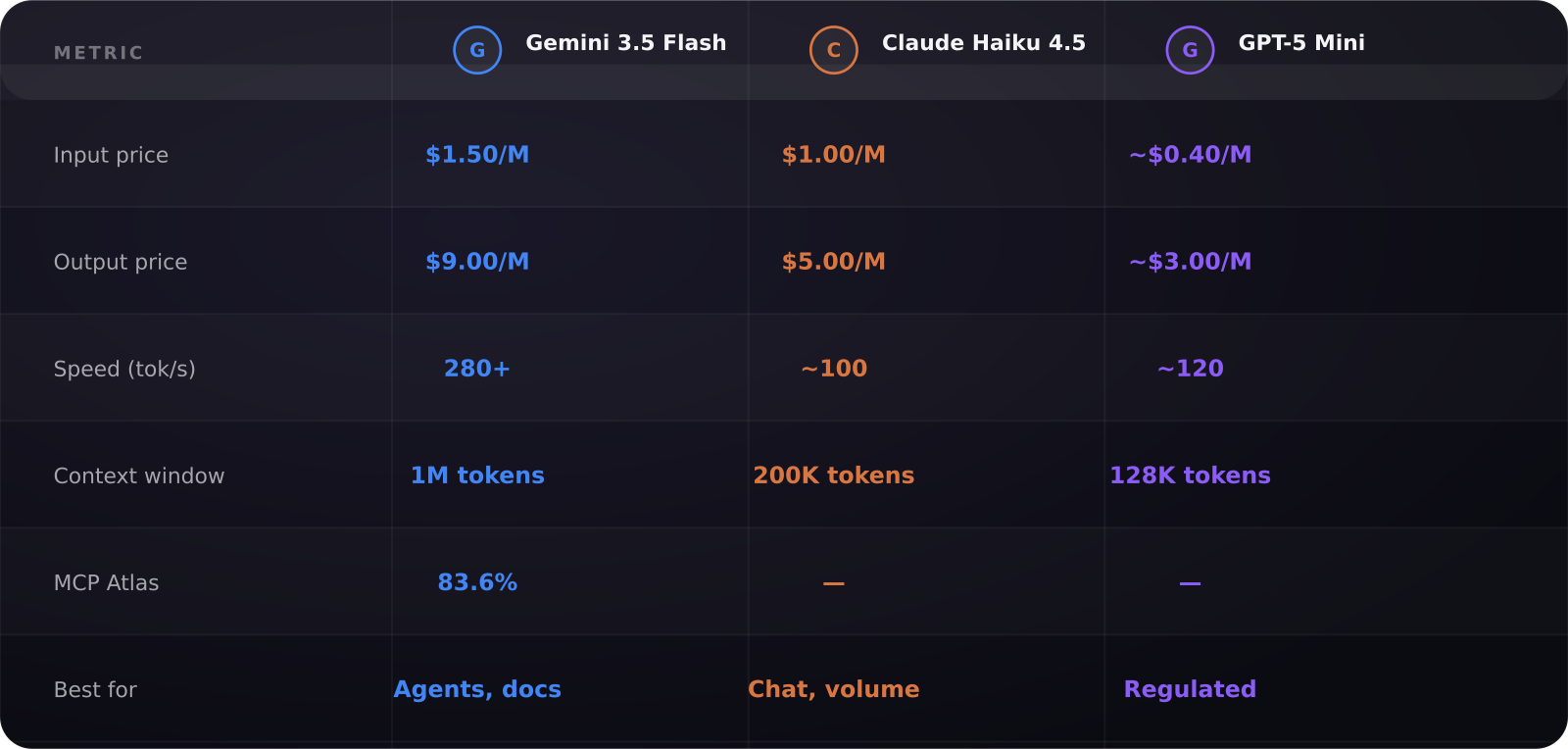
Raw throughput favors Gemini 3.5 Flash by a significant margin. Over 280 tokens per second puts it 2 to 3x faster than the other two in sustained output. For batch processing, document transformation, or any workload where you need high throughput across many parallel calls, that speed advantage compounds quickly.
Claude Haiku 4.5 flips the story on time-to-first-token. It's engineered for conversational flow — the perception that responses feel instant. If you're building a customer-facing chat interface where users are reading in real time, that first-token latency matters more than total tokens per second. Haiku 4.5 is the choice when you want users to feel like they're in a real conversation.
GPT-5 Mini lands in the middle on both metrics — not the fastest throughput, not the quickest first token, but solid and predictable across both dimensions.
Which is faster for agentic SaaS tasks?
This is where the 2026 model landscape shifted in a way that surprised many teams. Gemini 3.5 Flash scored 83.6% on MCP Atlas — a benchmark designed to evaluate how well models handle tool use and coordination within Model Context Protocol workflows. It also scores 76.2% on Terminal-Bench 2.1 and 84.2% on CharXiv Reasoning.
For SaaS products building autonomous agents — code review pipelines, research agents, customer data workflows — those numbers matter. Gemini 3.5 Flash was benchmarked as an orchestration layer component. It's built to be the workhorse inside an agent stack, not a soloist doing single calls.
Claude Haiku 4.5 is capable in agentic workflows but wasn't designed primarily for multi-step tool orchestration. GPT-5 Mini has solid tool use performance but doesn't match Gemini 3.5 Flash's published agentic scores.
If you're exploring the AI tools and workflows library, Gemini 3.5 Flash's MCP Atlas score is currently the strongest production signal for agent-heavy applications.
Is the price jump worth it?
Gemini 3.5 Flash costs $1.50 per million input tokens and $9.00 per million output tokens. That's a 3x jump from Gemini 3 Flash ($0.50 and $3.00 per million), which makes sense given the capability increase — it's beating last year's Pro model on benchmarks. It's still 40% cheaper than Gemini 3.1 Pro on both input and output.
Claude Haiku 4.5 is $5 per million output tokens — 44% cheaper than Gemini 3.5 Flash on the metric that hits hardest in high-volume deployments. If your use case doesn't need the speed or MCP Atlas numbers that Flash brings, Haiku 4.5 is the economically defensible choice.
GPT-5 Mini sits between them on output cost — competitive for general chat but not the cheapest option for document-heavy pipelines.
Which model wins your SaaS use case?
Gemini 3.5 Flash is the right pick if you're building multi-agent pipelines, processing long documents (up to 1 million tokens in a single context window), or need maximum throughput in batch jobs. The 5x larger context window alone justifies it for legal-tech, research, and documentation tools. If you're building an agent-native SaaS product and care about MCP tooling performance, it's the leading fast model for that workload right now.
Claude Haiku 4.5 wins on output cost and first-token latency. For conversational interfaces, real-time customer support tooling, or any application where users are typing and reading in a chat window, the lower latency profile matters more than raw throughput. The coding performance parity with Sonnet 4 is compelling if you're building a coding assistant at price-sensitive scale. For context on how it compares to open-source alternatives, see the DeepSeek V4 vs Kimi K2.6 vs Qwen3.6 Max breakdown we published this week.
GPT-5 Mini is the safest pick for health, legal, finance, or other regulated domains where OpenAI's safety tuning and audit trail matter to enterprise buyers. It's also the most compatible choice for teams already deep in the OpenAI ecosystem. See how it sits in the broader frontier landscape in the GLM-5.2 vs Claude Sonnet 5 vs GPT-5.6 comparison.
Context window: the hidden differentiator
Gemini 3.5 Flash's 1,048,576 token context window — roughly 750,000 words — is in a different category from the 200K that Claude Haiku 4.5 supports. For document-heavy workflows, contract review, codebase analysis, or any SaaS feature that needs to see the whole thing at once, that 5x difference changes the architecture of what you build. If you're regularly hitting context limits with other models, Gemini 3.5 Flash is the only one of these three that solves it structurally.
How I'd actually choose in 2026
For agent pipelines and best tool-use performance per dollar: Gemini 3.5 Flash. For conversational features at high volume with cost as the main constraint: Claude Haiku 4.5. For regulated industries or teams that need maximum OpenAI compatibility: GPT-5 Mini.
The era of "just use GPT-4o" is over. These three have genuinely different performance profiles, and the decision is worth a few hours of evaluation — the cost differential at scale can be substantial.
If you're producing video content that shows customers how your AI integration works, see how we approach AI tool video production for SaaS companies.
Frequently asked questions
Is Gemini 3.5 Flash better than Claude Haiku 4.5?
Gemini 3.5 Flash outperforms Claude Haiku 4.5 on speed (280+ tokens/sec), agentic benchmarks (83.6% MCP Atlas), and context window size (1M vs 200K). Claude Haiku 4.5 is 44% cheaper on output tokens and has lower time-to-first-token for conversational use cases. For agents and long-context work Gemini 3.5 Flash wins. For high-volume chat and cost efficiency Haiku 4.5 wins.
How much does Gemini 3.5 Flash cost in 2026?
Gemini 3.5 Flash costs $1.50 per million input tokens and $9.00 per million output tokens as of July 2026. This is 3x the price of Gemini 3 Flash but still 40% cheaper than Gemini 3.1 Pro. Cached input tokens cost $0.15 per million.
Which fast AI model should I use for building SaaS agents in 2026?
Gemini 3.5 Flash is currently the strongest pick for agentic SaaS workflows based on its 83.6% MCP Atlas score and 1 million token context window. For teams where output cost is the primary constraint, Claude Haiku 4.5 offers competitive agent capability at 44% lower output cost.
Was this article helpful?
Jorge Aguilar
Founder & Creator, SaaS Master
Producing SaaS and AI product videos since 2019 — 800+ videos for 200+ brands, covering tutorials, demos, walkthroughs, and explainers. Writing here about the tools, trends, and tactics that actually move the needle. LinkedIn · About · Work with me
Building an AI product that needs a clearer onboarding flow?
Client-owned videos that make your product easy to understand — demos, walkthroughs, onboarding, and explainers.
Explore AI product video production