DeepSeek V4 vs Kimi K2.6 vs Qwen3.6 Max: The Cheapest AI Model That Doesn't Suck in 2026
In short
DeepSeek V4, Kimi K2.6, and Qwen3.6 Max compared on real July 2026 pricing, benchmarks, and which one fits a SaaS workflow.
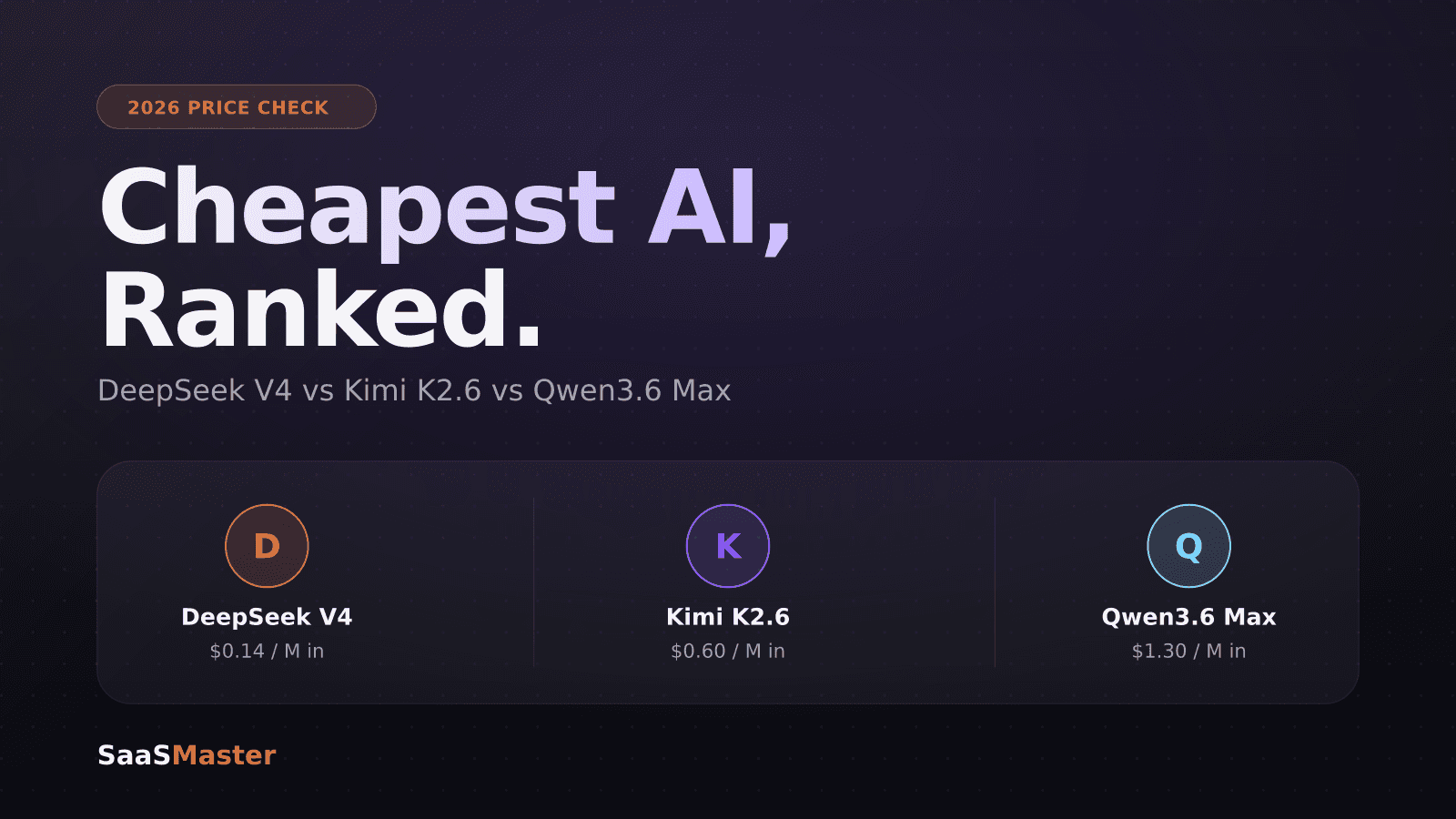
DeepSeek V4 Flash charges $0.14 per million input tokens. Qwen3.6 Max charges more than nine times that. Neither number tells you which model will actually get through a real coding task without falling apart halfway — and that's the question that matters if you're deciding which Chinese AI model to wire into your SaaS product this month.
All three — DeepSeek V4, Kimi K2.6 (from Moonshot AI), and Alibaba's Qwen3.6 Max — are now genuinely competitive with Western frontier models on cost-adjusted benchmarks, according to both Artificial Analysis and BenchLM's July 2026 leaderboards. But they're not interchangeable, and the price gap between them is bigger than most comparison posts admit.
Key takeaways
- DeepSeek V4 Flash is the cheapest of the three at $0.14 / $0.28 per million tokens with a 1 million-token context window, but it trails the other two on agentic and tool-use benchmarks.
- Kimi K2.6 is the current sweet spot for long, autonomous coding runs — SWE-Bench Pro jumped from 50.7% to 58.6% over K2.5, priced at $0.60 / $2.50 per million tokens on Moonshot's own API.
- Qwen3.6 Max Preview costs the most ($1.30 / $7.80 per million tokens) but ships as a full agent framework rather than a plain chat model, pairing with Qwen-Image 2.0 for end-to-end workflows like turning a document into a slide deck.
- Third-party hosts like OpenRouter and DeepInfra routinely run 10-20% cheaper than the official APIs for all three models, which matters more than it sounds like at scale.
- The right pick depends on whether you're optimizing for raw cost, coding-agent reliability, or full workflow automation — not which model technically "wins" a benchmark chart.
What are DeepSeek V4, Kimi K2.6, and Qwen3.6 Max?
All three are frontier-class open or semi-open models out of China, and all three shipped major updates within weeks of each other in mid-2026.
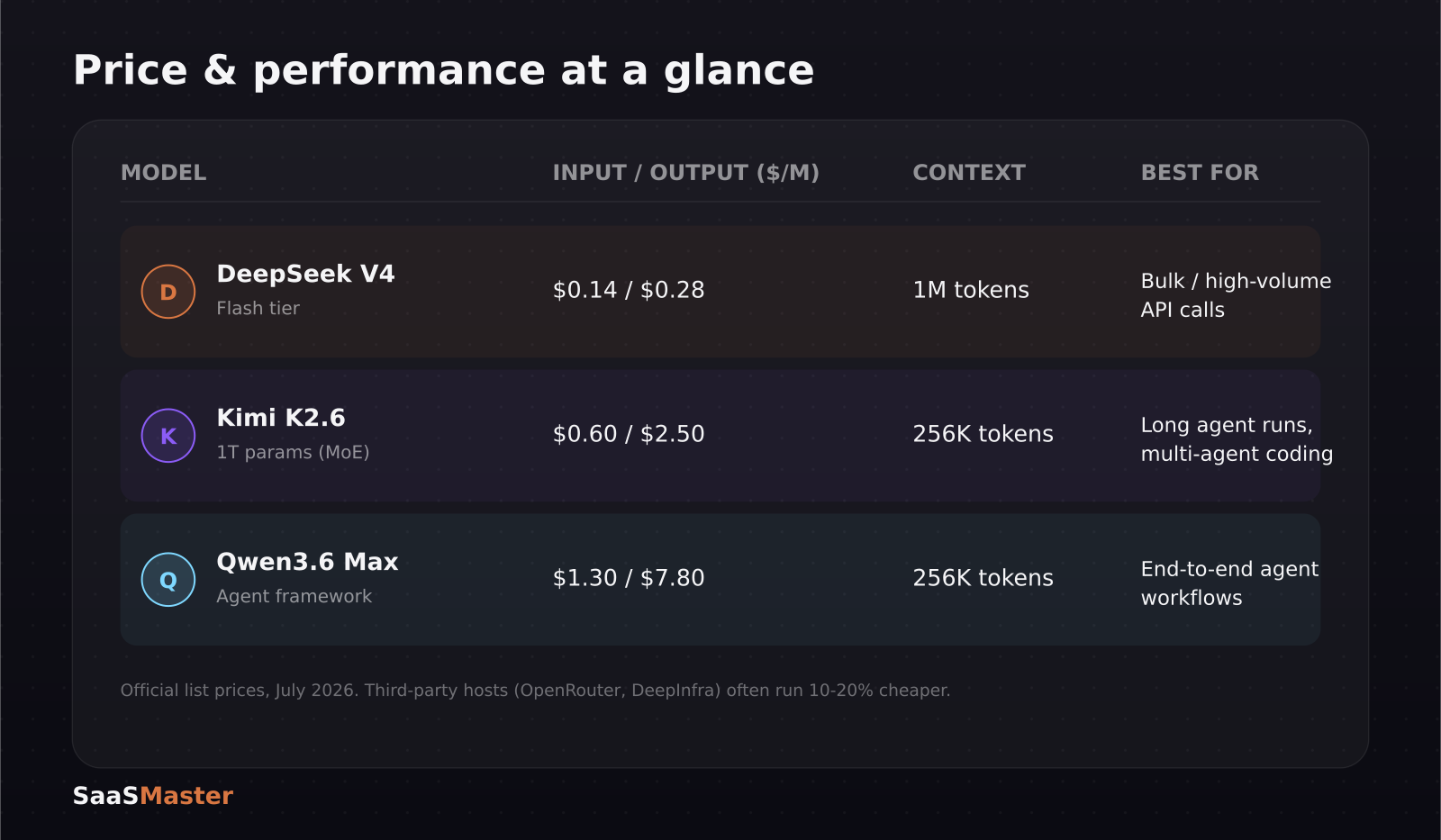
DeepSeek V4 comes in two API tiers. DeepSeek V4 Flash is the standard, high-volume option with a 1 million-token context window and up to 384K tokens of output, no surcharge for the extended context. DeepSeek V4 Pro is the higher-capability tier, priced roughly three times higher than Flash. On BenchLM's current Chinese-model leaderboard, DeepSeek V4 Pro (Max) scores 87, just behind GPT-5.4 at 88 and well behind Gemini 3.1 Pro at 93 — respectable, but DeepSeek has slipped behind Kimi and Qwen on pure agentic benchmarks even as it stays the cheapest.
Kimi K2.6 is Moonshot AI's trillion-parameter mixture-of-experts model (32 billion parameters active at once), built specifically for long agentic loops — the kind of plan-write-test-debug cycle that can run for days and spin up hundreds of collaborating sub-agents on a single task. It carries a 256K token context window.
Qwen3.6 Max Preview is Alibaba's flagship, and the search results are clear that it's positioned less as a chatbot and more as an agent framework — the newer Qwen3.7 release doubles down on this, combining the agent framework with Qwen-Image 2.0 so a single workflow can go from a research paper straight to a finished slide deck.
Which one is cheapest — and does it matter?
On paper, DeepSeek V4 Flash wins by a wide margin: $0.14 per million input tokens and $0.28 per million output tokens, against Kimi K2.6's $0.60 / $2.50 and Qwen3.6 Max's $1.30 / $7.80. That's not a small gap — Qwen costs roughly 28 times more per output token than DeepSeek Flash.
But cost per token is only half the story. A model that needs more retries, longer chains of reasoning, or a second pass to fix its own mistakes can end up costing more per finished task even at a lower rate card. This is exactly where Kimi K2.6 and Qwen3.6 Max pull ahead on agentic benchmarks: Kimi's Toolathlon score nearly doubled from K2.5 (27.8% to 50.0%), and its Terminal-Bench 2.0 score climbed from 50.8% to 66.7% — meaning it finishes more real tasks in one pass, which is where the actual savings show up.
If you're doing simple, high-volume classification or extraction work, DeepSeek V4 Flash's price is hard to beat. If you're running an autonomous coding agent that needs to survive a multi-hour task without supervision, the extra cost of Kimi K2.6 usually pays for itself.
Which model is best for coding agents?
Kimi K2.6 is the one built for this specifically. Moonshot designed it around plan-write-test-debug loops that can last for days, with the ability to instantiate hundreds of agents that collaborate on one task — a very different design goal than a general chat model. The benchmark jump from K2.5 to K2.6 backs this up: SWE-Bench Pro rose from 50.7% to 58.6%, and BrowseComp (Agent Swarm) rose from 78.4% to 86.3%.
Qwen3.6 Max is close behind on raw intelligence — it posts an Artificial Analysis Intelligence Index score of 40, comfortably above the field average of 29 — but its real strength is orchestration across a full agent framework rather than a single long coding session. If you already build workflows with the Claude Code, Cursor, and Windsurf lineup, think of Qwen3.6 Max as the model you'd reach for to chain several tools together, and Kimi K2.6 as the one you'd trust to babysit one hard coding problem overnight.
DeepSeek V4 can do agentic work too, and its 1M-token context window is genuinely useful for feeding an agent a huge codebase at once — but on the specific agentic benchmarks where Kimi and Qwen have focused their training, DeepSeek currently sits a step behind.
Which model should you actually use for your SaaS?
Here's how I'd frame the decision if I were picking one for a real product:
Pick DeepSeek V4 Flash if your workload is high-volume and relatively simple: support ticket triage, content tagging, basic summarization, anything where you're running millions of tokens through the model and the task itself doesn't require long multi-step reasoning.
Pick Kimi K2.6 if you're building or using an autonomous coding agent, especially one that needs to run unattended for hours. The price premium over DeepSeek is real, but so is the difference in task-completion rate.
Pick Qwen3.6 Max (or the newer Qwen3.7) if your use case is a genuine multi-tool workflow — research to slides, data to report, plugin to marketing copy — where you want one framework handling the whole chain rather than stitching together separate calls.
And don't sleep on routing through a provider like OpenRouter or DeepInfra rather than the official APIs directly. The blended pricing is consistently lower, and for K2.6 specifically, DeepInfra's FP4 tier matches the official $0.60 rate while some competing hosts run even cheaper.
A creator's take: what I noticed testing all three
I make video tutorials for SaaS and AI companies for a living, which means I spend a lot of time watching these models fail in front of a camera. The honest pattern I've seen: DeepSeek V4 is the one that surprises people with how far a $0.14 model can go on straightforward tasks, but it's also the one most likely to need a second pass on anything genuinely multi-step. Kimi K2.6 is the one I'd trust to run overnight without checking in — the agent-swarm design actually shows up in practice, not just on paper. Qwen3.6 Max feels less like "a model" and more like a small toolkit; it's the most interesting of the three if you're automating a whole workflow rather than answering one question well.
None of these are a clean replacement for Claude Sonnet 5 or Opus 4.8 if your product needs the most reliable reasoning available. What they're genuinely good for is cutting your model bill on the 80% of tasks that don't need the most expensive option on the market — the same logic behind picking the right browser agent in our Claude in Chrome vs. Comet vs. Atlas comparison. For more model breakdowns like this one, our AI Tools hub tracks pricing and benchmark changes as they land. And if you'd rather show your team or customers how a new model actually performs than write another internal doc about it, that's exactly the kind of walkthrough we build in AI tool video production.
Frequently asked questions
Is DeepSeek V4 free to use?
No. DeepSeek V4 Flash costs $0.14 per million input tokens and $0.28 per million output tokens through the official API, with a much larger discount for cached tokens. There's no unlimited free tier for production use, though some hosting providers offer limited free credits for testing.
Can I use Kimi K2.6 or Qwen through the API for a SaaS product?
Yes. Both Moonshot AI and Alibaba expose standard API access, and both models are also available through third-party inference providers like OpenRouter and DeepInfra, which is usually the cheaper route for production traffic.
Are these Chinese AI models safe for a US-based business?
Technically, yes — you're calling an API and getting text or code back, the same as with any model provider. The considerations that matter more are data residency (where your prompts are processed and logged) and each provider's terms of service, which are worth reading before you send customer data through any third-party model, regardless of where it's built.
Was this article helpful?
Jorge Aguilar
Founder & Creator, SaaS Master
Producing SaaS and AI product videos since 2019 — 800+ videos for 200+ brands, covering tutorials, demos, walkthroughs, and explainers. Writing here about the tools, trends, and tactics that actually move the needle. LinkedIn · About · Work with me
Building an AI product that needs a clearer onboarding flow?
Client-owned videos that make your product easy to understand — demos, walkthroughs, onboarding, and explainers.
Explore AI product video production