GLM-5.2 vs. Claude Sonnet 5 vs. GPT-5.6: The 2026 AI Model Price War
In short
GLM-5.2, Claude Sonnet 5, and GPT-5.6 Terra are all racing to match frontier performance at lower cost. Here's the 2026 benchmark and pricing breakdown.
GLM-5.2, Claude Sonnet 5, and GPT-5.6 Terra are the three models actually worth comparing this week if you're picking an AI model on price versus performance: GLM-5.2 is open-weight and costs about one-sixth of GPT-5.5's blended rate, Claude Sonnet 5 launched July 1 at $2 per million input tokens (introductory pricing through August 31) while approaching Opus 4.8-level performance, and GPT-5.6 Terra claims GPT-5.5-competitive quality at roughly half its price. All three are targeting the same gap: frontier-adjacent performance without frontier-tier pricing.
Key takeaways
- GLM-5.2, from Zhipu AI's Z.ai, is a 753-billion-parameter open-weight model priced at $1.40 input / $4.40 output per million tokens, and it beats GPT-5.5 on SWE-Bench Pro (62.1 vs. 58.6).
- Claude Sonnet 5 launched July 1, 2026 at an introductory $2 per million input tokens through August 31, positioned as approaching Opus 4.8 performance at a fraction of the cost.
- GPT-5.6 Terra prices at $2.50 input / $15 output per million tokens and is described as GPT-5.5-competitive at roughly half that model's price, but it's still in a ~20-partner limited preview.
- GLM-5.2 is MIT-licensed and downloadable from Hugging Face, meaning it can be self-hosted; Claude Sonnet 5 and GPT-5.6 Terra are both API-only.
- On FrontierSWE, GLM-5.2 (74.4%) is nearly tied with Claude Opus 4.8 (75.1%), which is the strongest evidence yet that open-weight Chinese models are closing the gap with the top US labs on coding specifically.
Why are these three models being compared right now?
Each one launched or became a talking point within roughly a month of the other: GLM-5.2 on June 13, Claude Sonnet 5 on July 1, and GPT-5.6 in limited preview from June 26. Z.ai's open-weight GLM-5.2 beating GPT-5.5 on multiple long-horizon coding benchmarks for about one-sixth the cost has become the centerpiece of a broader debate about whether Chinese labs are catching up to the leading US frontier models, and Claude Sonnet 5 and GPT-5.6 Terra are the two clearest US-side answers on the "good enough, much cheaper" end of that same pricing pressure.
How do the benchmarks actually compare?
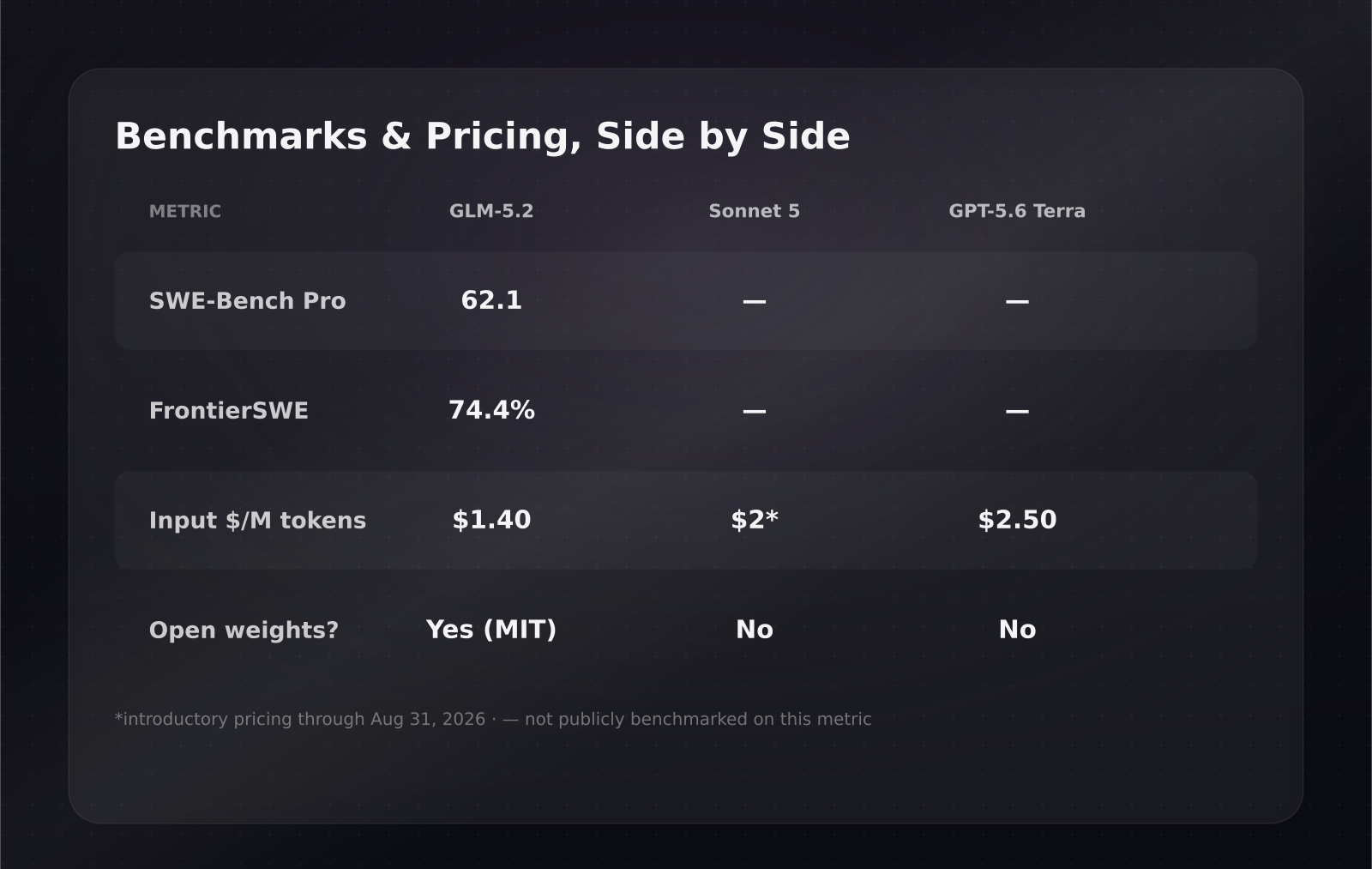
On SWE-Bench Pro, GLM-5.2 scores 62.1, ahead of GPT-5.5's 58.6 and its own predecessor GLM-5.1's 58.4. On FrontierSWE, GLM-5.2 hits 74.4%, which edges out GPT-5.5 (72.6%) and lands within a point of Claude Opus 4.8 (75.1%) — genuinely close for an open-weight model a fraction of the price of either. On MCP-Atlas, a tool-usage evaluation, GLM-5.2 scores 77.0, again just behind Opus 4.8's 77.8 but ahead of GPT-5.5. Claude Sonnet 5's specific benchmark positioning is "approaching Opus 4.8," Anthropic's own top model, while GPT-5.6 Terra's claim is parity with GPT-5.5 at half the cost — meaning all three models are effectively racing toward the same target from three different price points, rather than one clearly leading on raw capability.
How does the pricing actually break down?
GLM-5.2's official API pricing is $1.40 per million input tokens and $4.40 per million output tokens, with a cached-input rate as low as $0.26 per million tokens and a limited-time offer of free cached-input storage. Third-party routing through OpenRouter lists it even lower, at $0.56 input / $1.76 output. Enterprise subscriptions start at $12.60/month. Claude Sonnet 5 is priced at $2 per million input tokens as an introductory rate through August 31, 2026, positioned against Opus 4.8's substantially higher per-token cost. GPT-5.6 Terra runs $2.50 input / $15 output per million tokens. Put side by side, GLM-5.2 is the cheapest of the three on paper, Claude Sonnet 5 is the mid-priced US-lab option, and GPT-5.6 Terra is currently the most expensive of the three — though Terra isn't generally available yet, so that price may shift by the time most teams can actually buy it.
Does open-weight versus API-only actually matter for a typical SaaS team?
For most product teams, no — you're calling a hosted API either way and the difference is invisible day to day. It matters a lot for two specific situations: data-residency requirements that legally or contractually prevent your code or customer data from leaving your own infrastructure, and cost-at-massive-scale, where self-hosting an open-weight model like GLM-5.2 can undercut any API pricing once you're making enough calls to justify the infrastructure. If neither applies to you, the practical decision comes down to the same task-routing logic we've covered before: use the cheapest model that reliably clears your quality bar for a given task, and reserve the most expensive tier for the handful of tasks where a wrong answer actually costs you something.
There's a middle case worth naming too: teams that don't have a hard compliance requirement today but expect one soon, because they're selling into healthcare, finance, or government accounts. For those teams, testing an open-weight option like GLM-5.2 now — even while running production traffic through an API-only model — is a reasonable hedge, since migrating a self-hosting-capable model into your infrastructure later is a much smaller lift if you've already validated it works for your use case. We walked through that logic in more depth in Claude Sonnet 5 vs. Opus 4.8: which one should actually build your SaaS, and the same framework applies here across all three models, not just Anthropic's own lineup.
What should you actually do with this comparison?
Don't switch your whole stack over one benchmark table — benchmarks move monthly right now, and the model that's cheapest today may not be in three weeks once GPT-5.6 reaches general availability. What's worth doing is running your own top three or four highest-volume AI tasks through GLM-5.2, Claude Sonnet 5, and whatever tier of GPT-5.6 you can access, and comparing real output quality against your own rubric, not someone else's benchmark. If your coding workflow already runs through an agentic tool, this pairs directly with our breakdown of GitHub Copilot vs. Claude Code vs. Cursor vs. Windsurf pricing, since all of these underlying models eventually surface inside those tools. For the full, continuously updated picture of what's shipping, our AI tools hub is the place to check before making a model decision this quarter. And if you need to explain a model or cost change like this to your own customers or team in a way that doesn't require reading three benchmark reports, that's exactly the kind of update we produce through AI tool video production.
Is this actually evidence that China is "catching up" in AI?
That's the framing driving most of the coverage around GLM-5.2 right now, and it's worth being precise about what the benchmarks do and don't show. GLM-5.2 nearly matching Claude Opus 4.8 on FrontierSWE (74.4% vs. 75.1%) and beating GPT-5.5 outright on two separate coding benchmarks is real and measurable — this isn't a marketing claim, it's a reproducible test result other labs and independent evaluators have confirmed. What it doesn't prove is that GLM-5.2 matches Opus 4.8 or Sonnet 5 across the board; SWE-Bench Pro, FrontierSWE, and MCP-Atlas are specifically coding and tool-use benchmarks, and none of the public numbers claim parity on broader reasoning, creative writing, or the kind of ambiguous judgment calls that separate a merely competent model from one you'd trust unsupervised. The accurate read is narrower than "China caught up": on long-horizon coding tasks specifically, at a fraction of the cost, the gap has closed substantially. Whether that holds outside of coding is a separate question the current benchmarks don't answer.
Frequently asked questions
Is GLM-5.2 really better than GPT-5.5?
On specific coding benchmarks, yes: GLM-5.2 scores 62.1 versus GPT-5.5's 58.6 on SWE-Bench Pro, and 74.4% versus 72.6% on FrontierSWE. It does this at roughly one-sixth of GPT-5.5's blended API cost. It still trails Claude Opus 4.8 slightly on both of those benchmarks.
Can I self-host GLM-5.2 instead of using an API?
Yes. Z.ai released GLM-5.2's core weights under an unrestricted MIT license, and the model is downloadable from Hugging Face for teams that want to self-host, fine-tune, or run it inside their own infrastructure for data-residency reasons.
Is Claude Sonnet 5's $2 pricing permanent?
No. The $2 per million input tokens rate is explicitly introductory pricing that runs through August 31, 2026. Standard pricing after that date hadn't been confirmed as of this writing, so it's worth budgeting for a possible increase past that date.
Was this article helpful?
Jorge Aguilar
Founder & Creator, SaaS Master
Producing SaaS and AI product videos since 2019 — 800+ videos for 200+ brands, covering tutorials, demos, walkthroughs, and explainers. Writing here about the tools, trends, and tactics that actually move the needle. LinkedIn · About · Work with me
Building an AI product that needs a clearer onboarding flow?
Client-owned videos that make your product easy to understand — demos, walkthroughs, onboarding, and explainers.
Explore AI product video production