AI Tools
GPT-5.5 Instant vs Claude Sonnet 4.6: Which Should SaaS Creators Use in 2026?
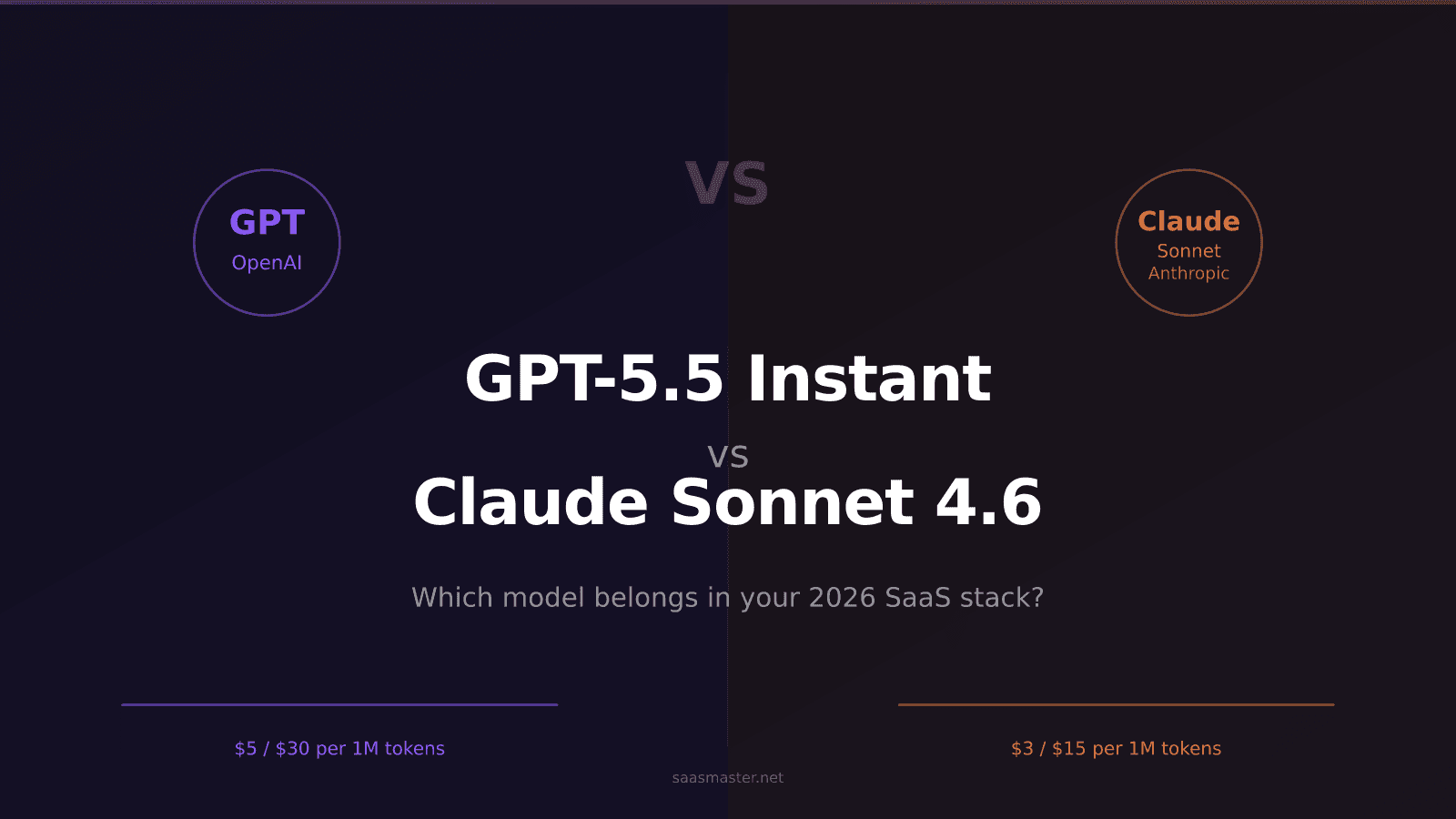
At $5 per million input tokens versus $3 for Claude Sonnet 4.6, GPT-5.5 Instant costs 67% more to run — and for most SaaS workflows, that difference adds up fast. But this isn't a story about one model crushing the other. Both are exceptional everyday models from the two most important AI labs right now, and the real question is which one earns its place in your specific stack.
GPT-5.5 Instant launched on May 5, 2026, three months after Sonnet 4.6 dropped in February. OpenAI positioned it as the new default for ChatGPT — the model that replaced Canvas with inline writing and coding blocks, retired GPT-5.2, and brought a 1M-token context window to everyday users. Sonnet 4.6 has been quietly dominating developer preference since its release: Anthropic's own data showed developers preferred it over Sonnet 4.5 roughly 70% of the time, and it even beat Opus 4.5 on preference tests 59% of the time.
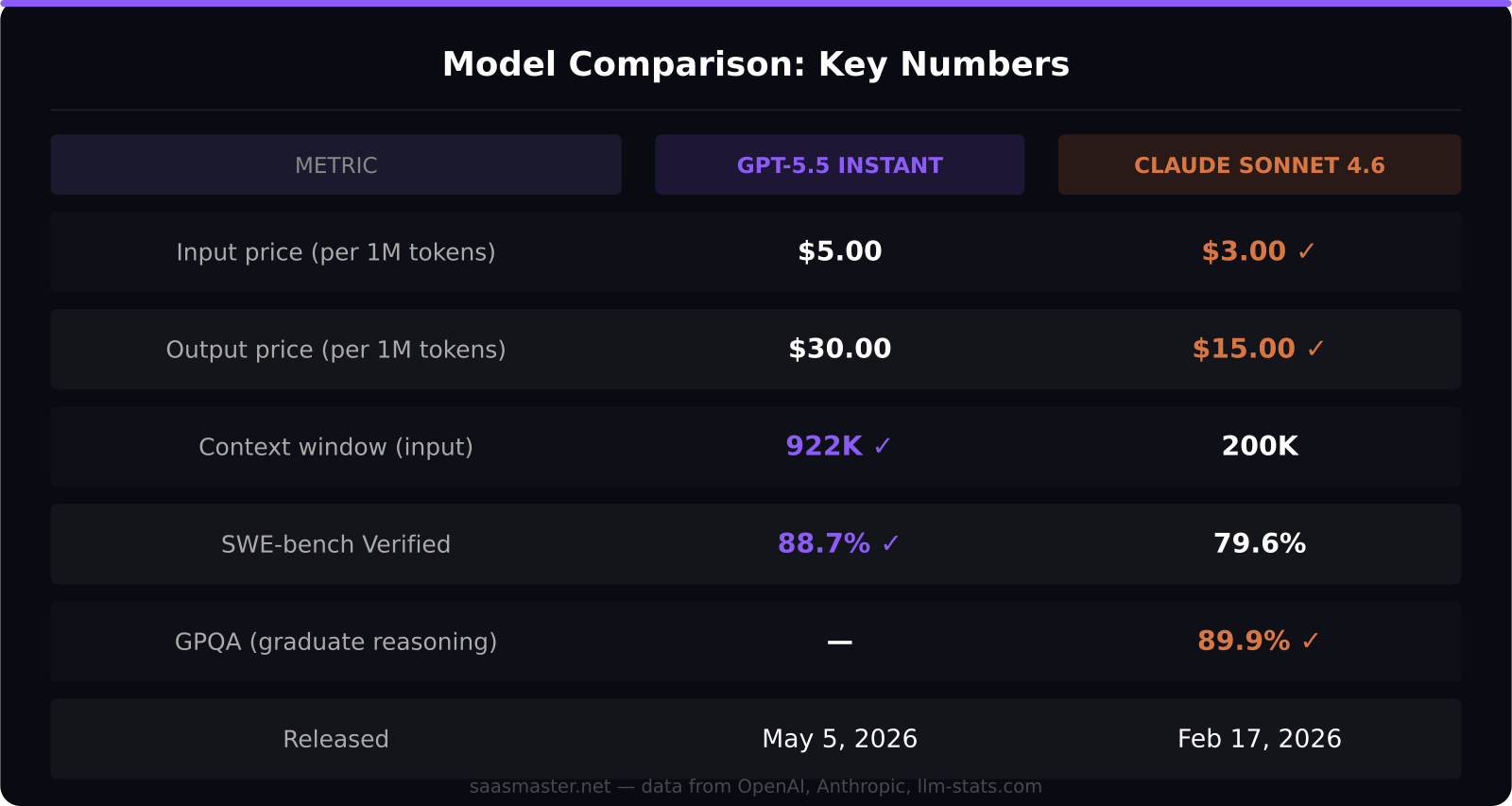
Key takeaways: - Claude Sonnet 4.6 is 1.7x cheaper on input ($3/M vs $5/M) and 2x cheaper on output ($15/M vs $30/M) - GPT-5.5 Instant has a larger context window: 922K input / 128K output vs Sonnet 4.6's 200K / 64K - GPT-5.5 leads on SWE-bench Verified (88.7% vs 79.6%) and Terminal-Bench 2.0 (82.7%) - Claude Sonnet 4.6 leads on Tau2 enterprise benchmarks and GPQA graduate reasoning (89.9%) - For most SaaS use cases, Sonnet 4.6 delivers comparable quality at meaningfully lower cost
What changed with GPT-5.5 Instant?
Canvas is gone. That is the most immediately visible change if you have been using ChatGPT for document creation. OpenAI replaced it with inline writing blocks and code blocks — the idea being that you should not need to jump into a side panel to edit content. For many users this feels like a downgrade in workflow; for others it cleans up an interface that was getting cluttered.
The other big change: GPT-5.2 models were retired on June 12, 2026. Existing conversations automatically moved to GPT-5.5 models. If you are building on the OpenAI API and have not pinned your model version, check your calls now.
GPT-5.5 Instant also introduced a cached input rate of $0.50 per million tokens — which is genuinely useful if you are running repetitive pipelines with large, stable system prompts that stay the same across thousands of calls.
How do the benchmarks actually compare?
Both models score impressively, but they win on different tasks.
GPT-5.5 Instant takes the top spot on SWE-bench Verified at 88.7%, meaning it is better at resolving real GitHub issues in code repositories. It also wins on Terminal-Bench 2.0 (82.7%) and shows meaningful gains on ARC-AGI-2, the abstract reasoning test that has been a hard benchmark for most models.
Claude Sonnet 4.6 does better on Tau2 benchmarks — particularly Tau2 Telecom (97.9%) and Tau2 Retail (91.7%), which measure complex multi-step task completion in realistic enterprise scenarios. It also scores higher on GPQA (89.9%), which tests graduate-level reasoning in science and math.
For general coding work where you are writing new code rather than navigating existing repositories, Sonnet 4.6 averages 66.4 versus GPT-5.5's 58.6 on aggregated coding benchmarks.
How big is the price gap at real scale?
Some concrete numbers make this clearer. At 10 million input tokens per month — a light production pipeline — Claude Sonnet 4.6 runs about $30 in and $150 out, totaling $180/month. GPT-5.5 Instant runs $50 in and $300 out, totaling $350/month. That is nearly double the cost for GPT-5.5 at modest scale.
At 100 million tokens — closer to a real API-backed SaaS product — you are looking at $1,800 versus $3,500 per month. The gap compounds as you grow.
The one pricing caveat: if your workload involves repetitive prompts with the same large system prompt, GPT-5.5's $0.50/M cached input rate brings your effective input cost down significantly for those repeated portions. Sonnet 4.6 also supports prompt caching, but the starting price advantage still holds.
What about context windows?
This is where GPT-5.5 Instant has a genuine structural advantage. Its 922K input context roughly doubles Sonnet 4.6's 200K limit. For tasks that require processing entire codebases, long legal documents, or multiple lengthy research papers in a single call, GPT-5.5 Instant becomes the more practical choice without workarounds.
For most everyday tasks — drafting content, answering questions, processing medium-length documents — neither model will hit its context limit. The context advantage matters most at the edges of what you are doing: big agentic pipelines, large document analysis, and extended multi-turn conversations that accumulate a lot of history.
Which should SaaS creators actually choose?
I have used both models in production over the last few months, and here is my practical read.
If you are building an API-backed product where token costs accumulate, start with Sonnet 4.6. The cost savings are significant, the quality difference in most tasks is minimal, and it is genuinely excellent at writing tasks, reasoning, and code generation. The preference data from real developers backs this up.
If you need the largest possible context window — processing full codebases, very long documents, or running agentic pipelines that build up large conversation histories — GPT-5.5 Instant earns its premium. This is a real functional advantage, not a benchmark abstraction.
If you are using ChatGPT via the web interface on a subscription plan rather than the API, the per-token pricing difference does not directly apply — and GPT-5.5 Instant's inline blocks workflow may feel more natural depending on how you work.
For SaaS content creation specifically — writing scripts, generating product descriptions, drafting documentation — Sonnet 4.6 tends to produce output that is a bit tighter and requires less editing in my experience. GPT-5.5 trends slightly more verbose. Neither is wrong; that is a style preference, not a quality gap.
Frequently asked questions
Is GPT-5.5 Instant faster than Claude Sonnet 4.6?
Both are speed-optimized API models designed for low latency at scale. GPT-5.5 Instant is named for its speed focus, and in practice both feel similarly snappy for typical workloads. Speed differences at this tier are rarely the deciding factor for production use.
Can I use GPT-5.5 Instant on the free ChatGPT plan?
Yes. GPT-5.5 Instant is now the default model for ChatGPT across all plans including Free. Plus and Pro subscribers get higher usage limits and the ability to switch between GPT-5.5 Instant and GPT-5.5 Thinking for complex reasoning tasks.
Will Anthropic release a Claude Sonnet 4.7 or 4.8?
There is no Sonnet 4.7. According to current Anthropic model information, the next Sonnet version will be 4.8. Claude Opus 4.8 is already in the current lineup at $5/$25 per million tokens, and a Sonnet 4.8 is expected to follow the same versioning pattern.
Was this article helpful?
SaaS Master
Creator behind SaaS Master — tutorials, walkthroughs, reviews, and explainers that help SaaS, AI, and WordPress products get understood and chosen. Writing here about the tools, trends, and tactics that actually move the needle. Work with me →
Want your product explained this clearly — in video?
Tutorials, walkthroughs, reviews, and shorts for SaaS, AI, and WordPress products.
Work With SaaS Master