GPT-5.6 Sol vs. Terra vs. Luna: What OpenAI's New Model Family Means for Your SaaS
In short
GPT-5.6 splits into three priced tiers: Sol, Terra, and Luna. Here's the 2026 pricing, limited-preview access, and what it means for your SaaS roadmap.
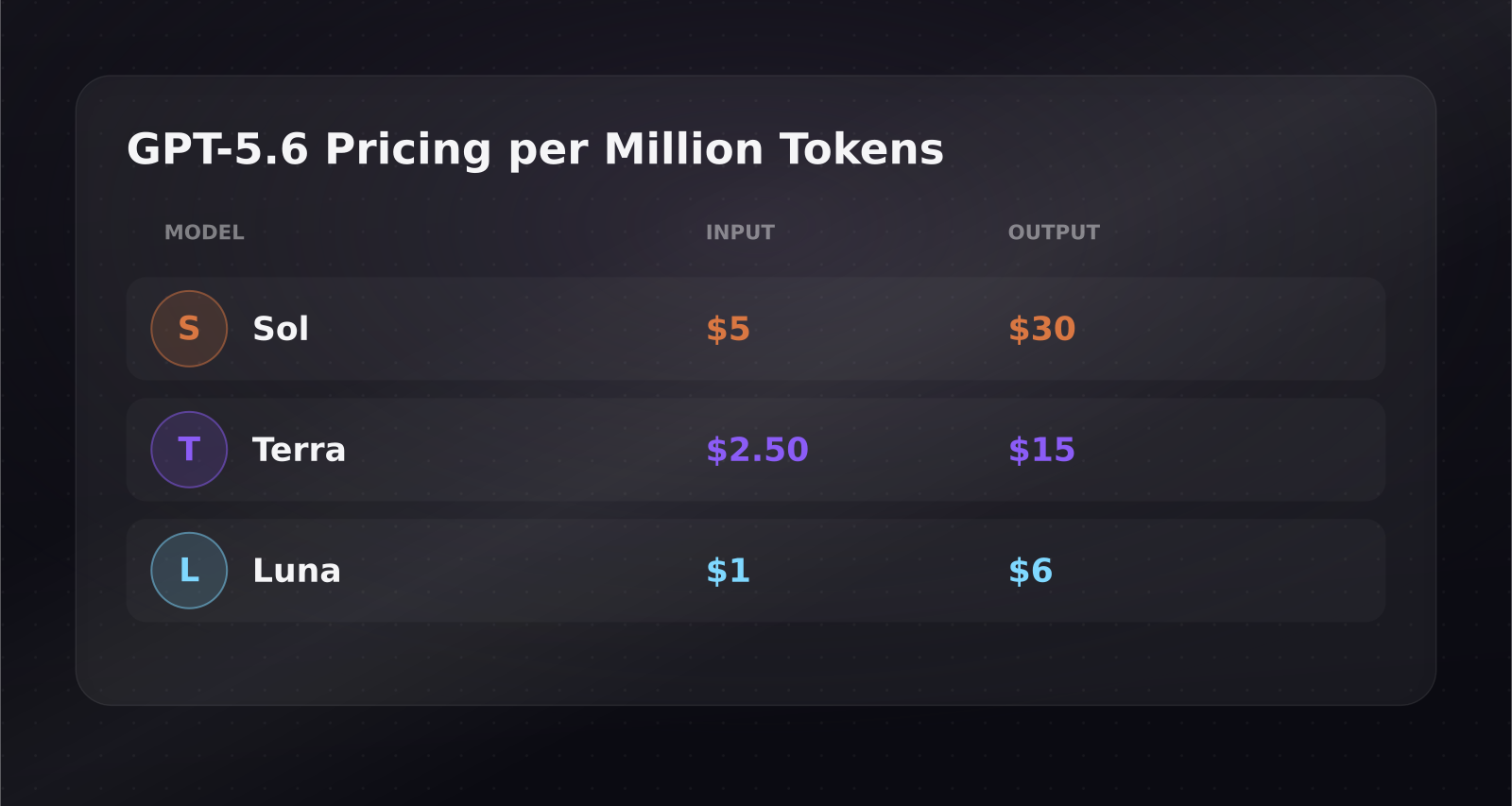
OpenAI's GPT-5.6 family — three models named Sol, Terra, and Luna — landed on June 26, 2026 as a limited preview available only to about 20 partner organizations through the API and Codex, gated by a US government safety review. Sol is the flagship at $5 input / $30 output per million tokens, Terra is the balanced mid-tier at $2.50/$15, and Luna is the fast, cheap option at $1/$6. General availability hasn't been announced yet, but OpenAI says it's coming "in the coming weeks." Here's what the three-tier split actually means if you're planning a SaaS product roadmap around it.
Key takeaways
- GPT-5.6 ships as three sized models instead of one: Sol (flagship), Terra (balanced, GPT-5.5-competitive performance at roughly half the price), and Luna (fast and cheap).
- Pricing per million tokens: Sol $5 input / $30 output, Terra $2.50/$15, Luna $1/$6 — a real spread depending on which task you're routing.
- Access is currently limited to roughly 20 trusted partner organizations via API and Codex, subject to a US government safety review before wider rollout.
- No general-availability date has been confirmed; OpenAI has only said it's planning wider access "in the coming weeks."
- The release lands the same week as reports of advanced White House talks with OpenAI, Google, and Anthropic over voluntary frontier-model release standards.
What actually is GPT-5.6, and why three models instead of one?
GPT-5.6 isn't a single upgrade, it's a tiered family, and the naming makes the intent obvious once you see the pricing next to it. Sol is the frontier model, priced at $5 per million input tokens and $30 per million output tokens, aimed at the hardest reasoning and coding tasks. Terra sits in the middle at $2.50/$15 and is described as delivering GPT-5.5-competitive performance while costing about half as much, which is the tier most production SaaS workloads will likely land on once it's generally available. Luna, at $1/$6, is built for high-volume, latency-sensitive tasks — think autocomplete, simple classification, or chat routing — where quality per token matters less than throughput and cost.
Who can actually use it right now?
Almost nobody, yet. The preview is limited to roughly 20 organizations with an existing OpenAI account representative, accessed only through the API and Codex — there's no consumer ChatGPT rollout at this stage. VentureBeat's reporting ties the narrow rollout directly to a US government safety review process, which is a meaningfully different launch pattern than OpenAI's past releases and suggests frontier model launches are now moving through an extra layer of oversight before wider distribution.
That matters more than it might sound like on first read. Earlier OpenAI launches typically went to a broad developer waitlist within days; gating a flagship release to roughly twenty named partners, with government review sitting in front of it, signals that the model itself was ready before the distribution process was. For a SaaS team weighing whether to hold a roadmap slot open for GPT-5.6, the practical implication is to plan around Terra and Luna reaching general availability on OpenAI's own timeline, not yours — there is currently no waitlist to join or account rep conversation that reliably moves that date up.
What does the tiered pricing tell you about how to plan for it?
If Terra really does hold GPT-5.5-competitive quality at roughly half the cost, that's the tier worth budgeting around once general availability lands — it's the one most likely to replace whatever mid-tier model your product currently routes everyday requests through. Sol only earns its price premium on tasks where the ceiling on quality actually matters: complex multi-step reasoning, hard coding problems, anything where a wrong answer is expensive to unwind. Luna's job is volume — the kind of task where you're paying for millions of calls a month and every fraction of a cent per token compounds. That three-way split mirrors how Anthropic has been positioning Claude Opus 4.8 against Sonnet 5, which we broke down in Claude Sonnet 5 vs. Opus 4.8: which one should build your SaaS — the industry is converging on "pick your model by task risk, not by whichever one is newest."
Why is this launch happening under a government safety review?
The timing isn't a coincidence. The Financial Times has reported the White House is in advanced talks with OpenAI, Google, and Anthropic to finalize voluntary standards for how frontier models get released, and GPT-5.6's narrow, partner-gated rollout looks like an early example of what that oversight looks like in practice rather than a marketing choice. It follows a separate precedent from earlier this quarter, when Fable 5 was pulled from international availability after the US Department of Commerce imposed export controls on June 12, only to be restored worldwide on July 1 once those controls were lifted. Frontier launches in 2026 increasingly come with a policy layer attached, and that's worth factoring into any roadmap that assumes a new model tier will be broadly available the moment it's announced.
What should a SaaS team do about GPT-5.6 today?
Nothing urgent, and that's the honest answer. With access limited to about 20 partner organizations and no confirmed GA date, there's no action item here beyond watching for the wider rollout. What is worth doing now is mapping which of your product's AI-dependent features would actually benefit from a Terra-tier model at half of GPT-5.5's cost once it's available — that's a cost conversation you can have internally before the model shows up, rather than after. It's also worth revisiting how your current model stack compares on the coding-agent side, since GPT-5.6 will eventually show up as an option inside tools like Codex and whatever competes with GitHub Copilot, Claude Code, Cursor, and Windsurf on your team's shortlist. For a running log of every model release that matters to SaaS builders, our AI tools hub tracks these as they land, and if you need to communicate a model or pricing change like this to your own users clearly, that's exactly the kind of update video we build through AI tool video production.
How does this compare to what happened with Fable 5 last month?
This isn't the first time a 2026 model launch has run into a policy wall instead of a technical one. Fable 5 was pulled from availability outside the US after the Department of Commerce imposed export controls on June 12, then restored to all users worldwide on July 1 once those controls were lifted — a three-week gap driven entirely by government decision-making, not model readiness. GPT-5.6's launch under an active safety review looks like the same dynamic playing out earlier in a release cycle: instead of shipping broadly and reacting to a policy decision after the fact, OpenAI appears to be building the review into the rollout from day one. If that pattern holds, teams planning around any frontier model release in the second half of 2026 should treat "announced" and "available to you" as two separate dates, sometimes weeks apart, rather than assuming a launch date is also an access date.
Frequently asked questions
When will GPT-5.6 be available to everyone?
OpenAI hasn't announced a firm general-availability date. As of this writing, access is limited to roughly 20 partner organizations through the API and Codex, and OpenAI has only said wider availability is coming "in the coming weeks."
What's the difference between Sol, Terra, and Luna?
They're three sizes of the same GPT-5.6 family. Sol is the flagship at $5 input / $30 output per million tokens for the hardest tasks. Terra is the balanced option at $2.50/$15, reportedly matching GPT-5.5's quality at about half the cost. Luna is the cheapest and fastest at $1/$6, built for high-volume, lower-complexity tasks.
Why is GPT-5.6's rollout gated by a government safety review?
Reporting ties the narrow, partner-only preview to an active US government safety review process, which lines up with separate reports of advanced White House talks with OpenAI, Google, and Anthropic over voluntary standards for releasing frontier AI models. It's a sign that frontier launches are increasingly subject to policy oversight before wide distribution, not just internal readiness testing.
Was this article helpful?
Jorge Aguilar
Founder & Creator, SaaS Master
Producing SaaS and AI product videos since 2019 — 800+ videos for 200+ brands, covering tutorials, demos, walkthroughs, and explainers. Writing here about the tools, trends, and tactics that actually move the needle. LinkedIn · About · Work with me
Building an AI product that needs a clearer onboarding flow?
Client-owned videos that make your product easy to understand — demos, walkthroughs, onboarding, and explainers.
Explore AI product video production