AI Tools
Kimi K2.7 Code vs DeepSeek V4 Pro: Which Open-Weight Coding AI Wins in 2026?
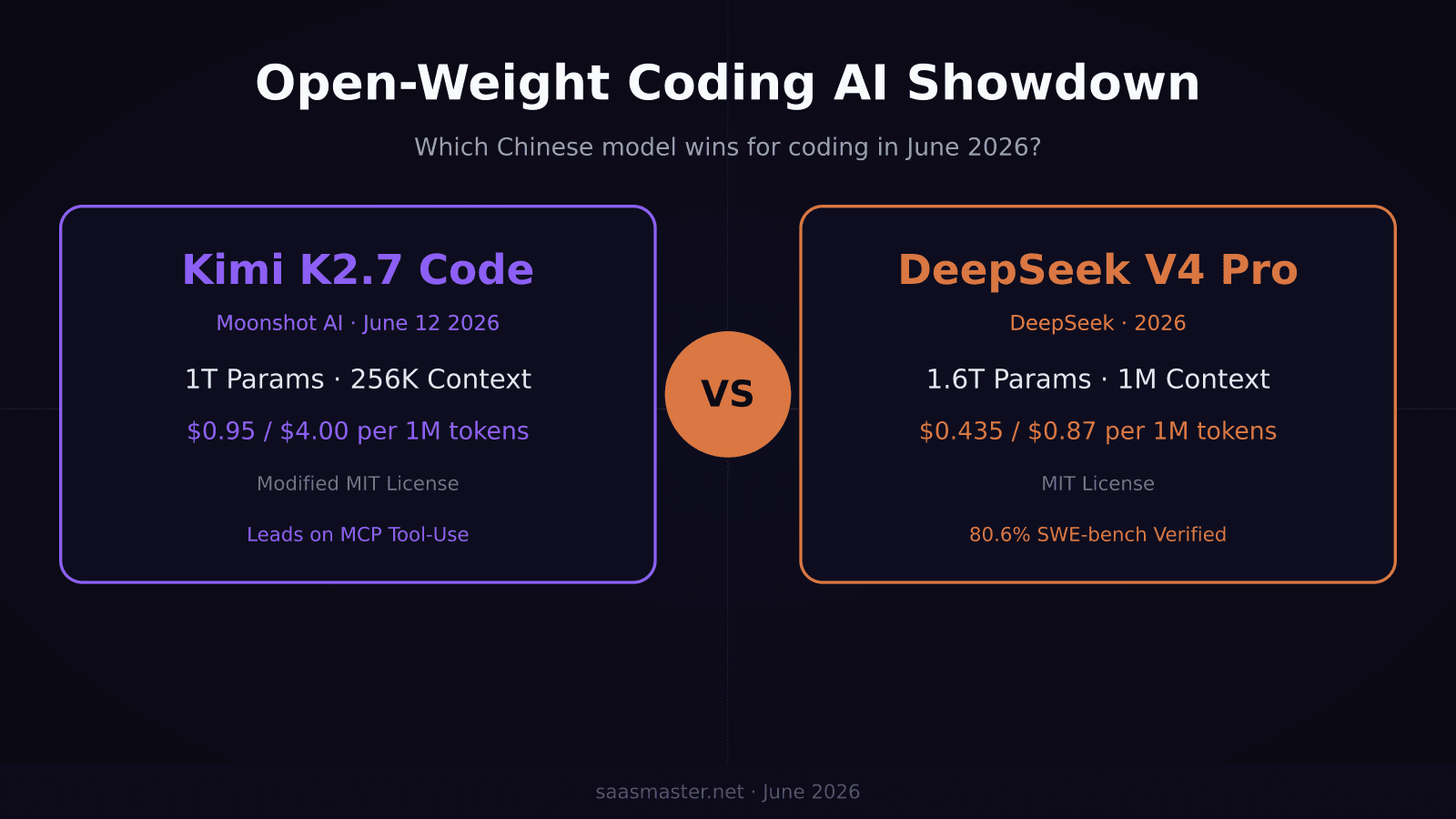
Two of the most capable open-weight coding models available today are both built in China, both free for commercial use, and both far cheaper than GPT-5.5. Kimi K2.7 Code launched on June 12, 2026 — and it immediately raises the question: is it actually better than DeepSeek V4 Pro, the model that has spent the past several weeks sitting at 80.6% on SWE-bench Verified, the best score any open-weight model has posted?
Here is what the specs, pricing, and benchmarks actually show — and when to use which.
Key takeaways
- Kimi K2.7 Code released June 12, 2026 from Moonshot AI: 1 trillion parameters, 256K context, Modified MIT license
- It cuts thinking-token consumption 30% versus K2.6 and leads on MCP tool-use benchmarks (81.1 on MCP Mark Verified)
- DeepSeek V4 Pro holds 80.6% on SWE-bench Verified — independently tested, the best open-weight score available
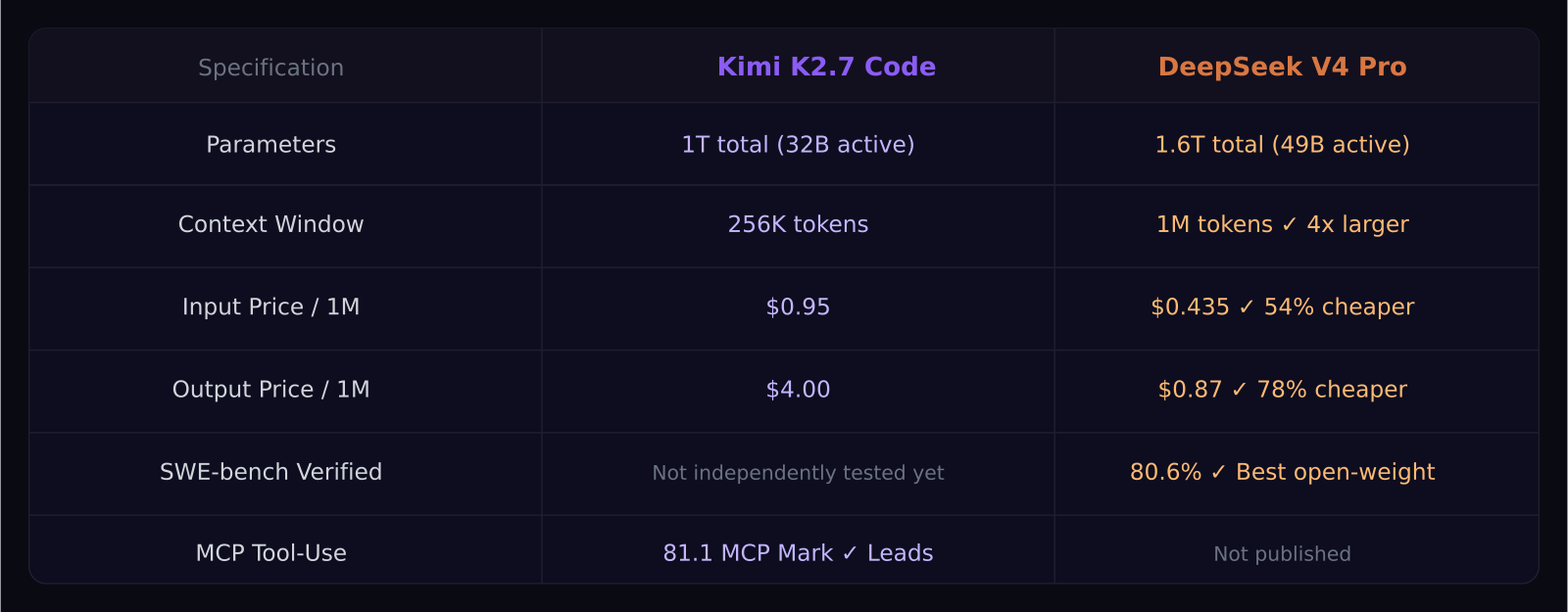
- V4 Pro has a 4x larger context window (1M tokens) and costs 54% less on input ($0.435 vs $0.95 per million tokens)
- Choose K2.7 for MCP-heavy agentic workflows; choose V4 Pro for verified benchmark performance and high-volume use
What Kimi K2.7 Code actually is
Moonshot AI published Kimi K2.7 Code on Hugging Face on June 12, 2026, under a Modified MIT license that allows commercial use without restrictions. The architecture is a 1-trillion-parameter Mixture-of-Experts model with 32 billion active parameters per token and 384 experts — large in the same class as DeepSeek V4, but tuned specifically for coding and agentic tasks.
The headline from Moonshot: K2.7 consumes 30% fewer reasoning tokens than its predecessor K2.6 while delivering better results on internal benchmarks. In practice, this means lower API costs on thinking-heavy tasks and faster response times when the model works through multi-step coding problems.
The context window is 256K tokens. That is large enough for most real-world tasks, but it is exactly one quarter of DeepSeek V4 Pro's 1 million-token window, and that gap matters at repository scale.
API pricing for K2.7 Code: $0.95 per million input tokens and $4.00 per million output tokens through the Kimi API, with the model ID kimi-k2.7-code.
One caveat worth stating clearly: every benchmark Moonshot published for K2.7 comes from its own internal suites — Kimi Code Bench v2, Program Bench, and MLS Bench Lite. The gains versus K2.6 are strong (plus 21.8%, plus 11%, plus 31.5% respectively), but as of mid-June 2026, K2.7 has not posted a score on SWE-bench Verified or Terminal-Bench 2.0. That is a meaningful gap for production decisions.
Where K2.7 does post numbers from independent-style evaluations: MCP tool-use. It scores 76.0 on MCP Atlas and 81.1 on MCP Mark Verified. Moonshot designed this model for agentic workflows that chain tool calls, and those scores suggest the architecture reflects that intent well.
What DeepSeek V4 Pro actually is
DeepSeek V4 Pro is the current flagship from Shenzhen-based DeepSeek: a 1.6-trillion-parameter Mixture-of-Experts model with 49 billion active parameters per token. It launched in 2026 under an MIT license and is available on Hugging Face and via the DeepSeek API.
The benchmark that stands out: 80.6% on SWE-bench Verified, an independent test where models fix real bugs from open-source GitHub repositories. At that score, V4 Pro is tied with Gemini 3.1 Pro — making it the top open-weight model on that leaderboard as of mid-June 2026.
Context window: 1 million tokens. This is a genuine practical advantage for tasks involving full codebase analysis, long conversation histories embedded with code, or feeding in large sets of documentation alongside the task.
Pricing: $0.435 per million input tokens and $0.87 per million output tokens. That is roughly half the input cost of K2.7 and less than a quarter of the output cost. DeepSeek also offers V4-Flash at $0.14 per million input and $0.28 per million output for high-volume lighter tasks.
How the benchmarks compare
This comparison has an important asymmetry: V4 Pro has a published, independently verified SWE-bench Verified score of 80.6%. K2.7 Code does not have a comparable third-party number yet.
On MCP tool-use, K2.7 is the stronger documented performer. Moonshot built this model specifically to handle the multi-step, tool-call-heavy work that defines production AI agents, and 81.1 on MCP Mark Verified is a real signal.
For general coding completions, bug fixes, and reasoning tasks where you want a reliable external reference point, V4 Pro is the defensible choice today. For MCP-driven agents, K2.7 looks better on paper — but independent testing has not caught up yet.
Which model is cheaper?
DeepSeek V4 Pro wins by a wide margin. Running 10 million input tokens costs $4.35 through V4 Pro versus $9.50 through K2.7 Code. The 30% thinking-token reduction in K2.7 helps close that gap partially — fewer tokens per task means lower total spend — but it does not fully offset the raw per-token price difference.
For high-volume production workloads, V4 Pro or V4-Flash are the economical choices. K2.7 makes more sense when the agentic workflow benefits from its MCP architecture in ways that justify the higher per-token rate.
Context window: the gap that matters
DeepSeek V4 Pro's 1 million-token window is four times the size of K2.7's 256K. For typical coding tasks — generating a function, reviewing a pull request, fixing a bug — 256K is sufficient. For tasks involving full repository analysis, feeding in long test output histories alongside context, or handling multi-turn agent conversations that accumulate a lot of state, V4 Pro's window opens options K2.7 cannot match at this time.
If your pipeline regularly approaches or exceeds 200K tokens per call, this becomes a decisive factor.
When to use each model
K2.7 Code is the better fit for MCP-heavy agentic stacks where you need a model explicitly designed to handle chained tool calls and multi-step agent execution. The architecture shows through in the MCP benchmark scores, and the Modified MIT license is clean for commercial deployment.
V4 Pro makes more sense when you need a verified benchmark record from independent tests, you are running at high enough volume that per-token price matters significantly, or your tasks require very long context windows. The MIT license is equally permissive.
Both are genuinely competitive with mid-tier closed models at a fraction of the price. The decision today comes down to one thing: whether you need confirmed independent benchmark scores (V4 Pro) or you are optimizing for MCP agentic workflows and willing to bet on Moonshot's internal numbers (K2.7).
My take
I've watched Chinese open-weight models close the gap on Western closed models for about a year now, and what stands out about this generation is that the gap has effectively closed for most practical coding tasks. K2.7 Code and V4 Pro together are a credible alternative to Claude Haiku 4.5 or GPT-5.5 for everyday coding work at dramatically lower cost.
The K2.7 versus V4 Pro decision right now feels like it hinges on risk tolerance. DeepSeek V4 Pro has the independent confirmation. K2.7 does not yet. For builders running MCP-heavy agentic stacks who can tolerate some benchmark uncertainty, K2.7 is worth testing today. For everyone else, V4 Pro is the safer default until SWE-bench numbers for K2.7 come through.
Frequently asked questions
Is Kimi K2.7 Code better than DeepSeek V4 Pro?
It depends on the use case. K2.7 leads on MCP tool-use benchmarks and uses 30% fewer thinking tokens than K2.6, making it strong for agentic workflows. DeepSeek V4 Pro scores 80.6% on independently verified SWE-bench — a number K2.7 has not been tested on yet. For verified coding performance, V4 Pro leads today. For MCP-heavy agentic tasks, K2.7 looks better on available data.
Can you use these models commercially?
Yes. K2.7 Code is released under a Modified MIT license and V4 Pro under MIT. Both explicitly allow commercial use. Always review the actual license text before production deployment to ensure your use case falls within the terms.
How do these compare to Claude Opus 4.8 on coding?
Claude Opus 4.8 currently leads the Artificial Analysis Intelligence Index at 61.4 and is considered the top closed model for complex reasoning and agentic tasks. On raw SWE-bench Verified, top closed models still lead. However, V4 Pro at 80.6% and K2.7's MCP scores are competitive with many frontier-class models at a fraction of the cost per token — which is the real story here.
Was this article helpful?
SaaS Master
Creator behind SaaS Master — tutorials, walkthroughs, reviews, and explainers that help SaaS, AI, and WordPress products get understood and chosen. Writing here about the tools, trends, and tactics that actually move the needle. Work with me →
Want your product explained this clearly — in video?
Tutorials, walkthroughs, reviews, and shorts for SaaS, AI, and WordPress products.
Work With SaaS Master