Microsoft's $2.5 Billion Bet on AI Adoption: What Frontier Company Means for SaaS Teams
In short
Microsoft committed $2.5 billion and 6,000 engineers to Frontier Company on July 2, 2026 to fix stalled AI pilots. Here is what it means for SaaS teams today.
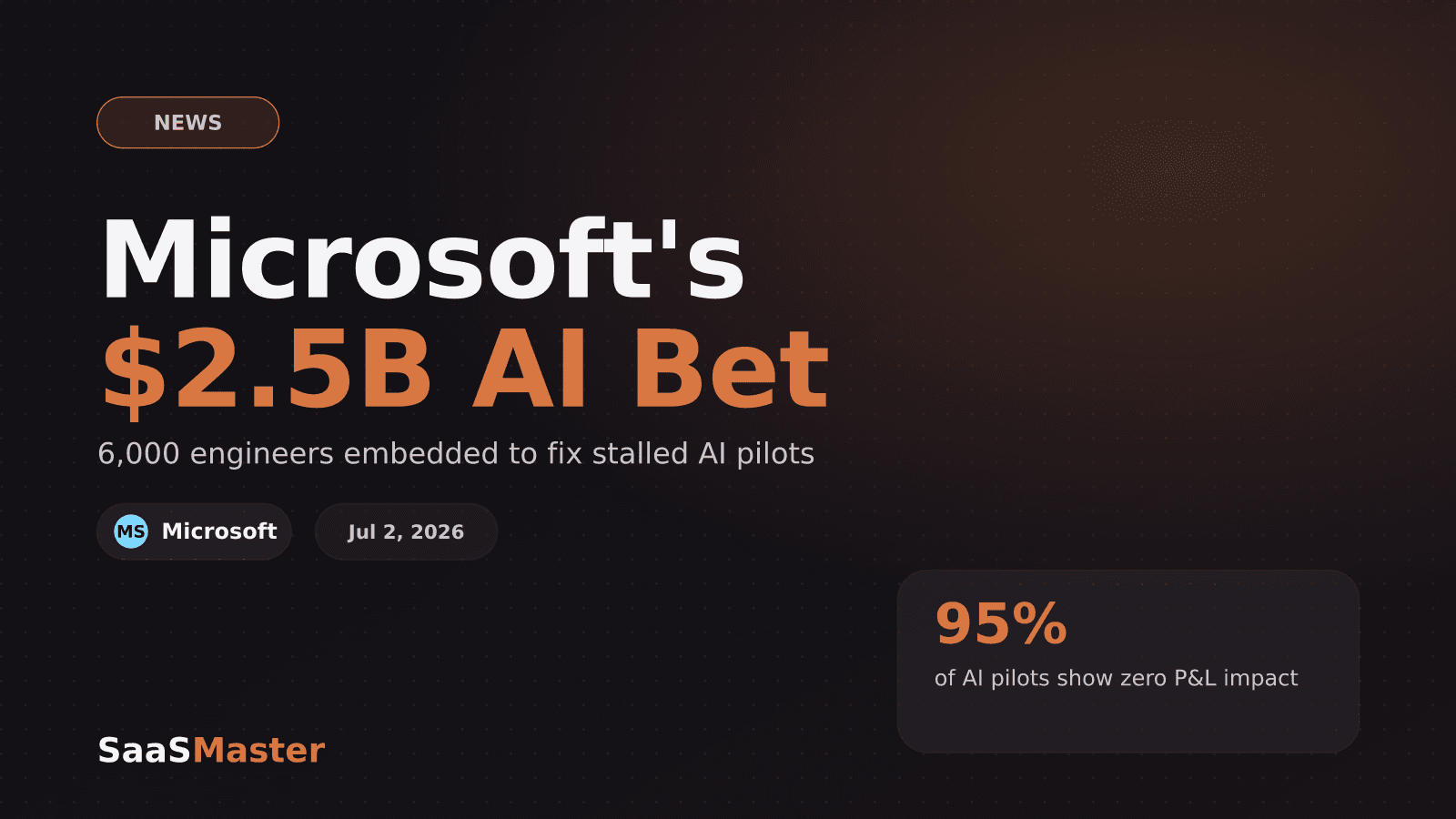
Microsoft announced Frontier Company on July 2, 2026 — a new $2.5 billion business unit that embeds roughly 6,000 engineers, consultants, and industry specialists directly inside customer organizations to get stalled AI projects actually into production. The move responds to a well-known problem: most enterprise AI pilots never reach the finish line, and Microsoft is betting that the fix isn't a better model, it's more hands-on engineering.
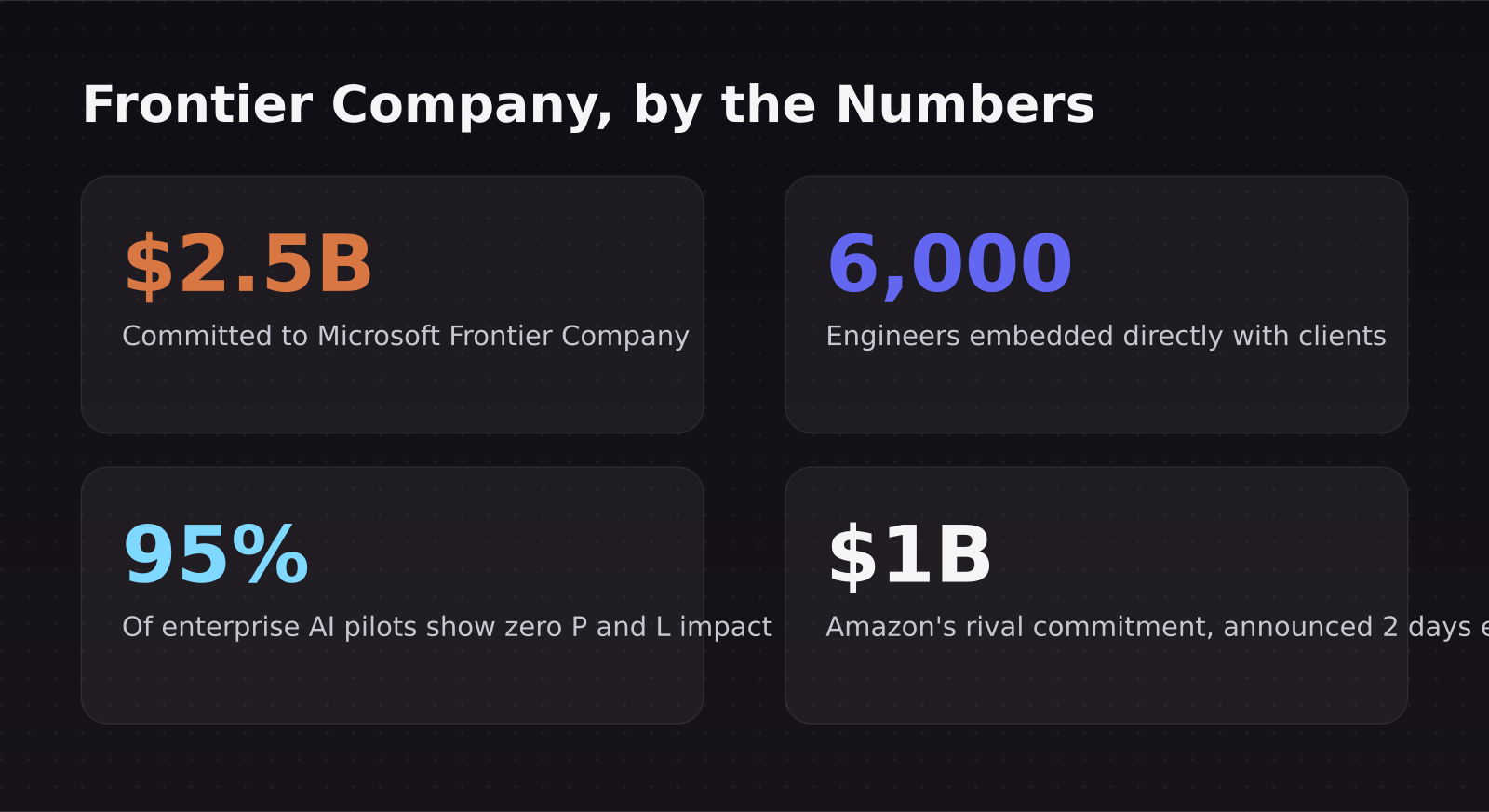
Key takeaways: - Frontier Company launched July 2, 2026 with $2.5 billion in funding and about 6,000 employees, led by 30-year Microsoft veteran Rodrigo Kede Lima. - The unit uses "forward deployed engineering" — technical staff embedded on-site with clients to co-design, build, and maintain AI systems rather than hand off a playbook. - Research cited by Microsoft from MIT's Project NANDA found 95% of enterprise generative AI pilots deliver zero measurable P&L impact — the exact gap Frontier Company is positioned to close. - Amazon committed $1 billion to a similar AI implementation initiative just two days earlier, and Microsoft's own stock was down roughly 21% for 2026 at the time of the announcement.
Why is Microsoft building a $2.5 billion consulting arm now?
Microsoft has spent years selling Copilot and Azure AI services on the promise that enterprises could plug AI into existing workflows with minimal friction. The MIT Project NANDA finding — that 95% of generative AI pilots show no measurable financial return — undercuts that pitch directly. Frontier Company is Microsoft's admission that the bottleneck was never really model quality; it's the unglamorous work of integration, change management, and getting an organization's actual data and processes lined up with what the AI can do.
That's also why the timing matters. Amazon announced a comparable $1 billion AI implementation commitment just two days before Microsoft's announcement, and both moves land while Microsoft's stock sits about 21% down for the year — investor pressure to show AI is actually generating revenue, not just headlines, is clearly part of the calculus here.
What does "forward deployed engineering" actually involve?
Forward deployed engineering is a staffing model, not a new technology. Frontier Company folds together four kinds of people and sends them to work inside a client's organization instead of consulting from a distance:
- Existing Microsoft forward-deployed engineers who already do hands-on technical implementation work.
- Technical consultants who translate business goals into a working AI architecture.
- Industry specialists with domain expertise in the client's specific sector.
- Sales professionals who stay involved through the deployment, not just the initial pitch.
The stated goal is to move clients "beyond pilot projects" into AI applied across real business operations, with Rodrigo Kede Lima — who has led enterprise-wide transformation efforts at Microsoft for six years — running the new business.
How does Frontier Company compare to a normal Microsoft consulting engagement?
Microsoft has always had a professional services arm, and Copilot rollouts have always come with implementation partners. What's different about Frontier Company is scale and structure, not the basic idea of "Microsoft helps you deploy Microsoft AI."
- Scale: 6,000 employees dedicated specifically to this unit is a meaningfully larger standing commitment than a typical partner-led rollout team, and it's funded as its own $2.5 billion business rather than a cost center inside an existing consulting division.
- Structure: forward deployed engineers stay embedded with a client through build, deployment, and ongoing improvement, rather than handing off a completed project and moving to the next account.
- Outcome framing: the stated goal is measurable business outcomes and demonstrated return on AI investment, not a completed pilot or a signed-off proof of concept — a direct response to the finding that most pilots never translate into P&L impact.
- Leadership: putting a 30-year enterprise transformation veteran in charge, rather than a product or engineering lead, signals this is being run as a change-management problem first and a technology rollout second.
What does this mean for SaaS companies that aren't Microsoft's direct customers?
If you build or sell SaaS software, this announcement matters even if you never sign a contract with Frontier Company, for two reasons.
First, it validates a trend already visible in the AI agent space: the technology has outpaced most teams' ability to actually operationalize it. The same gap shows up in how small SaaS teams are running parts of their operations on autonomous agents — the tooling exists, but wiring it correctly into a real workflow is still the hard part, at any company size.
Second, it's a signal about where enterprise AI budgets are heading. Gartner has already warned that agentic AI could put up to $234 billion of SaaS spending at risk by 2030 as AI agents start doing work that used to require a seat-based software license. Microsoft positioning 6,000 people to close the implementation gap is a direct response to that same pressure — if agentic AI is going to displace SaaS spend, cloud vendors want to be the ones capturing the services dollars that replace it.
There's also a quieter infrastructure story underneath this: more of the databases and backends that AI agents run on are themselves being built by AI. Supabase's $500M raise noted that a majority of new databases on the platform are now created by AI agents rather than humans — which is exactly the kind of "AI building the plumbing AI runs on" loop that makes hands-on implementation help, like Frontier Company promises, more relevant rather than less.
Should SaaS teams expect competitors to copy this move?
Almost certainly, and the timing already shows it: Amazon's $1 billion AI implementation commitment landed within 48 hours of Microsoft's announcement. Expect Google Cloud and the major AI labs to follow with their own forward-deployed engineering offers, since the underlying problem — AI pilots that never reach production — isn't specific to any one vendor's models.
For smaller SaaS companies without a $2.5 billion budget to embed engineers at every customer, the practical takeaway is the same lesson Frontier Company is built around: the deployment and change-management work matters as much as the model you pick. If your own product or onboarding needs the equivalent of "forward deployed engineering" — someone walking a new customer through exactly how a feature works instead of leaving them a help doc — a well-made SaaS explainer video is the cheaper version of the same idea: reducing the gap between "we shipped the feature" and "the customer actually uses it."
There's a useful scale lesson here too. A $2.5 billion commitment and 6,000 embedded engineers is Microsoft's version of closing the "pilot never reaches production" gap for the largest enterprise accounts on the planet. Most SaaS companies will never operate at that scale, but the underlying failure mode — a feature or workflow that works in a demo and dies at rollout — is identical at ten customers or ten thousand. The fix is proportionally smaller too: clear onboarding sequences, walkthrough content, and someone accountable for whether a customer actually adopted a feature after they bought it, not just whether it shipped.
Frequently asked questions
When did Microsoft announce Frontier Company?
Microsoft announced Frontier Company on July 2, 2026, committing $2.5 billion and approximately 6,000 employees to help enterprise customers move AI projects from pilot to production.
Who leads Microsoft Frontier Company?
Rodrigo Kede Lima, a 30-year industry veteran who has spent the last six years leading enterprise transformation efforts at Microsoft, was named President of Microsoft Frontier Company.
Why are enterprise AI pilots failing so often?
Research from MIT's Project NANDA, cited around Microsoft's announcement, found that 95% of enterprise generative AI pilots produce no measurable impact on profit and loss — a gap attributed to integration and change-management failures rather than the underlying AI models themselves.
Was this article helpful?
Jorge Aguilar
Founder & Creator, SaaS Master
Producing SaaS and AI product videos since 2019 — 800+ videos for 200+ brands, covering tutorials, demos, walkthroughs, and explainers. Writing here about the tools, trends, and tactics that actually move the needle. LinkedIn · About · Work with me
Building an AI product that needs a clearer onboarding flow?
Client-owned videos that make your product easy to understand — demos, walkthroughs, onboarding, and explainers.
Explore AI product video production