AI & SaaS
Ramp Raises $750M at $44 Billion: Why AI-Powered Finance Is the Hottest SaaS Category
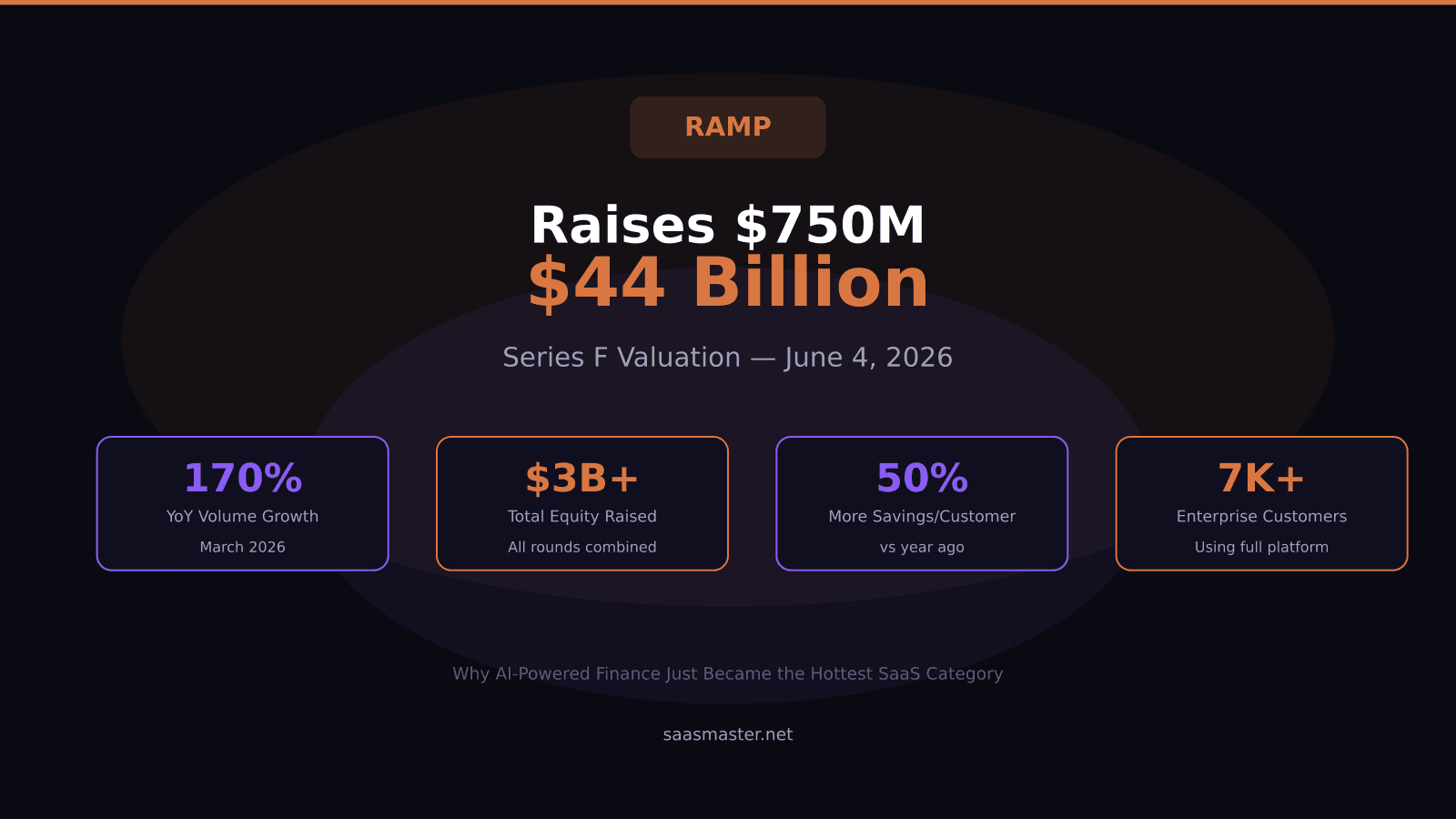
On June 4, 2026, Ramp closed a $750 million Series F round at a $44 billion valuation, becoming one of the most valuable private fintech companies in history. Purchase volume grew 170% year over year in March 2026 — the company's fastest growth rate in three years — at a scale roughly 20 times larger than where it started. This is not startup momentum. Something structural is shifting in how companies manage money, and Ramp is at the center of it.
Key takeaways
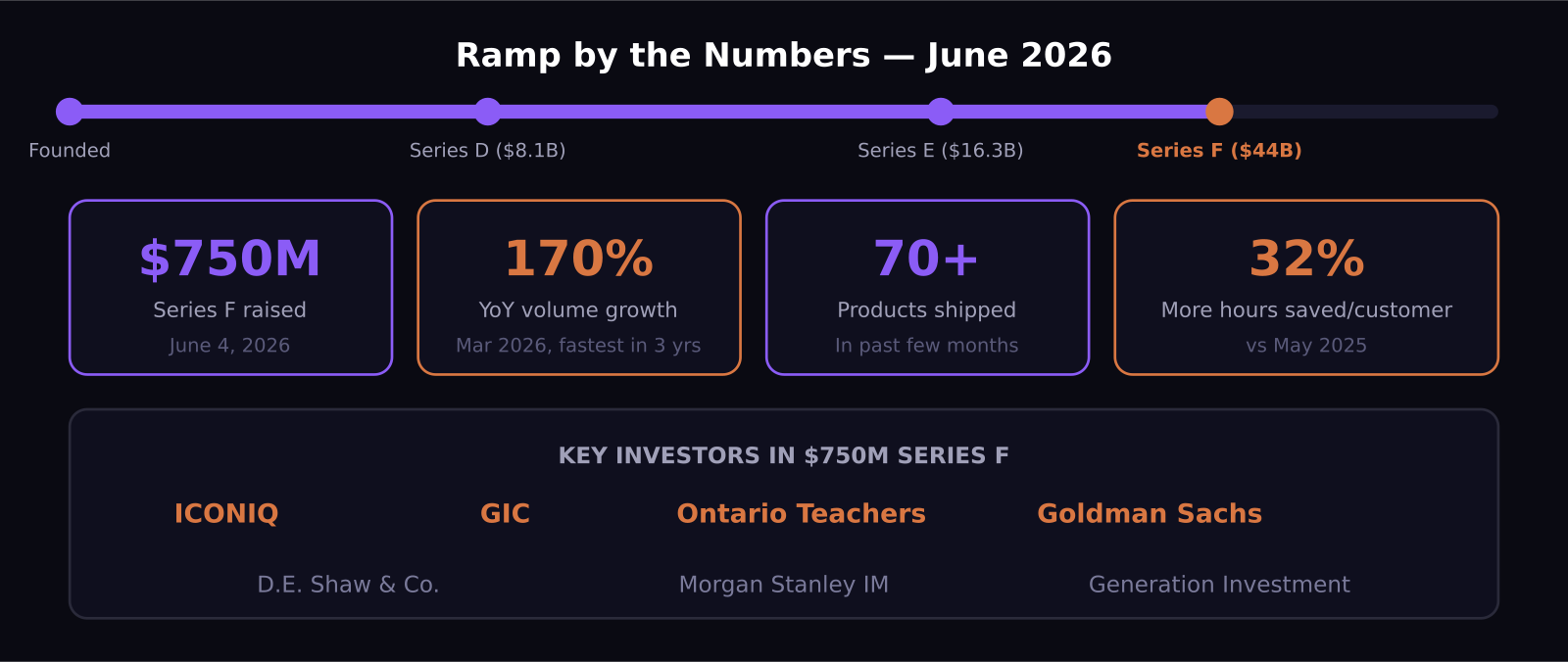
- Ramp raised $750M Series F on June 4, 2026, at a $44 billion valuation — total equity financing now exceeds $3 billion
- Purchase volume grew 170% year over year in March 2026, the fastest growth rate in three years at 20x prior scale
- Median customer saved 50% more dollars and 32% more hours annually in May 2026 vs a year earlier
- Ramp is building AI token spend management — tracking AI provider costs at the individual token level for 7,000+ enterprise customers
- New investors include Goldman Sachs Alternatives, D.E. Shaw & Co., Morgan Stanley Investment Management, and Generation Investment Management
What is Ramp and why does it matter?
Ramp is a financial operations platform that combines corporate cards, expense management, bill pay, and accounting automation in one system. Its core platform is available for free — Ramp earns revenue primarily through interchange fees when customers use its cards, and through premium subscriptions for advanced features. That pricing model is part of why it grew fast: there was no reason not to try it.
What has transformed Ramp from a well-designed fintech product into a $44 billion company is AI. The platform automatically codes transactions, matches receipts, flags policy violations in real time, and surfaces unauthorized SaaS purchases on corporate cards before they become a budget problem. Every automated decision includes explainable reasoning, which matters for finance teams that need an audit trail, not just an output.
Over the past year, that AI layer has gotten significantly better. The median Ramp customer saved 50% more dollars and 32% more hours annually in May 2026 compared to a year earlier. For users on the full platform suite, those savings more than doubled.
Who led the $750M round?
The round was led by ICONIQ, GIC (Singapore's sovereign wealth fund), and Ontario Teachers' Pension Plan — three institutional investors with long time horizons and significant enterprise SaaS track records. New investors include Goldman Sachs Alternatives, D.E. Shaw & Co., Morgan Stanley Investment Management, Generation Investment Management, Insight Partners, and BroadLight Capital.
That investor list reads less like a growth-stage fintech bet and more like institutional capital following a category-defining company. ICONIQ in particular has a history of leading rounds in companies that go on to become infrastructure: Snowflake, Figma, and Databricks are in that playbook. GIC also led the Supabase $500M round that closed the same day, June 4, 2026 — a notable double signal about where long-horizon capital is moving.
What is Ramp's AI token spend management product?
The most strategically significant product announcement tied to this round is Ramp's AI token spend management offering. As companies deploy AI agents and large language models at scale, the costs compound quickly across teams. Token spend from providers like Anthropic, OpenAI, and Google can balloon without visibility into who is spending what, on which model, for what task.
Ramp is building tooling that pulls token-level usage data directly from AI providers into its expense management platform. This gives finance and engineering teams a unified view of AI infrastructure costs alongside all other corporate spend — the same dashboard that shows your SaaS subscriptions and T&E can now show how many tokens your product team spent on GPT-5.5 last month and what it cost per customer request.
This is genuinely new territory. Standard corporate card platforms manage monthly SaaS subscriptions. AI inference costs fluctuate per API call, vary by model, and require a fundamentally different architecture to track. Ramp is betting that the same platform already managing your broader spend is the right home for your AI budget — and with 7,000-plus enterprise customers already on the platform, the distribution advantage is real.
What do the Billhop and Juno acquisitions mean?
The round announcement confirmed two completed acquisitions: Billhop, a UK and European payments platform, and Juno, a guest travel management company.
Billhop is the more strategically significant. Ramp announced plans to begin serving companies headquartered in the United Kingdom and Europe this summer. For a US-native spend management platform, European expansion requires local payment rails, VAT handling, and regulatory compliance infrastructure — Billhop provides exactly that. This is the first time Ramp has moved outside the US market, and the timing is deliberate: the AI token spend management story is global from day one.
Juno brings native guest travel management into the platform. Travel spend is one of the harder categories to manage through a corporate card system because it involves bookings for external parties, variable policies across teams, and multi-format receipts. Adding Juno closes a visible gap and increases the total spend Ramp can manage per enterprise customer.
What this means for SaaS builders and operators
For anyone running or building a SaaS company in 2026, Ramp's trajectory is worth watching on two levels.
First, if you are not using an AI-native finance tool, the productivity gap is widening. The customer savings data from Ramp is not self-reported marketing — it is derived from actual transaction data across a large user base. Fifty percent more savings and 32% more hours recovered per customer year over year is a compounding advantage for the companies using the platform.
Second, Ramp's AI token spend management feature signals something broader about where enterprise software is going. As AI becomes a meaningful and variable line item on the P&L — not just a $50/month SaaS subscription, but an ongoing infrastructure cost that fluctuates with usage — the tooling to manage it needs to evolve. Finance teams need granularity that existing expense software was not designed for. Ramp is one of the first platforms to address this directly, and the $750M round gives it the resources to build fast.
The $44 billion valuation puts Ramp in rarefied company. More interesting than the number is what it implies: Ramp is building toward becoming the financial operating system for AI-native companies. Given the growth rate, the quality of capital coming in, and the timing of the AI token spend product, that ambition looks increasingly well-funded.
Frequently asked questions
What is Ramp's valuation after the June 2026 funding round?
Ramp is valued at $44 billion following its $750 million Series F round, which closed on June 4, 2026. Total equity financing in the company now exceeds $3 billion.
Is Ramp free to use?
Ramp's core platform — corporate cards, expense management, and accounting automation — is available at no cost. Ramp earns revenue primarily through interchange fees when customers use its corporate cards, and through premium plan subscriptions for advanced features.
What is Ramp's AI token spend management?
Ramp is building a product that pulls token-level usage data from AI providers like Anthropic, OpenAI, and Google directly into its expense management platform. It gives companies visibility into exactly how much they are spending on AI model inference, broken down by team, model, and task — alongside all other corporate spend in a single dashboard.
Was this article helpful?
SaaS Master
Creator behind SaaS Master — tutorials, walkthroughs, reviews, and explainers that help SaaS, AI, and WordPress products get understood and chosen. Writing here about the tools, trends, and tactics that actually move the needle. Work with me →
Want your product explained this clearly — in video?
Tutorials, walkthroughs, reviews, and shorts for SaaS, AI, and WordPress products.
Work With SaaS Master