Stripe Billing vs Adyen (Orb) in 2026: Which Usage-Based Billing Platform Fits Your SaaS?
In short
Adyen just paid $335M for Orb. Compare Stripe Billing vs Adyen/Orb pricing, metering limits, and which fits your SaaS usage billing needs.
$335 million. That is what Adyen just agreed to pay for Orb, a five-year-old usage-based billing startup, in a deal expected to close July 1, 2026. It is the second time in seven months a payments giant has bought its way into billing infrastructure, after Stripe paid a reported $1 billion for Metronome back in January. If two of the biggest names in payments are spending a combined $1.3 billion on metered billing in under a year, that alone tells you something: billing is no longer a back-office checkbox, it is the thing your pricing strategy, your margins, and your AI-era monetization all run through.
Key takeaways
- Adyen is acquiring Orb for $335 million, all cash, expected to close July 1, 2026. Orb already bills for Vercel, Glean, Replit, and Supabase.
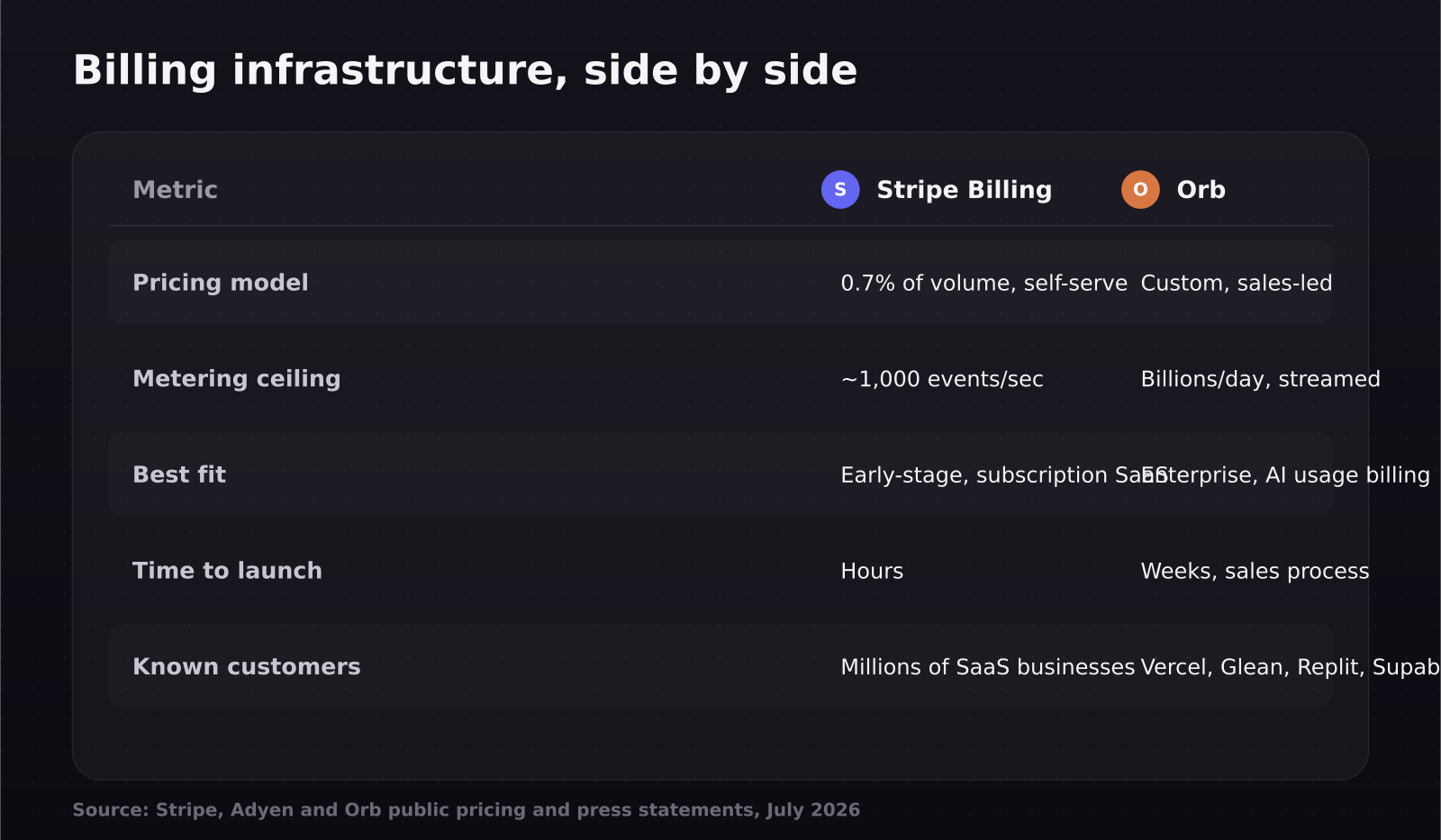
- Stripe Billing charges 0.7 percent of billing volume on its pay-as-you-go plan, on top of standard card processing, and includes 100 million metered events a month before you need a sales conversation.
- Stripe's own $1 billion Metronome acquisition in January exists because Stripe Billing's native metering tops out around 1,000 events per second per account, a ceiling that AI products billing per token blow past fast.
- Orb has no public self-serve price list. It is sold as enterprise infrastructure, and Supabase reportedly cut its invoicing costs by roughly 0.4 percent of total revenue after switching to it.
- For most SaaS teams under a few million in annual recurring revenue, Stripe Billing is still the right starting point. Orb-style infrastructure earns its cost once your usage volume or pricing complexity outgrows what a general-purpose processor can meter cleanly.
What did Adyen actually buy when it bought Orb?
Orb was founded in 2023 by two former Asana engineering leads, and it does one thing: it ingests raw product usage events, whether that is API calls, compute minutes, or AI tokens, and turns them into invoices under whatever pricing logic a company defines, without an engineering team having to hand-roll that logic themselves. It already handles this for Vercel, Glean, Replit, and Supabase. Supabase alone reportedly pushes 1.5 million invoices a month through the platform.
Adyen is not buying Orb to run it as a side project. The plan is to fold billing signals into Adyen's existing risk and identity layer, so that usage data, payment data, and fraud scoring start informing each other in real time. In plain terms: Adyen wants to stop being just the company that moves money and start being the company that also tells you what to charge for it.
That is the same bet Stripe made in January when it bought Metronome. Stripe Billing's built-in metering is genuinely capable for most SaaS pricing, but it was designed around subscription and per-seat logic, not the high-frequency, sub-second usage events that AI products generate when they bill per token or per inference call. Metronome closes that gap for Stripe the same way Orb closes it for Adyen.
How does Orb's pricing model compare to Stripe Billing?
This is where the two products diverge the most, and it matters if you are choosing between them.
Stripe Billing publishes real numbers you can act on today: 0.7 percent of billing volume on the pay-as-you-go plan, dropping to roughly 0.67 percent on annual commitments, plus standard card processing at 2.9 percent plus 30 cents. One-off invoices run 0.4 percent each. You get subscriptions, usage metering with 100 million events included monthly, dunning, retries, and a customer portal, all inside a product you can be live with in an afternoon.
Orb does not publish self-serve pricing at all. It is sold through a sales process, priced against your usage volume and the complexity of your pricing model, and its higher tiers add things most early-stage SaaS teams never touch: data warehouse sync into Snowflake or Redshift, Salesforce and NetSuite integration, parent-child customer hierarchies for enterprise accounts, and streaming aggregation built to handle billions of events a day.
That gap in transparency is not an accident. Stripe Billing is built to be self-served by a two-person startup. Orb, and by extension the Adyen deal, is built for companies that already have a billing engineer on staff and are trying to get pricing changes shipped in hours instead of quarters.
Which platform is cheaper, Stripe Billing or Orb?
For a typical early-stage SaaS product doing subscription or light usage billing, Stripe Billing is almost certainly cheaper and faster to launch. There is no minimum contract, no sales call, and the 0.7 percent fee is easy to model against revenue from day one.
Orb becomes cost-competitive, and sometimes cheaper in absolute terms, once your billing complexity or event volume grows past what a general processor handles gracefully. Supabase's reported 0.4 percent revenue reduction after switching came from eliminating reconciliation overhead and invoice errors at massive scale, not from a lower sticker price. That is a real saving, but it only shows up once you are processing millions of invoices a month. Below that scale, the sales-led onboarding and lack of published pricing usually make Orb the more expensive option in practice, simply because of the time and negotiation it takes to get live.
Should a small SaaS company switch to either one right now?
If you are under roughly $2 million in annual recurring revenue and your pricing is subscription-based or lightly usage-based, switching anything right now is probably a distraction. Stripe Billing, or an equivalent like Chargebee or Paddle, already covers what you need, and the Adyen-Orb news does not change that math today.
Where this news actually matters is if you are building an AI-native product that bills per token, per inference, or per agent run. That is exactly the workload Stripe's native metering was not designed for, and it is exactly why Stripe bought Metronome and Adyen bought Orb within months of each other. If your product's usage events are already outrunning what your current processor can meter without a sales call, this is the moment to start evaluating Orb, Metronome, or a similar metering layer, not after you have already lost a quarter to invoicing errors.
What should you actually do about billing in 2026?
Start by mapping your actual billing events for the next twelve months of your roadmap, not just what you charge for today. If any part of your roadmap involves AI features billed by usage, token, or compute, model what that volume looks like at 10x your current scale before you pick infrastructure. Stripe Billing plus a lightweight usage add-on covers almost every SaaS company through their first few million in revenue. The moment your pricing model needs hourly aggregation, multi-entity billing, or real-time usage dashboards for enterprise customers, that is your signal to have the Orb or Metronome conversation, not before.
The two acquisitions this year are a strong signal that whoever owns billing infrastructure is trying to own the relationship with how software companies price their products going forward. For a deeper look at what happens when usage-based billing gets forced onto teams that were not ready for it, see our breakdown of the GitHub Copilot usage-based billing shock, and for the funding side of the AI infrastructure story, our coverage of Together AI's $800 million round is worth reading alongside this one. If you are trying to figure out whether your own AI spending is a genuine SaaS risk or just noise, our piece on Gartner's agentic AI spending numbers digs into that question directly.
None of this replaces the harder problem most SaaS teams actually have: explaining a usage-based price to a customer who is used to a flat monthly bill. That is a communication problem before it is a billing-platform problem, and it is usually where our saas explainer videos work comes in, walking a prospect through exactly what they will be charged for and why, before pricing confusion becomes a churn reason.
For more on how SaaS teams are navigating growth decisions like this one, visit our SaaS growth and product education hub.
Frequently asked questions
Is Orb going away now that Adyen bought it?
No. Adyen has said Orb will operate as an indirect, wholly owned subsidiary under an incubator model after the deal closes, meaning it continues serving existing customers like Vercel, Glean, Replit, and Supabase as a standalone product rather than being folded directly into Adyen's core platform immediately.
Does Stripe Billing support AI token-based billing?
Stripe Billing can meter usage, but its native throughput tops out around 1,000 events per second per account with 100 million events included monthly. For high-frequency, per-token AI billing beyond that, Stripe now points customers toward Metronome, which it acquired in January 2026 specifically to handle that volume.
How much does Orb cost for a small startup?
Orb does not publish self-serve pricing, and it is sold through a sales-led process priced against your usage volume and pricing complexity. In practice, this makes it a poor fit for early-stage startups under a few million in revenue, where a transparent, self-serve platform like Stripe Billing is faster and cheaper to launch with.
Was this article helpful?
Jorge Aguilar
Founder & Creator, SaaS Master
Producing SaaS and AI product videos since 2019 — 800+ videos for 200+ brands, covering tutorials, demos, walkthroughs, and explainers. Writing here about the tools, trends, and tactics that actually move the needle. LinkedIn · About · Work with me
Need a walkthrough that helps buyers understand a complex product faster?
Client-owned videos that make your product easy to understand — demos, walkthroughs, onboarding, and explainers.
Explore SaaS video production