Claude Sonnet 5 vs GPT-5.6 Terra: The Mid-Tier AI Showdown With a Deadline
In short
Claude Sonnet 5 vs GPT-5.6 Terra compared: benchmarks, pricing, and which mid-tier AI model SaaS teams should build on before Sonnet 5's August 31 price hike.
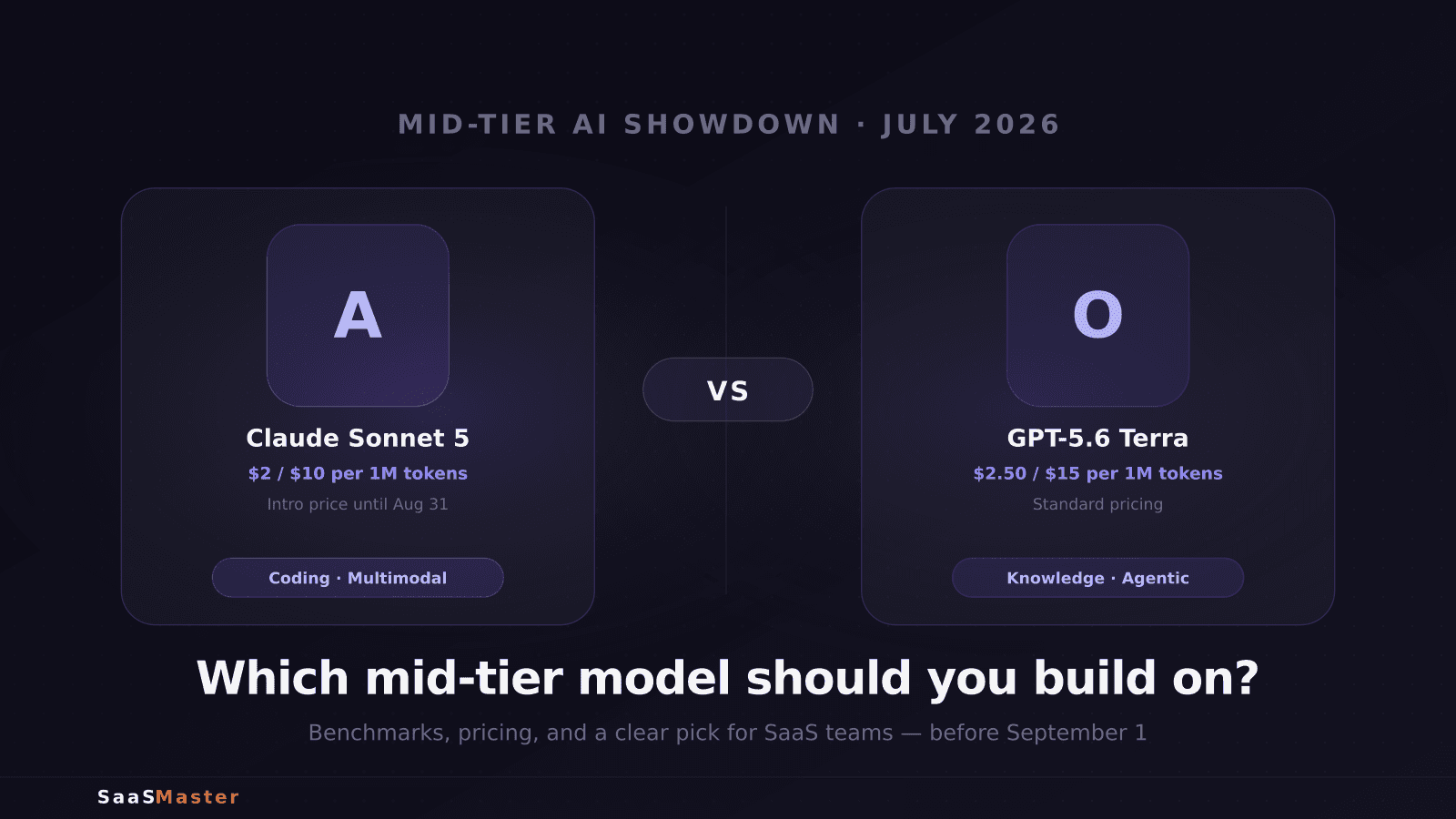
There is a deadline attached to this comparison: August 31, 2026. That is when Claude Sonnet 5's introductory price jumps 50% — from $2/$10 to $3/$15 per million tokens. If you have been putting off deciding which mid-tier AI model to build on, the clock is running. This breakdown is designed to help you make that call with current data, not after the pricing changes.
Key takeaways
- Claude Sonnet 5 leads on coding (71.4 vs 63.4 avg) and multimodal tasks (88.3 vs 80.7)
- GPT-5.6 Terra leads on knowledge tasks (92.9 vs 57.4) and agentic tool use (87.4 vs 81.9)
- Sonnet 5 is cheaper right now: $2/$10 vs Terra's $2.50/$15 — but the gap closes after August 31
- Both support 200K context windows with no practical advantage to either on document length
- The right pick is use-case specific: Sonnet 5 for coding and multimodal, Terra for knowledge and long tool chains
Why mid-tier models matter more than flagships right now
The frontier model race in 2026 has produced a genuinely useful side effect: the mid-tier models from both Anthropic and OpenAI are now significantly better than last year's flagships. Claude Sonnet 5 (released June 30) and GPT-5.6 Terra (released July 9) both sit in the $2–$3 input / $10–$15 output per million token range, and both are built for production agentic workloads — the multi-step, tool-using pipelines that SaaS companies are building into customer-facing products.
The frontier tiers (Claude Fable 5 Opus 4.8, GPT-5.6 Sol) are still better on the hardest tasks, but cost 5–10x more per token. For most production SaaS use cases — document summarization, code review, customer-facing agents, onboarding automation — that extra capability goes unused. Mid-tier is where the real value is in 2026.
Benchmark breakdown: where each model leads
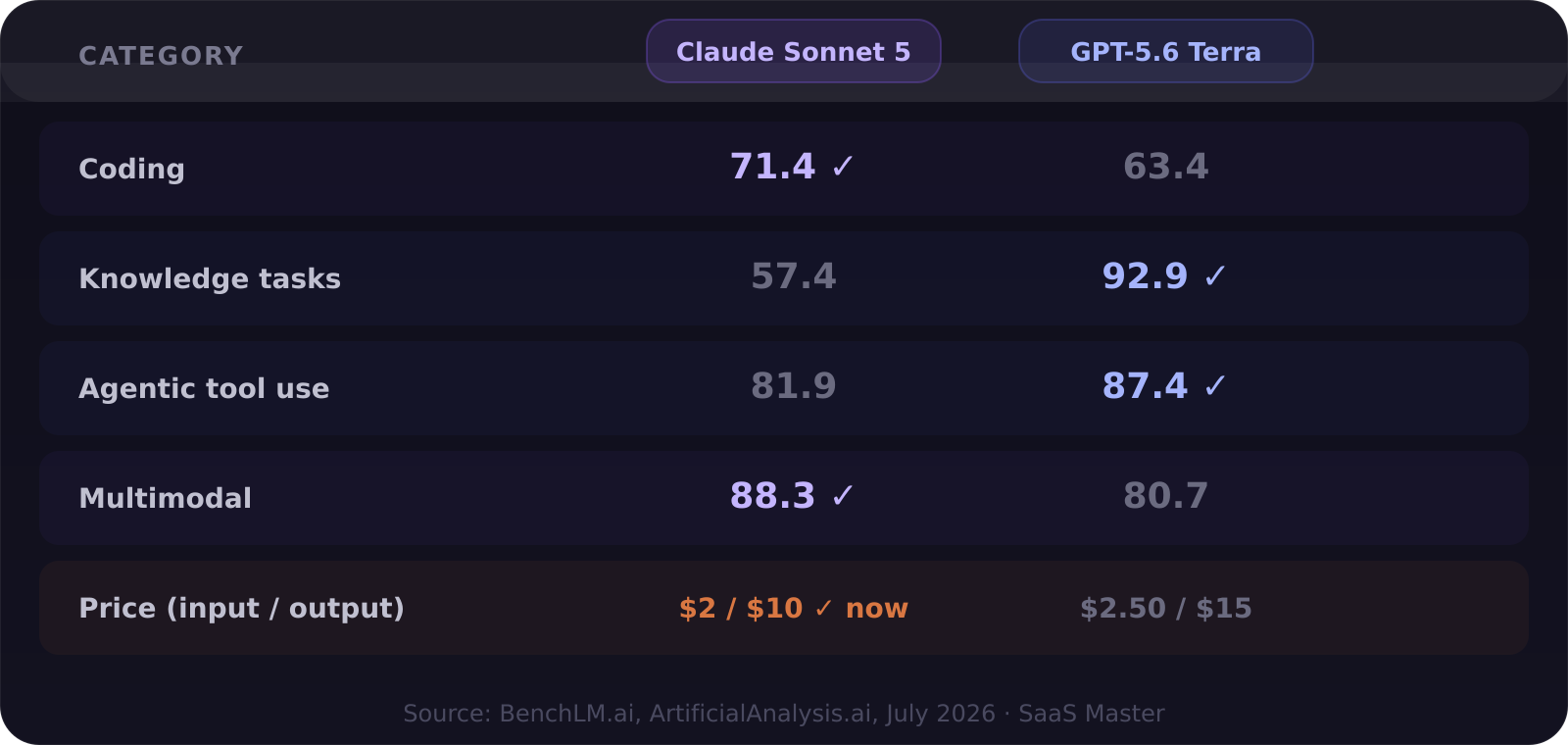
These scores are from ArtificialAnalysis.ai and BenchLM.ai as of July 2026. They map to specific real-world use cases, not abstract leaderboard positions.
Coding (Sonnet 5 wins, 71.4 vs 63.4): Claude Sonnet 5 was built with coding as a primary discipline. It handles multi-file edits, debugging sessions, and technical explanation consistently better than Terra in side-by-side tests. The gap holds across Python, TypeScript, and Rust.
Knowledge tasks (Terra wins by a wide margin, 92.9 vs 57.4): This is Terra's clearest win, and the gap is large enough to drive the decision for knowledge-intensive products. Tasks involving synthesis of factual information, domain-specific Q&A, structured extraction from long documents, and competitive research consistently favor Terra.
Agentic tool use (Terra wins, 87.4 vs 81.9): Multi-step tool chains with web browsing, file systems, and external APIs run more reliably on Terra. Sonnet 5 is meaningfully more agentic than previous Sonnet versions, but Terra's architecture handles longer chains with more consistency. If you are orchestrating AI through tools like n8n or Make automations, that matters at scale.
Multimodal (Sonnet 5 wins, 88.3 vs 80.7): Document analysis, image understanding, and processing mixed-format inputs all favor Sonnet 5. For SaaS products that handle screenshots, PDFs, or UI recordings, this is a practical advantage.
Which is actually cheaper, and for how long?
Today, Claude Sonnet 5 is cheaper on every dimension. Input: $2 vs $2.50 per million tokens. Output: $10 vs $15 per million tokens. At 10 million output tokens per month — a realistic production workload — that's $100 versus $150 per month in pure output cost, before input, before caching.
After August 31, Sonnet 5 moves to $3/$15. At that point the pricing is essentially equal: both models cost $2.50–$3 per million input and $15 per million output. The pricing advantage disappears, and the decision becomes purely about capability.
If you are building now and want real cost benchmarks, running production evaluations on Sonnet 5 before September 1 gives you a window where the model is both competitive and cheaper. If your product launches in Q4, price in the Terra rate — it will be closer to what Sonnet 5 costs then.
How to pick for your specific SaaS use case
If coding, development tooling, or multimodal input processing is central to your product: Claude Sonnet 5 is the better fit today and likely after the price change too, given its consistent benchmark leads in those categories. For SaaS video production workflows where the AI model processes UI screenshots, mixed-format documents, or rich media, the multimodal advantage is practical, not theoretical.
If knowledge retrieval, research assistance, structured data extraction, or complex multi-step tool chains are central: GPT-5.6 Terra's leads on knowledge and agentic benchmarks make it the safer production choice, even at the slightly higher price. The 35-point knowledge task gap is not something you close with better prompting.
For teams building general-purpose SaaS features — chatbots, copilots, onboarding assistants — either model works well, and Sonnet 5's current price advantage gives it a slight edge until September.
For the full three-way flagship comparison, see Claude Fable 5 vs GPT-5.6 vs Gemini 3.5 Pro from earlier this week. And if you want to see how Grok 4.5 fits into this picture — SpaceXAI's new Cursor-trained coding model at $2/$6 — check our full Grok 4.5 review.
Context windows and other practical details
Both models support 200K context windows. Neither has a practical advantage on document length for standard SaaS applications. Rate limits on the API favor OpenAI slightly for high-volume enterprise accounts, though Anthropic's limits have improved significantly in 2026.
Neither model supports fine-tuning in the standard API tier as of July 2026. If your use case requires fine-tuning, you are looking at enterprise agreements with both providers — worth knowing before you architect around it.
Latency: GPT-5.6 Terra runs slightly faster on standard inference in ArtificialAnalysis latency testing. The difference matters for real-time chat features but is negligible for async pipelines.
Frequently asked questions
Will Claude Sonnet 5's price definitely increase on August 31?
Yes. Anthropic has confirmed the introductory pricing ends August 31, 2026, with standard pricing at $3 input / $15 output per million tokens starting September 1. The pricing structure is published on the Anthropic pricing page.
Can I switch between Sonnet 5 and GPT-5.6 Terra easily mid-project?
Both models support the standard chat completions format, and both are available on OpenRouter for A/B testing without separate API accounts. Switching is technically straightforward. Output style and behavior will differ enough that prompt tuning is usually needed when moving between them.
Is GPT-5.6 Terra just GPT-5.5 with a new name?
OpenAI positioned Terra as matching GPT-5.5 capability at half the cost of Sol. But Terra also incorporates architectural updates from the full GPT-5.6 training run — it is not a rebrand. It is an updated model at a lower price point than the flagship Sol tier.
Was this article helpful?
Jorge Aguilar
Founder & Creator, SaaS Master
Producing SaaS and AI product videos since 2019 — 800+ videos for 200+ brands, covering tutorials, demos, walkthroughs, and explainers. Writing here about the tools, trends, and tactics that actually move the needle. LinkedIn · About · Work with me
Building an AI product that needs a clearer onboarding flow?
Client-owned videos that make your product easy to understand — demos, walkthroughs, onboarding, and explainers.
Explore AI product video productionRelated guides
More AI Tools & AI Workflows →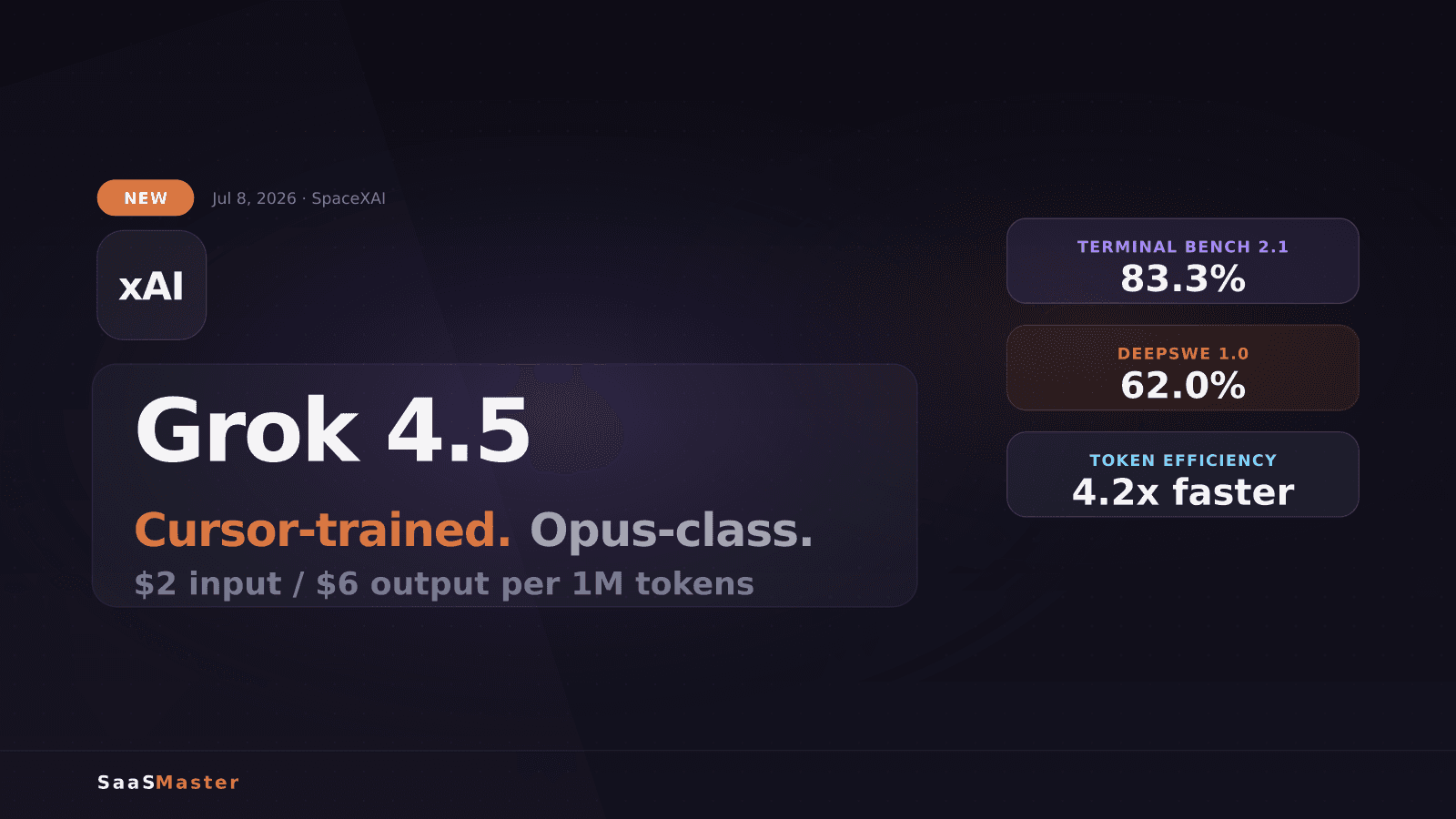
Grok 4.5: SpaceXAI's Cursor-Trained Coding Model Lands at $2/$6 Per Million Tokens
How to Get Your SaaS Tool Recommended by AI Engines
ChatGPT Go vs Plus in 2026: The $12 Gap That Changes Everything