Grok 4.5: SpaceXAI's Cursor-Trained Coding Model Lands at $2/$6 Per Million Tokens
In short
Grok 4.5 launches July 8 with Cursor training data, $2/$6 per million token pricing, and 4.2x token efficiency over Opus 4.8. Here's what SaaS teams need to know.
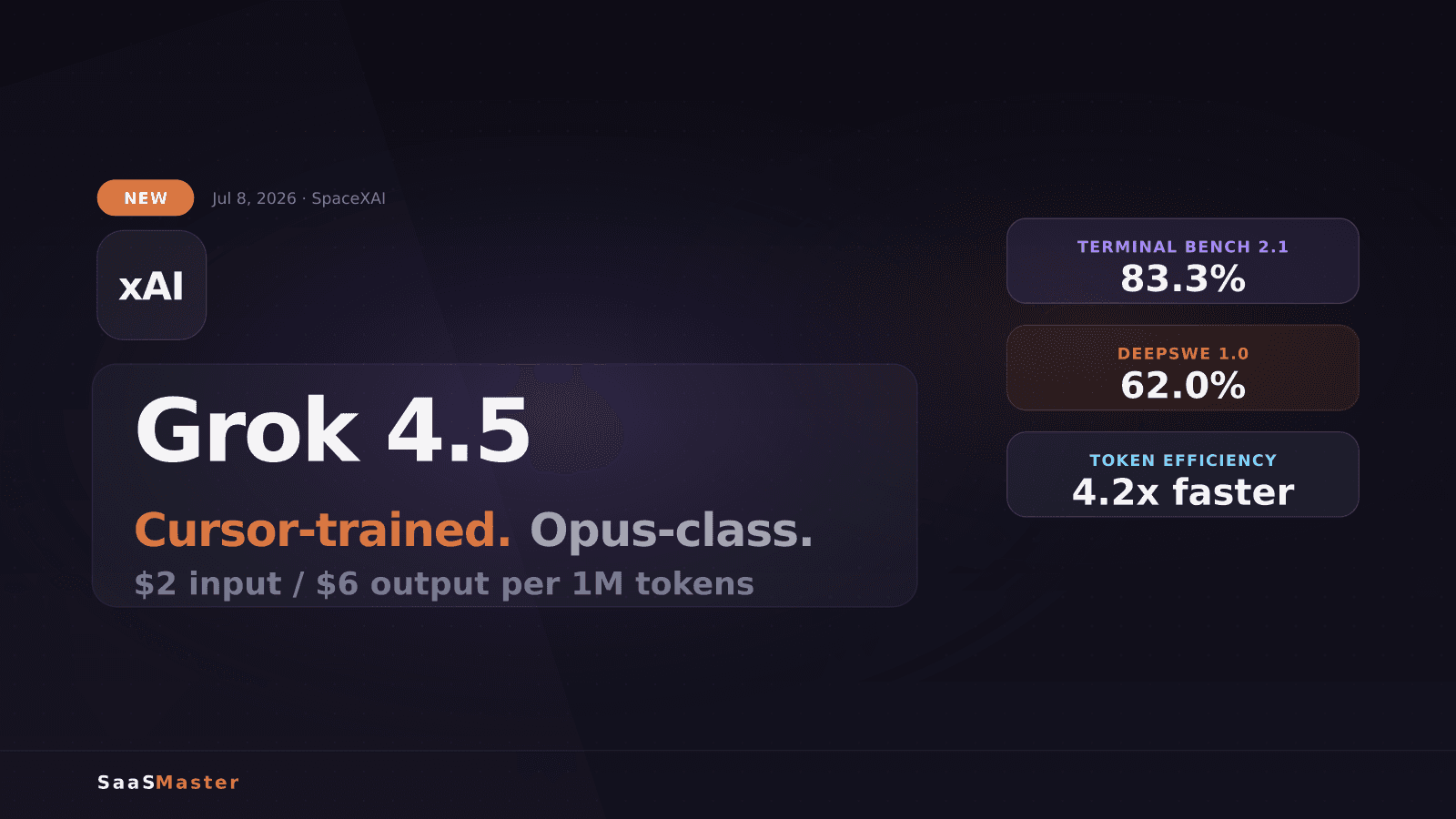
Three weeks ago, SpaceXAI's Grok lineup was a distant third in serious developer conversations. Then on July 8, 2026, the company shipped Grok 4.5 — a model trained on real Cursor developer sessions, priced at $2 input / $6 output per million tokens, and positioned as comparable to Claude Fable 5 Opus 4.8 at a fraction of the cost. The pricing alone cleared about 70% of the objections I hear when SaaS teams consider switching coding agents.
Key takeaways
- Grok 4.5 costs $2/$6 per million tokens — cheaper on output than Claude Sonnet 5 ($10 output) and GPT-5.6 Terra ($15 output)
- Trained on real Cursor developer sessions after SpaceXAI's $60B acquisition of the coding IDE
- Uses 4.2x fewer output tokens than Opus 4.8 on SWE Bench Pro tasks — token efficiency is a real number here
- Training data controversy: Cursor's own codebase was accidentally included, which may have inflated some benchmark scores
- Available now in Grok Build, Cursor (all plans), and the SpaceXAI API console; EU availability expected mid-July
What is Grok 4.5, exactly?
Grok 4.5 is SpaceXAI's fifth-generation flagship model, designed for three primary use cases: coding, agentic tasks, and general knowledge work. It's the first model built after SpaceXAI completed its $60 billion acquisition of Cursor — the AI code editor used inside VS Code and JetBrains — and that relationship is central to what makes Grok 4.5 different.
Most AI coding models are trained on GitHub data, Stack Overflow, and documentation. Grok 4.5 was trained on Cursor developer session data: how real developers interact with codebases over long sessions, how they prompt agents through multi-file edits, what errors they hit, and how they recover. That's a qualitatively different training signal, and it shows up in how the model handles long agentic coding runs.
Elon Musk described it as "Opus-class, but faster" — comparable to Claude Fable 5 Opus 4.8 in capability while being significantly cheaper and faster to run. The benchmarks are worth examining carefully, though, because the story is more nuanced than that framing suggests.
The benchmark numbers — and the controversy
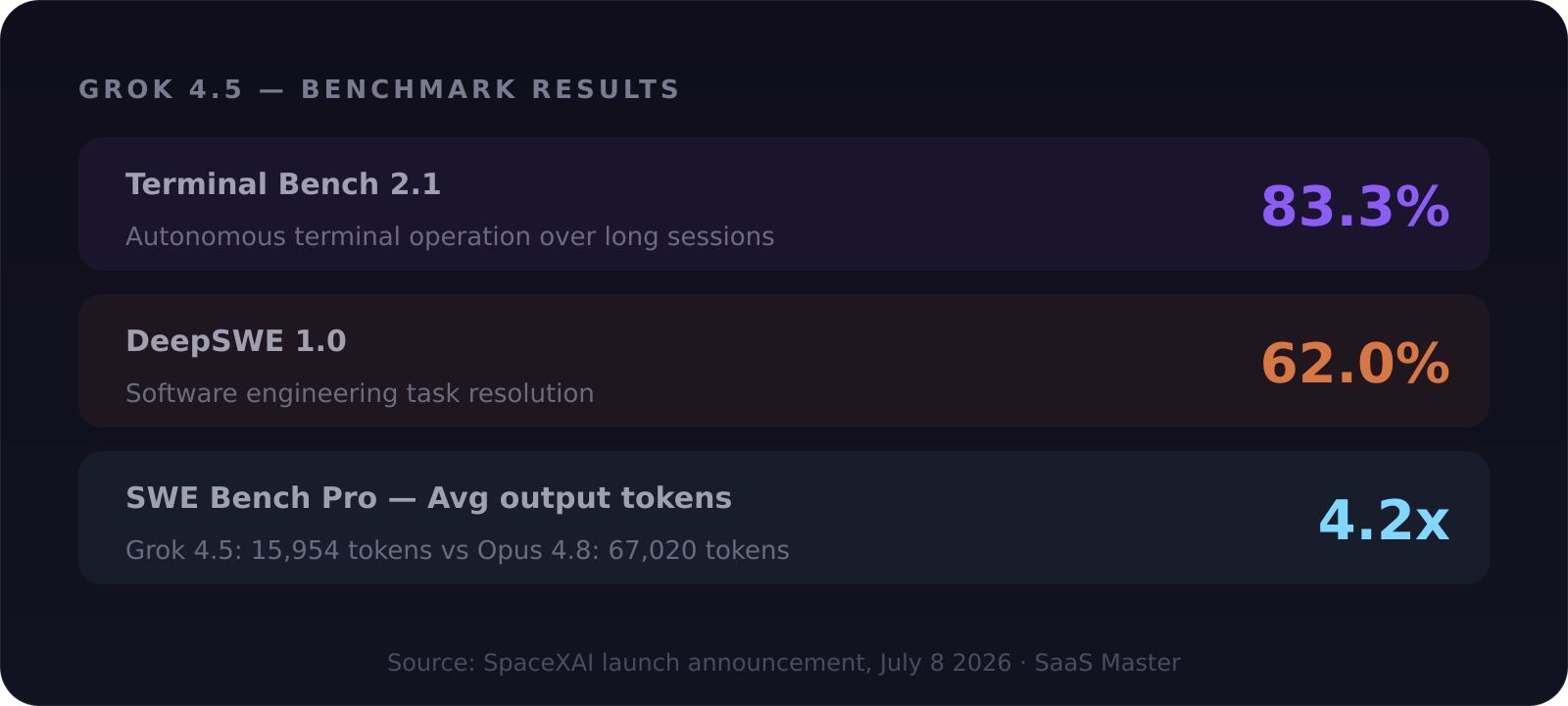
SpaceXAI's launch announcement included three headline scores:
- DeepSWE 1.0: 62.0%
- SWE Marathon resolution rate: 29.0%
- Terminal Bench 2.1: 83.3%
Terminal Bench is the benchmark that matters most here. It measures how an AI operates autonomously inside a real terminal environment over extended, multi-step sessions. An 83.3% score puts Grok 4.5 in competitive territory with frontier models on the benchmark that matters most for CI/CD pipelines, coding agents, and infrastructure automation.
The controversy: Shortly after launch, it emerged that a snapshot of Cursor's own codebase had accidentally been included in Grok 4.5's training data. For benchmarks using Cursor's internal test suites, this could have artificially inflated scores. Both SpaceXAI and Cursor confirmed the contamination and said cleaned data will be used for future versions. As of July 13, 2026, the DeepSWE scores have not been revised.
The token efficiency claim is harder to dispute. On SWE Bench Pro tasks, Grok 4.5 used an average of 15,954 output tokens to resolve a task. Opus 4.8 at max effort used 67,020. That 4.2x difference is real and substantial — at scale, the per-task cost gap is far larger than the token prices alone imply.
Pricing: what this means for SaaS teams
At $2 per million input and $6 per million output, Grok 4.5 occupies an unusual position: priced like a mid-tier model but benchmarked against flagships. For teams running production coding agents, this pricing can have a measurable impact on monthly AI spend.
If your agent runs 50 API calls per task with 3,000 output tokens each, you're spending $0.90 per task on Grok 4.5 versus $1.50 on Claude Sonnet 5 and $2.25 on GPT-5.6 Terra. At thousands of tasks per day, that gap is significant. For a full look at how OpenAI's three tiers stack up at different volumes, see the GPT-5.6 Sol vs Terra vs Luna breakdown.
For AI tool video production workflows where the model needs to narrate complex technical steps clearly, Grok 4.5's ability to produce concise, well-structured output at fewer tokens is also a practical advantage.
Where Grok 4.5 fits in the current AI landscape
Grok 4.5 is the most interesting pricing move in the AI tools space in 2026 so far. But pricing isn't the whole story.
The model makes the most sense for teams where coding agents or CI/CD automation are the primary workload, for developers already running Cursor who want native integration, and for organizations outside the EU where the model is already live.
It's a harder sell for knowledge-intensive tasks — synthesis from long documents, structured extraction, multilingual support — where GPT-5.6 Terra and Claude Sonnet 5 have stronger track records based on current benchmark data. For a direct head-to-head of those two mid-tier models, see our Claude Sonnet 5 vs GPT-5.6 Terra comparison. And if you're evaluating open-weight Chinese alternatives, the Qwen3.7-Max vs DeepSeek V4 Pro breakdown covers those in detail.
The Cursor integration in practice
Because SpaceXAI now owns Cursor, Grok 4.5 is available on all Cursor plans — including the free tier. That's a meaningful change from a few months ago when developers had to bring their own API key for any non-default model. For SaaS engineering orgs standardized on Cursor, switching to Grok 4.5 requires almost no configuration.
One caveat worth tracking: if future benchmarks show a meaningful score drop after the contaminated data is removed from training, the value proposition changes. Right now, the Terminal Bench numbers and the token efficiency data are the two cleanest signals to trust.
The $2/$6 pricing is also not guaranteed to stay indefinitely. Introductory pricing that resets after a quarter is now standard across AI providers — Claude Sonnet 5's August 31 price increase being the most immediate example. If you want to evaluate Grok 4.5 at current rates, this is the window to do it.
Frequently asked questions
Is Grok 4.5 available in the EU?
Not as of July 13, 2026. SpaceXAI confirmed that EU availability across Grok Build, Cursor, and the API console is expected in mid-July, tied to EU AI Act compliance requirements.
Does the training data controversy affect real-world performance?
The contamination affected benchmarks using Cursor's internal test suites, not general external coding tasks. SpaceXAI says Terminal Bench results and external SWE evaluations are unaffected. The next model version will use the cleaned training corpus.
How does Grok 4.5 compare to Claude Sonnet 5 on cost?
Grok 4.5: $2 input / $6 output per million tokens. Claude Sonnet 5: $2 input / $10 output (until August 31, then $3/$15). On output-heavy workloads like coding agents, Grok 4.5 is meaningfully cheaper at both current and post-August pricing.
Was this article helpful?
Jorge Aguilar
Founder & Creator, SaaS Master
Producing SaaS and AI product videos since 2019 — 800+ videos for 200+ brands, covering tutorials, demos, walkthroughs, and explainers. Writing here about the tools, trends, and tactics that actually move the needle. LinkedIn · About · Work with me
Building an AI product that needs a clearer onboarding flow?
Client-owned videos that make your product easy to understand — demos, walkthroughs, onboarding, and explainers.
Explore AI product video productionRelated guides
More AI Tools & AI Workflows →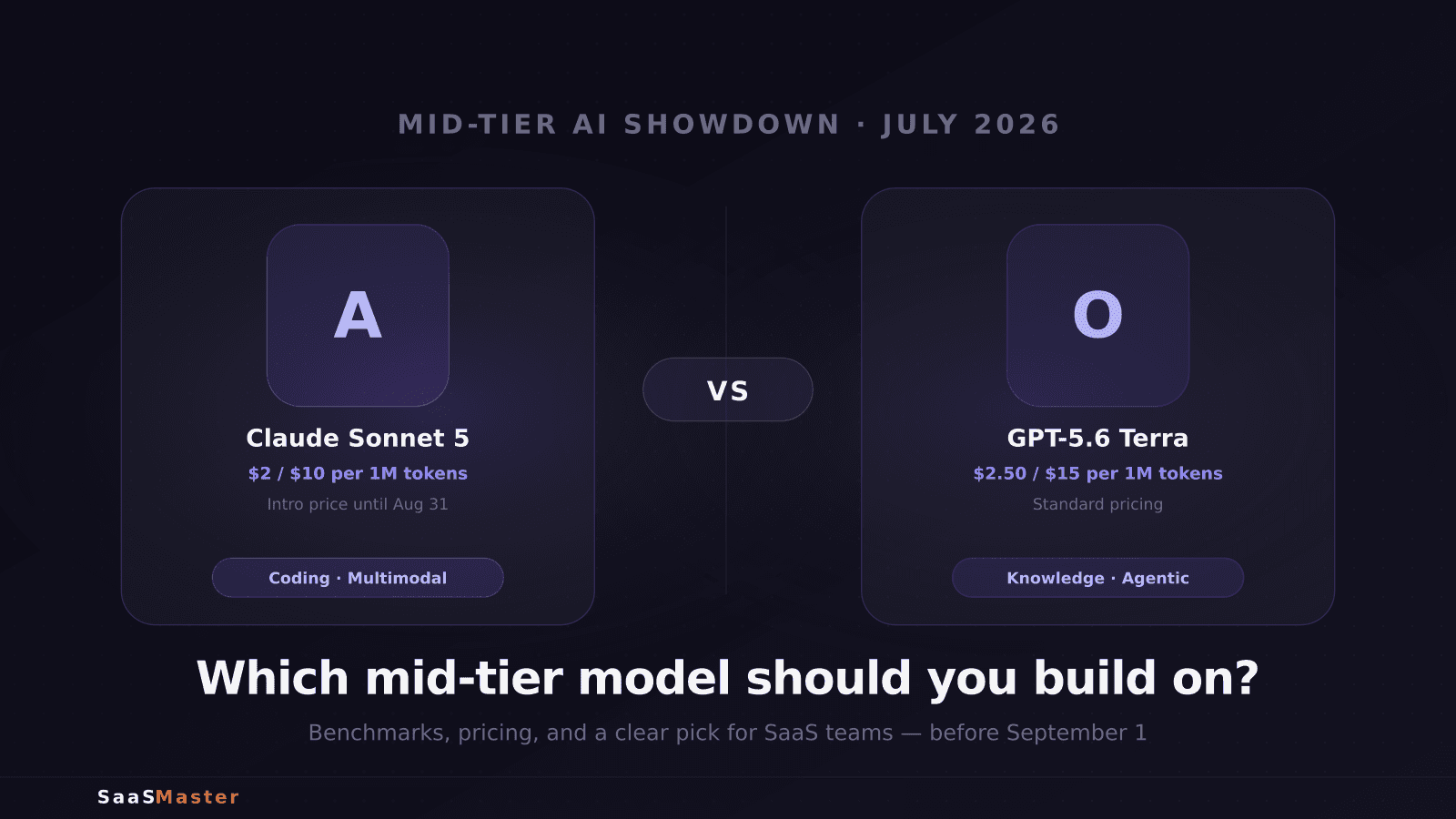
Claude Sonnet 5 vs GPT-5.6 Terra: The Mid-Tier AI Showdown With a Deadline
How to Get Your SaaS Tool Recommended by AI Engines
ChatGPT Go vs Plus in 2026: The $12 Gap That Changes Everything