AI & SaaS
Supabase Hits $10.5 Billion: What AI Agents Are Doing to Database Infrastructure
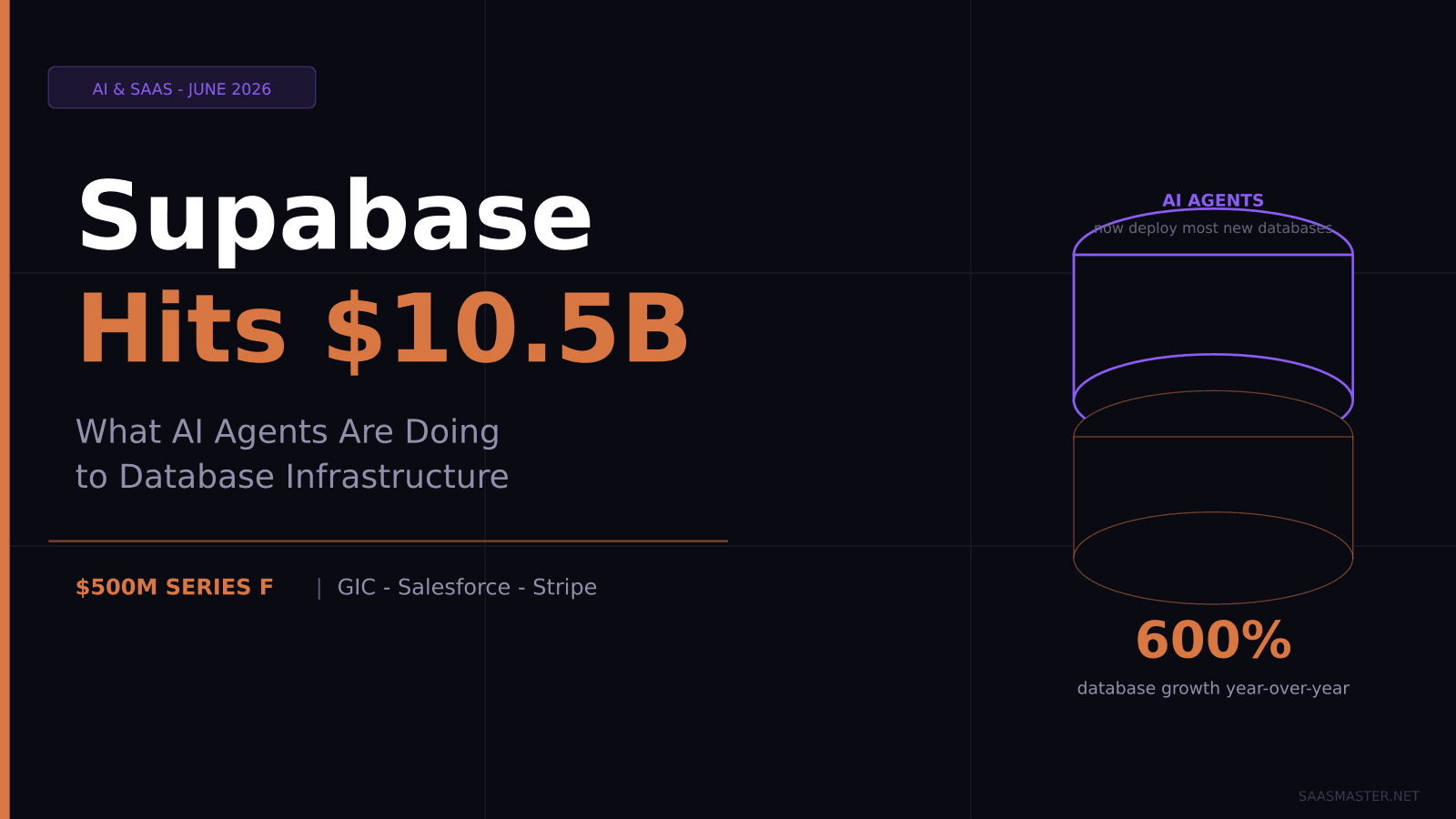
The most striking detail in Supabase's June 2026 Series F announcement is not the $500 million raised or the $10.5 billion valuation. It is this: AI agents — not human developers — now create the majority of new databases on the platform. Anthropic's Claude Code is the single largest contributor to new Supabase database deployments since the start of 2026. That one data point tells you more about where infrastructure spending is heading than any market analysis.
Key takeaways
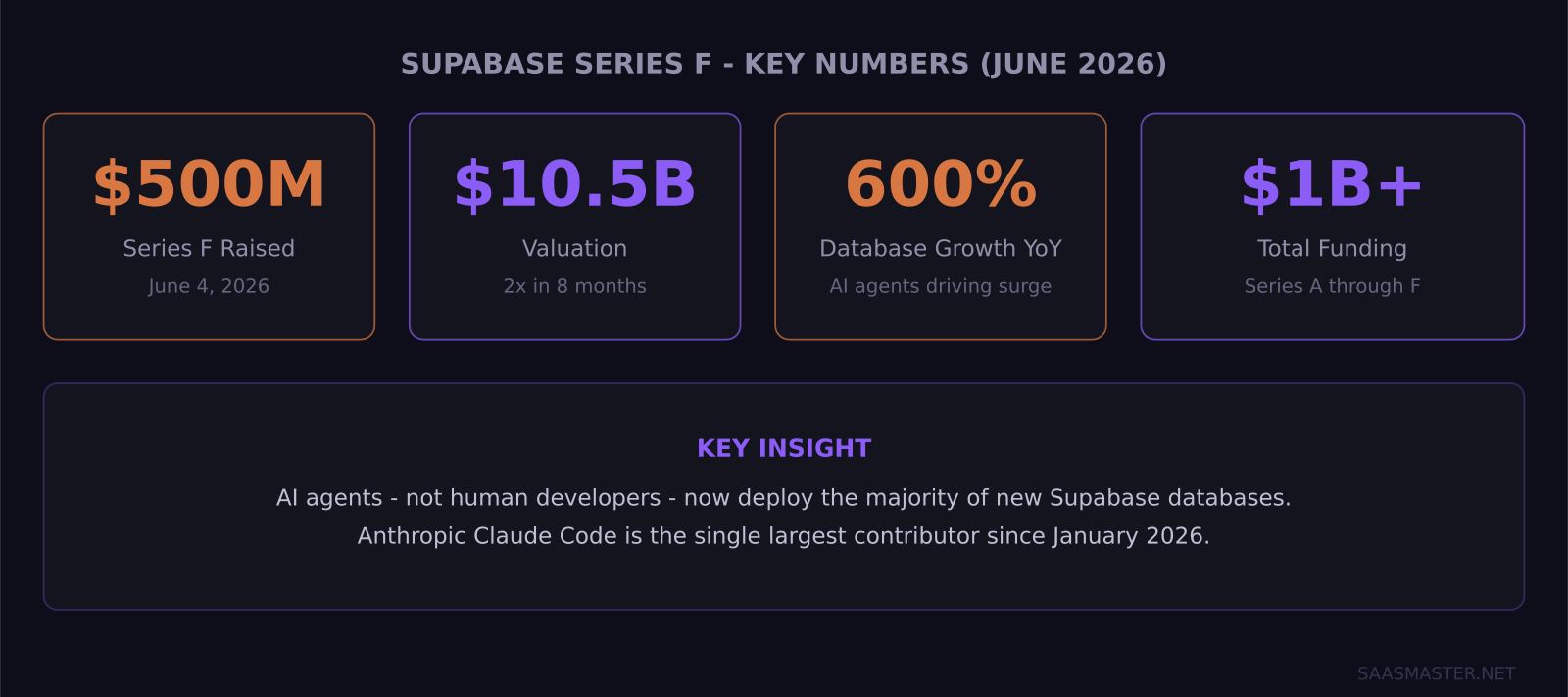
- Supabase raised $500M at a $10.5B valuation on June 4, 2026, doubling its valuation from $5B in just 8 months
- Databases grew 600% year-over-year; the user base more than doubled since the October 2025 Series E
- AI coding agents now deploy the majority of new Supabase databases, with Claude Code as the top contributor
- Multigres — an open-source horizontal scaling layer for Postgres — is the company's next major product push
- Total funding now exceeds $1 billion, with new investors Salesforce Ventures and Stripe joining the round
The funding round in context
Supabase closed a $500 million Series F led by Singapore's GIC on June 4, 2026. Existing investors Accel, Y Combinator, Craft Ventures, Felicis, Peak XV, and Coatue all participated again. Two new names stood out: Salesforce Ventures and Stripe, both of which have clear strategic interest in open-source developer infrastructure. Stripe participating for a second time signals conviction rather than a first-look bet.
This comes just 8 months after a Series E that valued the company at $5 billion. Valuations doubling in under a year tend to happen during genuine inflection points — the kind where the growth numbers are real and the underlying cause is structural, not promotional.
The round brings total funding past $1 billion and gives Supabase a long runway to execute on Multigres and its agentic infrastructure vision without needing to rush toward profitability.
Why this happened: AI agents and the vibe coding surge
A year ago, most database deployments on Supabase were created by developers working in an IDE or terminal. Today, the majority are created by AI agents — tools like Claude Code, Cursor, and Windsurf that autonomously scaffold full-stack applications including the backend database. CEO Paul Copplestone confirmed that Claude Code alone is now the single largest source of new database deployments on the platform.
This is not a soft trend backed by vague anecdotes. Supabase reported 600% year-over-year growth in databases created on the platform. The user base more than doubled between October 2025 and June 2026. When AI coding assistants became genuinely capable of writing production-quality backend code, they converged on Supabase because the platform's API-first design, Postgres foundation, and generous free tier made it the easiest target to hit autonomously.
The "vibe coding" concept — generating entire apps through conversational prompts to AI agents — moved from developer joke to mainstream workflow in 2026. Supabase is currently the default database layer for most vibe-coded projects. That is a network effect that is difficult to dislodge.
What Multigres means for builders
The most forward-looking piece of the Series F is Multigres. Supabase's current architecture is excellent for the vast majority of SaaS and startup use cases. Multigres addresses what comes next: apps that outgrow a single Postgres instance.
Multigres is an open-source horizontal scaling layer for Postgres. It introduces database sharding, high availability, zero-downtime migrations, and connection pooling while maintaining full compatibility with the Postgres ecosystem. Supabase has already released Multigres v0.1 alpha, which is public and self-hostable today.
Why does this matter for the average SaaS builder? Because horizontal scaling has historically been the moment you need to migrate away from Supabase — to PlanetScale, Neon, or a managed Aurora cluster. Multigres is designed to eliminate that migration moment. If it delivers on its promise, Supabase becomes a viable foundation all the way from day zero to production scale, not just the first chapter.
Who should care about this news
If you are already building on Supabase, the main takeaway is that the platform is becoming more serious, not less. The $500 million buys engineering bandwidth to close the gaps that currently push teams to alternatives as they scale. Expect major improvements to branching, migrations, and multi-region support over the next 12 months.
If you are evaluating Supabase as part of a new stack, the Salesforce Ventures and Stripe involvement signals long-term institutional commitment. That matters for an open-source infrastructure tool where you are betting on the maintainer's durability.
If you are using AI coding agents — Claude Code, Cursor, or similar — you are likely already contributing to Supabase's growth without realizing it. Most agents default to Supabase when spinning up a new project because it is the path of least resistance in their training and documentation exposure. Understanding why that default exists helps you make a more deliberate infrastructure choice.
What this signals for developer tools broadly
Supabase is not an outlier — it is the clearest example of a shift where AI agents, not individual developers, are becoming primary decision-makers for infrastructure adoption. Agents pick tools based on documentation quality, API consistency, and how well the tool is represented in their training data. Supabase scores well on all three, which is why Claude Code reaches for it first.
This creates a new dynamic: developer tools companies are increasingly optimizing for AI agent adoption alongside human developer experience. Supabase's MCP server support, Deno Edge Functions API, and push for fully declarative schema management all serve this goal. Companies that do not think about how AI agents interact with their product will lose ground to those that do.
The $10.5 billion valuation is not just a bet on Supabase's current user base. It is a bet that the developer writing code by hand is being partially replaced by an agent that reads documentation and calls APIs. Supabase built for that agent first — and the funding round is the market's confirmation that the bet is paying off.
Frequently asked questions
Does the Series F mean Supabase will change its free tier?
No changes to the free tier have been announced. The free tier currently supports 2 active projects, 500MB database storage, 5GB bandwidth, and 50MB file storage. Supabase has maintained its free tier through every previous funding round. The Series F is an investment in infrastructure buildout and Multigres development, not a signal of pricing restructuring.
What is Multigres and when is it production-ready?
Multigres is Supabase's open-source horizontal scaling layer for Postgres. It adds database sharding, high availability, and zero-downtime migrations while keeping full Postgres compatibility. The v0.1 alpha is public and self-hostable now. Stable production features are still in development; expect a clearer production timeline later in 2026.
How does Supabase compare to Neon and PlanetScale for scaling in 2026?
Supabase currently edges out Neon on overall ecosystem maturity and documentation, while PlanetScale remains strong for MySQL-based workloads. For AI agent workflows and standard SaaS backends, Supabase is what most agents default to — and with Multigres on the horizon, the gap in horizontal scaling capability that previously favored Neon and PlanetScale is closing fast.
Was this article helpful?
SaaS Master
Creator behind SaaS Master — tutorials, walkthroughs, reviews, and explainers that help SaaS, AI, and WordPress products get understood and chosen. Writing here about the tools, trends, and tactics that actually move the needle. Work with me →
Want your product explained this clearly — in video?
Tutorials, walkthroughs, reviews, and shorts for SaaS, AI, and WordPress products.
Work With SaaS Master