Together AI Just Raised $800M. Here's What It Means for SaaS Teams Choosing an AI Stack.
In short
Together AI's $800M Series C at $8.3B valuation signals open-source inference is now a production default. What it means for SaaS developers picking AI providers in 2026.
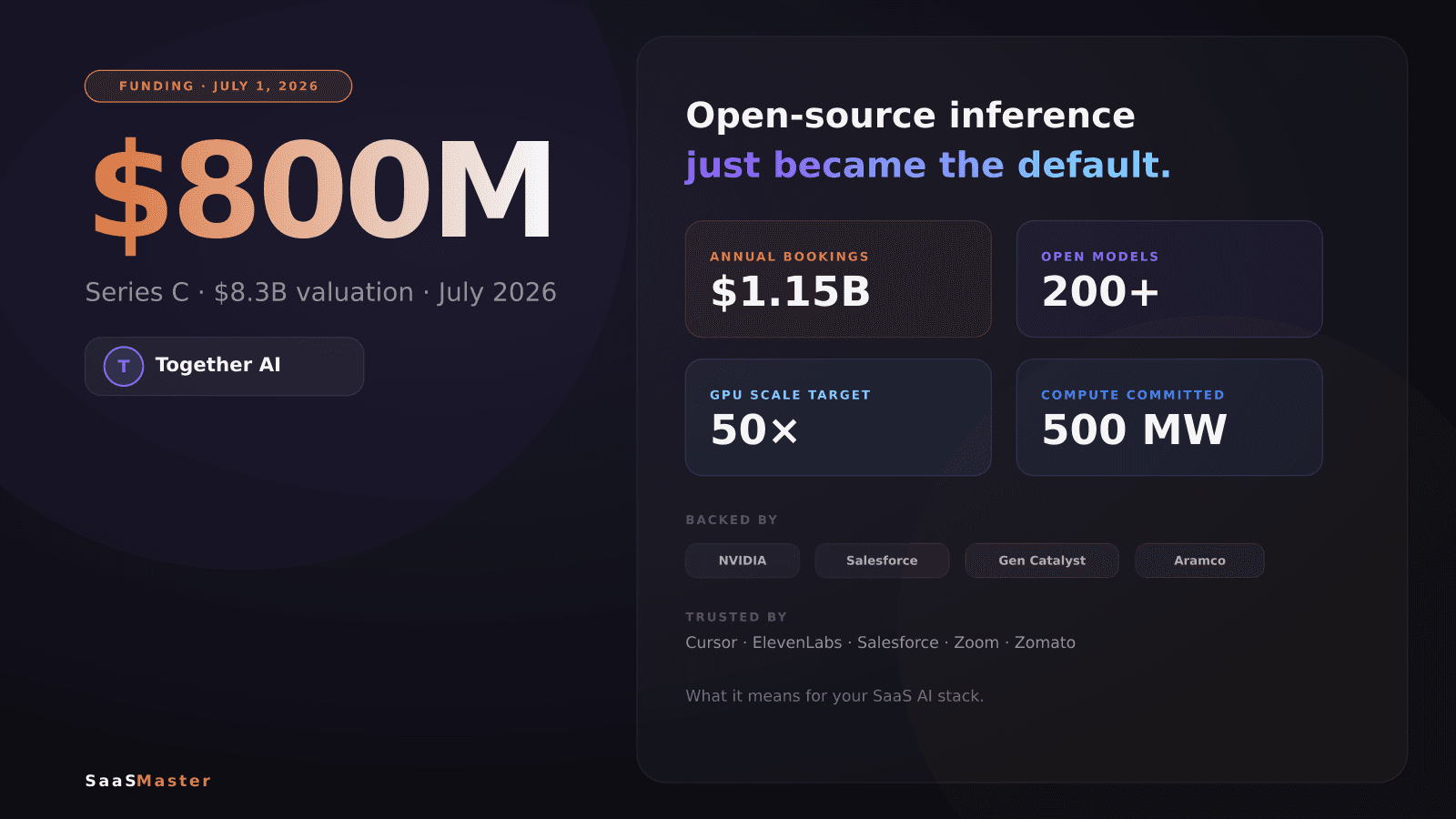
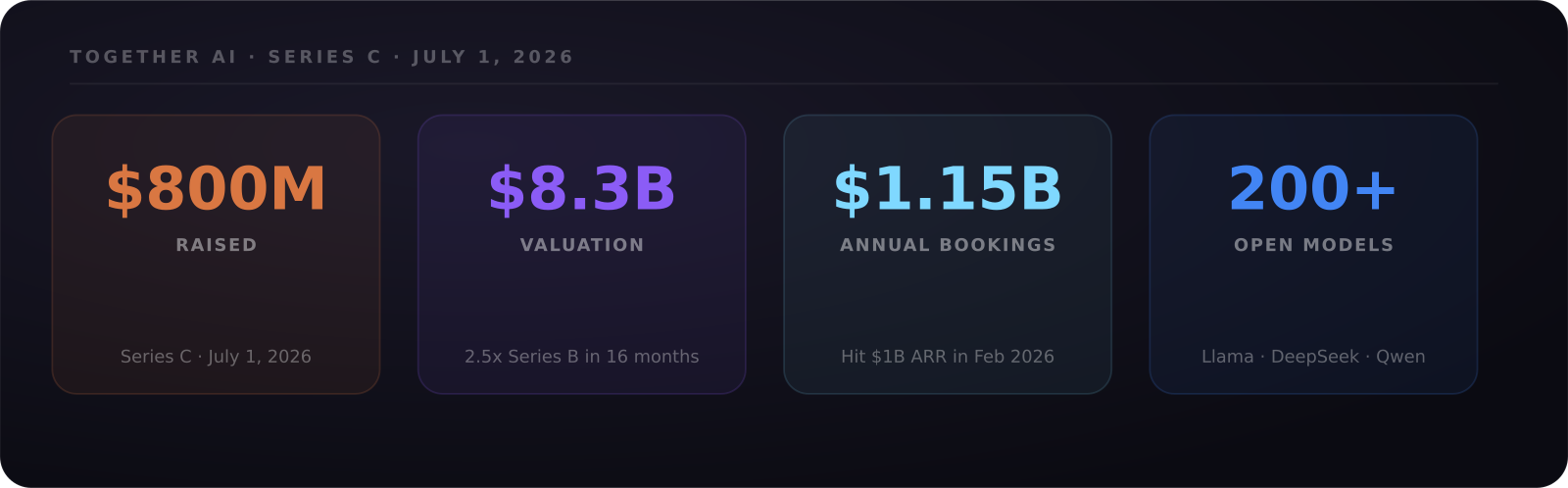
When an AI infrastructure company hits $1.15 billion in annual bookings and raises $800 million in a single round — valuing it at $8.3 billion — something fundamental has shifted. On July 1, 2026, Together AI closed one of the largest AI infrastructure raises of the year, backed by Aramco Ventures, NVIDIA, Salesforce Ventures, General Catalyst, and Vista Equity Partners. The story isn't just the headline number. It's what that number says about where SaaS teams are routing their production AI workloads.
Key takeaways
- Together AI raised $800M at an $8.3B valuation on July 1, 2026 — more than doubling its $3.3B Series B valuation from just 16 months earlier
- Annual bookings exceed $1.15B and the company hit $1B ARR in February 2026
- The platform hosts 200+ open-source models including Meta Llama 4, DeepSeek V3, Qwen 3, and Mixtral — often at up to 50% lower cost than equivalent closed API calls
- Plans to expand GPU infrastructure 50x over five years backed by commitments for 500 MW of compute capacity
- Customers include Cursor, ElevenLabs, Salesforce, Zoom, and Zomato — spanning both AI-native startups and established enterprise SaaS
What Together AI actually does
Together AI is an AI neocloud. They rent out access to GPU clusters, host open-source models, and provide the inference API layer that sits between your SaaS product and the underlying model weights. You call their API; they handle infrastructure, model serving, scaling, and optimization.
What makes Together AI different from using the OpenAI API is the model selection. They support over 200 open-source models — Meta's Llama 4 family, DeepSeek V3, Qwen 3, Mixtral, and more — running on optimized NVIDIA Blackwell infrastructure with FP4 quantization and speculative decoding baked in. Their headline claim for 2026: up to 2x faster inference than self-hosting these models, at up to 50% lower cost than comparable closed-model API calls.
The platform serves both individual developers and large-scale production deployments. You can process up to 30 billion tokens asynchronously in batch jobs, or call models synchronously with sub-second latency for real-time applications.
Why $800M matters for the industry
The scale of this round reflects momentum. Together AI's Series B, raised 16 months ago, was $305 million at a $3.3 billion valuation. This Series C represents a 2.5x valuation increase in just over a year, driven by demand the company says is growing faster than they can build infrastructure to serve.
The investor composition matters. NVIDIA joined as a strategic backer — and NVIDIA has clear financial incentive to support the infrastructure layer that accelerates GPU compute demand. Salesforce Ventures participated, and Salesforce is already a named customer. Owning equity in the inference platform that powers your own AI features is a reasonable hedge. When NVIDIA and Salesforce both put money into your inference provider, that's the enterprise software stack signaling that open-source inference is now a serious production category.
What changed in 2026 for open-source inference
Two years ago, most SaaS teams defaulted to OpenAI for any AI feature. The models were better, reliability was established, and the tooling worked. Open-source alternatives existed but required significant infrastructure work.
That calculus has shifted. Llama 4, DeepSeek V3, and Qwen 3 have closed much of the benchmark gap with GPT-5 and Claude Sonnet on standard tasks. And Together AI's position as a managed inference layer means developers can access those models without standing up their own GPU clusters or managing model weights and serving infrastructure.
For many SaaS applications — customer support automation, document processing, code generation, content workflows — open-source inference on Together AI is now a credible default rather than a niche cost-cutting play. See how far the open-source models have come in the DeepSeek V4 vs Kimi K2.6 vs Qwen3.6 Max comparison for context. Also worth reading alongside the MiniMax M3 integration guide for Claude Code if you're evaluating open-source models for developer tools.
Who's actually running on it
Together AI's customer list reads like a directory of the AI-native startup wave. Cursor — the AI code editor that grew explosively in 2025 — runs some inference through Together AI. ElevenLabs uses it for voice model workflows. Decagon, a customer support AI company, runs on it. Hedra and Cartesia, which build audio and voice tooling, are customers.
On the enterprise side: Salesforce, Zoom, and Zomato are named customers. This mix of AI-native startups and established SaaS companies is significant. Together AI isn't only serving the scrappy startup segment avoiding OpenAI costs. It's running in production at enterprise scale, which changes the reliability calculus significantly.
What 500 MW of committed compute means for your SaaS
The $800M Series C funds a dramatic expansion of compute capacity. Together AI has secured commitments for over 500 MW of compute — a substantial figure for any independent AI infrastructure company — with plans to expand their GPU footprint roughly 50x over the next five years.
For SaaS developers, this matters for reliability and capacity headroom. The risk with emerging AI infrastructure providers has always been availability: can they serve your traffic when your product scales? A company with 500 MW of committed capacity, NVIDIA as a strategic partner, and $8.3B in valuation is a meaningfully different reliability proposition than it was 12 months ago.
What this means if you're building a SaaS product
If you're using OpenAI, Anthropic, or Google as your only AI provider, Together AI is worth evaluating as a primary or secondary inference source for specific workloads.
The cost argument is real. Running Llama or DeepSeek on Together AI at up to 50% lower cost than equivalent GPT-5 calls can be meaningful at production volume. For SaaS products where AI features sit in the critical path of every user session, API costs can become the largest infrastructure line item.
The reliability argument is becoming credible in a way it wasn't 18 months ago. With $8.3B in valuation, NVIDIA equity backing, and 500 MW of committed compute, the infrastructure risk objection to open-source inference has less force.
The customization argument is compelling for the right teams: Together AI lets you fine-tune open-source models on their platform using your own data. For SaaS companies with domain-specific training data — legal, medical, financial, coding — a fine-tuned Llama or Qwen can outperform a general-purpose closed model on your specific task at a fraction of the cost per call. This is the kind of AI product differentiation that's hard to build on top of a closed API where you can't touch the weights.
The bigger picture
Together AI's raise is one data point in a structural shift. The AI infrastructure layer is bifurcating into closed-model APIs (OpenAI, Anthropic, Google) and managed open-source inference (Together AI, Fireworks AI, Groq). Both markets are growing, but the open-source side is growing faster — driven by cost pressure, data privacy requirements, and the narrowing benchmark gap between open and closed models.
For SaaS teams making AI stack decisions in 2026, the right question isn't closed or open-source. It's which use cases in your product are better served by each, and who's the best managed inference partner for the open-source workloads. Together AI's $800M round is a strong argument that the answer to that second question is increasingly them.
Browse more analysis in the AI tools and workflows library. If you're building a SaaS product with AI at the core and thinking about how to communicate that to customers through video, see how we help AI-first companies at SaaS video production.
Frequently asked questions
What does Together AI do?
Together AI is an AI inference cloud that provides API access to 200+ open-source AI models — including Meta Llama 4, DeepSeek V3, Qwen 3, and Mixtral — on optimized GPU infrastructure. Companies use it to run open-source models without managing their own infrastructure, typically at lower cost than equivalent closed-model API calls.
Is Together AI's $800M raise significant?
Yes — it's one of the largest AI infrastructure raises of 2026 and valued the company at $8.3B, up from $3.3B just 16 months earlier. The inclusion of NVIDIA and Salesforce Ventures as strategic backers is notable given both are existing customers building on the platform.
Should my SaaS use Together AI instead of OpenAI?
It depends on the use case. Together AI is worth evaluating if you're running high-volume inference where cost is a constraint, processing data that requires open-source models for privacy or compliance, or want to fine-tune models on proprietary training data. OpenAI remains the stronger choice for tasks requiring GPT-5's frontier reasoning or tight integration with the OpenAI tooling ecosystem.
Was this article helpful?
Jorge Aguilar
Founder & Creator, SaaS Master
Producing SaaS and AI product videos since 2019 — 800+ videos for 200+ brands, covering tutorials, demos, walkthroughs, and explainers. Writing here about the tools, trends, and tactics that actually move the needle. LinkedIn · About · Work with me
Building an AI product that needs a clearer onboarding flow?
Client-owned videos that make your product easy to understand — demos, walkthroughs, onboarding, and explainers.
Explore AI product video production