MiniMax M3 in Claude Code: The Free 428B Coding Model Developers Are Testing
In short
MiniMax M3 plugs into Claude Code via an Anthropic-compatible API. Here's the 2026 setup steps, benchmarks, and where it beats or trails Claude itself.
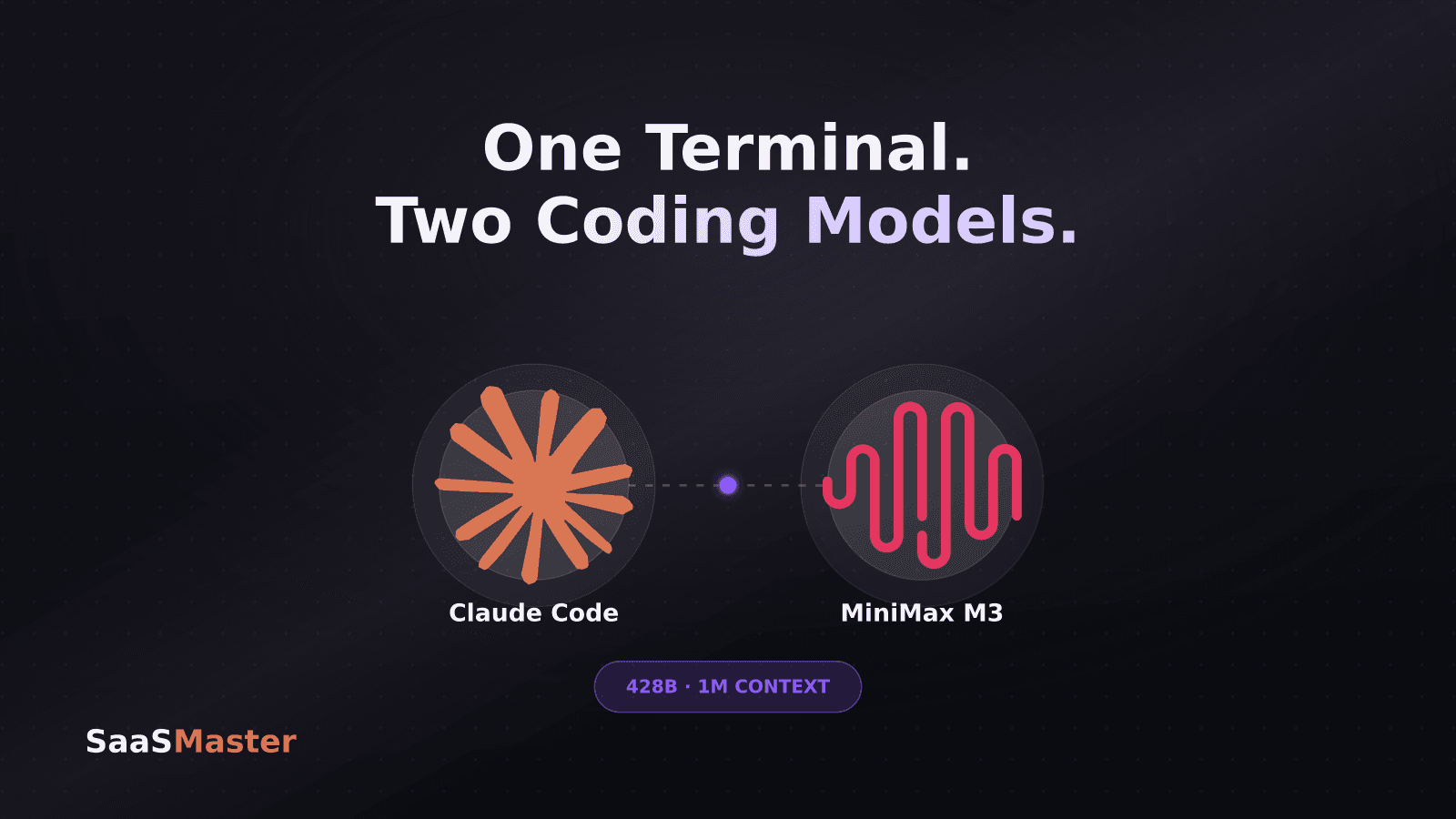
MiniMax M3 is a free, open-weight coding model that plugs directly into Claude Code through an Anthropic-compatible API shim, so you keep the exact same terminal workflow you already use with Claude while swapping the model underneath it. It launched June 1, 2026 from Shanghai-based MiniMax, scores 59.0% on SWE-Bench Pro (ahead of both GPT-5.5 and Gemini 3.1 Pro on that benchmark), and carries a 1-million-token context window. Here's what changes when you actually point Claude Code at it, and where it still falls short of the real thing.
Key takeaways
- MiniMax M3 is a 428-billion-parameter Mixture-of-Experts model (about 22B active per token) with up to a 1M-token context window and native image and video understanding.
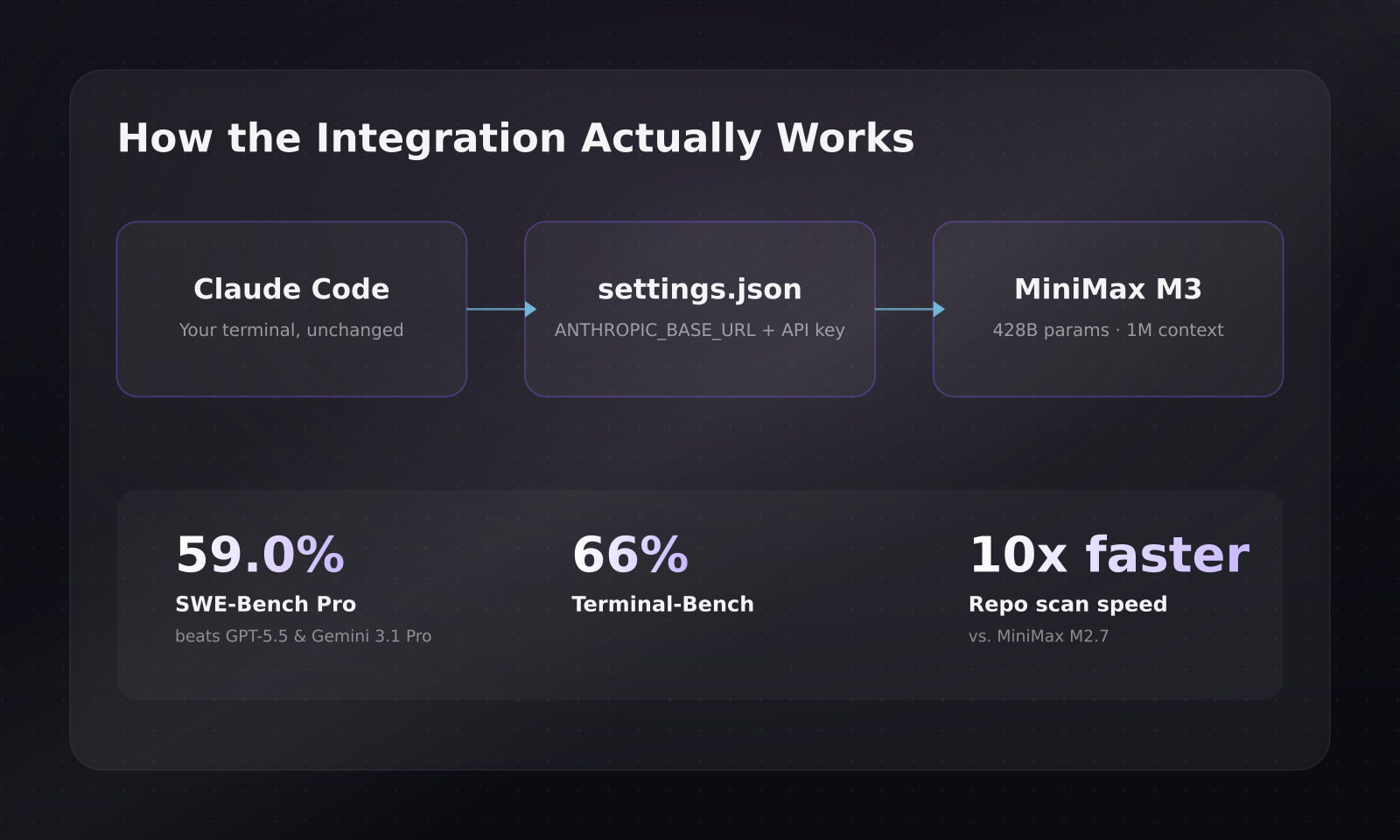
- It scores 59.0% on SWE-Bench Pro, 66% on Terminal-Bench, and 83.5 on BrowseComp — ahead of GPT-5.5 and Gemini 3.1 Pro on the SWE-Bench Pro number specifically.
- It connects to Claude Code by pointing ANTHROPIC_BASE_URL at MiniMax's API and swapping in a MiniMax key — no changes to how Claude Code itself behaves.
- Full-repository context handling is the standout: a repo scan that took 40 seconds on the older M2.7 model drops to about 4 seconds on M3.
- The model's weights are open, so teams with data-residency requirements can self-host it inside their own perimeter, something closed API-only models can't offer.
What is MiniMax M3, and why is it showing up inside Claude Code?
MiniMax M3 is the newest release in MiniMax's M-series of models, and it's the first open-weight model to combine frontier-level coding performance, a 1-million-token context window, and native multimodal understanding of images and video in a single architecture. It ranks 24th out of 70 models on BenchLM's provisional leaderboard with an overall score of 73, which puts it solidly mid-tier overall, but its coding-specific numbers are where it gets interesting: it's specifically tuned for long-context coding, full-repository analysis, and agentic tool-use loops, which is exactly the job Claude Code is built to hand off to a model.
[[video:GM32tNeSP3E]]
How do you actually connect MiniMax M3 to Claude Code?
The integration works because MiniMax exposes an Anthropic-compatible endpoint, so Claude Code doesn't know the difference between talking to Anthropic and talking to MiniMax. In practice: you edit (or create) `~/.claude/settings.json`, add an `env` block, set `ANTHROPIC_BASE_URL` to `https://api.minimax.io/anthropic` for international accounts, and drop in an API key from the MiniMax developer platform. Everything Claude Code does on top of that — thinking blocks, prompt caching, tool-use round trips, even slash commands like `/compact`, `/clear`, and `/agents` — behaves identically to how it works against Claude Opus 4.7, because it's routed through the same Anthropic SDK surface.
Where does MiniMax M3 actually outperform, and where does it fall short?
The clearest win is context handling at scale. A full-repository scan that took roughly 40 seconds on MiniMax's previous M2.7 model completes in about 4 seconds on M3, and time-to-first-tool-call in a multi-step agent loop drops from around 12 seconds to under 1 second. If your bottleneck is "the model keeps losing track of a large codebase" or "every agent step feels sluggish before it even starts working," that's a real, measurable improvement.
On raw coding benchmarks, M3 posts a 59.0% on SWE-Bench Pro, which is ahead of GPT-5.5 and Gemini 3.1 Pro on that specific test, plus 66% on Terminal-Bench and 83.5 on BrowseComp. Those are strong numbers for a model you can self-host for free. What they don't capture is day-to-day judgment on ambiguous requests, multi-file refactors that require holding a lot of implicit project intent in mind, or the kind of nuanced back-and-forth you get from Claude's own models — developers testing it directly describe it as a serious alternative worth trying, not an outright replacement, particularly for teams that need data to stay inside their own infrastructure. If you're deciding between agentic coding tools more broadly, our recent breakdown of GitHub Copilot vs. Claude Code vs. Cursor vs. Windsurf pricing covers how the closed-model options stack up on cost, which is the other half of this decision.
Should a SaaS team actually run MiniMax M3 instead of Claude?
The honest answer is: probably not instead of, but possibly alongside. MiniMax M3's biggest real advantage isn't raw quality, it's that the weights are open. If you're building in a regulated industry, or a client contract requires code and prompts to never leave your own infrastructure, M3 is a model you can run inside your own perimeter — something no closed API-only model, Claude included, can offer. For everyone else, the free cost and 1M context window make it a legitimate model to point at large, low-risk tasks (bulk refactors, repo-wide documentation passes, first-draft test generation) while keeping Claude's models on the judgment-heavy work: architecture decisions, ambiguous feature requests, anything where getting it wrong is expensive. That's also roughly how we'd frame Claude Sonnet 5 against Opus 4.8 in our recent comparison of Claude Sonnet 5 vs. Opus 4.8 — route by task risk, not by whichever model has the shinier benchmark chart that week.
If your team is evaluating which AI coding stack to standardize on this quarter, it's worth reading this alongside how AI browsing agents are shaking out too, since the two are converging on similar agentic patterns — see our look at Claude in Chrome vs. Perplexity Comet vs. ChatGPT Atlas. For teams that want a broader library of AI tool breakdowns like this one, our AI tools hub tracks new model releases as they land.
If your engineering team is experimenting with multiple coding models and needs to show stakeholders what actually changed, that's exactly the kind of internal-facing walkthrough we build through AI tool video production — a five-minute screen recording of the before-and-after often lands better with a non-technical exec than a benchmark table.
What does the setup actually look like in practice?
Walking through it the way it's shown in the video above: open (or create) `~/.claude/settings.json`, add an `env` block with `ANTHROPIC_BASE_URL` pointed at MiniMax's endpoint, paste in your API key from the MiniMax developer platform, and restart Claude Code. That's the entire migration. There's no separate MiniMax-specific CLI to learn, no new prompt syntax, and no re-authoring of existing `/agents` configurations — because Claude Code is talking to the same Anthropic SDK shape regardless of which model sits behind it, your existing project setup, custom commands, and agent definitions carry over untouched.
The practical test worth running before you commit to anything is a side-by-side on your own repository: point one Claude Code session at Claude's own model and a second at MiniMax M3, give both the same multi-file task, and compare not just whether the code runs, but whether it made the same architectural call you would have made. Benchmarks describe averages across thousands of tasks; they don't tell you how a model handles your specific codebase's quirks, and that's the only test that actually matters before a team standardizes on anything.
Frequently asked questions
Is MiniMax M3 actually free to use?
The model weights are open and available on Hugging Face, so self-hosting is free beyond your own compute costs. MiniMax also offers hosted API access with its own pricing for teams that don't want to manage the infrastructure themselves.
Do I need to change how I use Claude Code to switch models?
No. Because MiniMax exposes an Anthropic-compatible API, you only change two settings — the base URL and the API key — inside `~/.claude/settings.json`. Every Claude Code command, including thinking blocks and slash commands, keeps working the same way.
Is MiniMax M3 better than Claude for coding?
It beats GPT-5.5 and Gemini 3.1 Pro on the SWE-Bench Pro benchmark specifically, and it's dramatically faster on large-repo context handling than its own predecessor. But benchmark wins on one test don't capture nuanced judgment across ambiguous, multi-file work, which is where testers still lean on Claude. Most teams get more value running it alongside Claude for high-volume, lower-risk tasks than swapping it in entirely.
Was this article helpful?
Jorge Aguilar
Founder & Creator, SaaS Master
Producing SaaS and AI product videos since 2019 — 800+ videos for 200+ brands, covering tutorials, demos, walkthroughs, and explainers. Writing here about the tools, trends, and tactics that actually move the needle. LinkedIn · About · Work with me
Building an AI product that needs a clearer onboarding flow?
Client-owned videos that make your product easy to understand — demos, walkthroughs, onboarding, and explainers.
Explore AI product video production