AI Tools
How to Build SaaS AI Agents with Claude Sonnet 5 in 2026
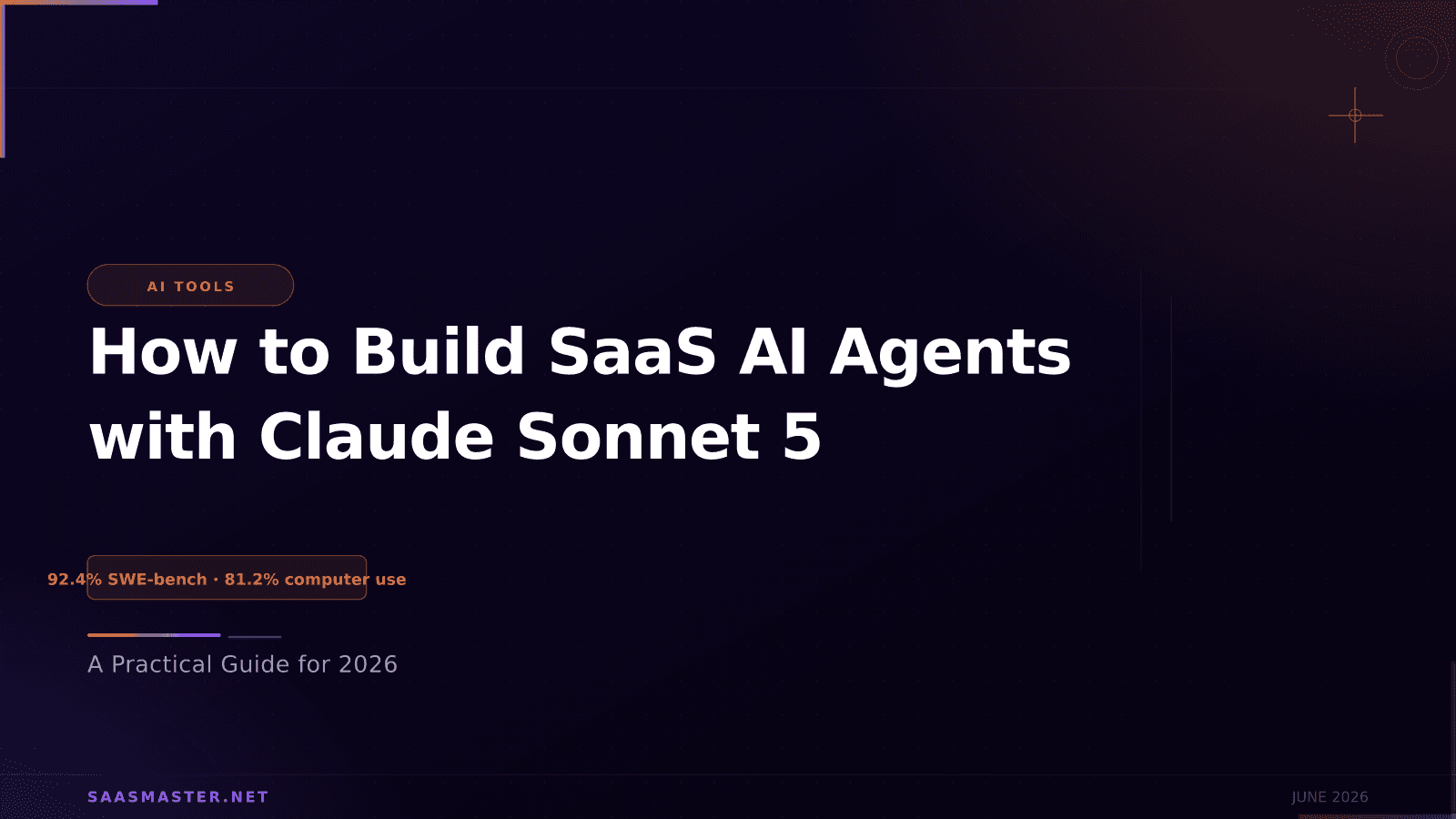
Claude Sonnet 5 launched today as the most capable mid-tier agent model available, with improvements specifically in reasoning, tool use, coding, and autonomous execution. Building agentic SaaS features with Sonnet 5 is meaningfully different from building them with previous Claude versions: the model completes more tasks without human correction, uses fewer tool calls per task, and handles longer execution chains more reliably. Here is a practical guide to building SaaS agents with Sonnet 5.
Key takeaways
- Sonnet 5's tool calling is more efficient than Sonnet 4.6, using fewer steps for the same intelligence and carrying end-to-end tasks through without stalling.
- The model scores 92.4% on SWE-bench Verified and 81.2% on OSWorld, making it the strongest agent backbone at mid-tier pricing.
- Intro pricing of $2 input and $10 output through August 31 makes agent prototyping cost-effective now.
- The best SaaS agent architectures route simple tasks to Haiku 4.5 and complex tasks to Sonnet 5, saving 60 to 80% on API costs.
- Sonnet 5 supports tool use, computer use, long context, and Claude Code's Dynamic Workflows for parallel subagent execution.
What makes Sonnet 5 better for agents
The specific improvements in Sonnet 5 relevant to agent builders are: fewer tool calls to complete equivalent tasks, better planning before execution, improved ability to recover from intermediate failures, and stronger code execution within agent loops.
Daniel Shepard from Zapier described a two-part automation, updating Salesforce account tiers and sending a launch announcement, that previously stalled halfway through with Sonnet 4.6. Sonnet 5 completed it end-to-end. That kind of reliability improvement is what separates a demo-quality agent from a production-ready one.
The tool use pattern for SaaS
A well-designed SaaS agent using Sonnet 5 typically follows this structure: receive a user intent in natural language, plan the sequence of tool calls needed, execute them in order, observe each result, handle errors, and return a structured completion.
The tools you expose to the agent should be narrow and explicit. Broad tools that accept any input lead to more failures than tools with well-defined schemas. Each tool should do one thing, accept typed parameters, and return structured output that the model can reliably parse on the next step.
Start with three to five tools. Agents with fewer tools have lower failure rates. Add tools as the agent demonstrates stable behavior with the existing set.
Routing with Haiku 4.5
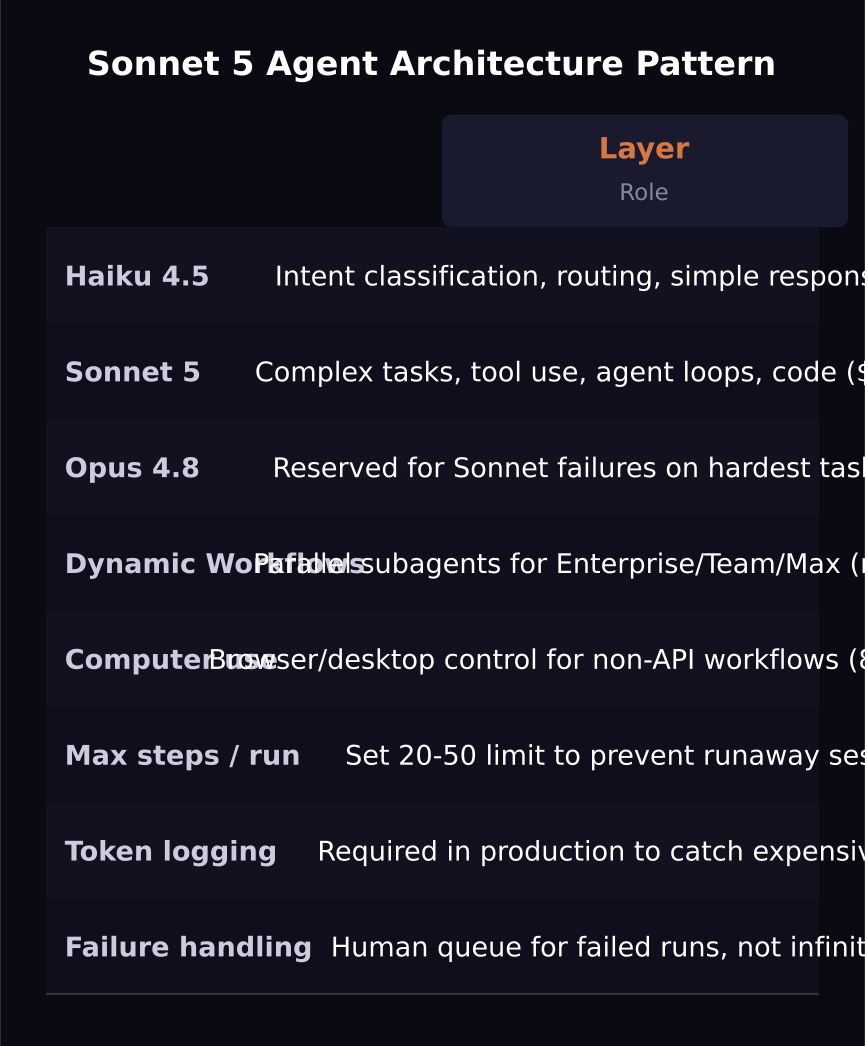
The most cost-effective SaaS agent architecture uses Haiku 4.5 for intent classification and task routing, Sonnet 5 for execution of complex tasks, and Opus 4.8 in reserve for tasks that Sonnet 5 fails twice.
A user sends a message to your SaaS product. Haiku 4.5 classifies it as simple (answerable directly), medium (requires tool lookup), or complex (requires multi-step execution). Simple and medium tasks stay with Haiku or move to Sonnet 5 for a single tool call. Complex tasks get a full Sonnet 5 agent loop. This routing layer alone can reduce your total API spend by 60 to 80% compared to running everything through Sonnet 5.
Parallel execution with Dynamic Workflows
For Enterprise, Team, and Max plan users, Claude Code's Dynamic Workflows feature allows Sonnet 5 to spawn parallel subagents for different parts of a complex task. Instead of executing steps sequentially, the model can plan the task, identify which steps are independent, and run them concurrently, reducing total wall-clock time for complex workflows.
Subagents consume tokens at standard Sonnet 5 rates with no Dynamic Workflows premium. The feature is in research preview but production-ready for well-tested use cases.
Monitoring and failure handling
Every agentic SaaS product needs four things in production: per-run token logging (so you can catch runaway agents before they cost $100 in a single session), a maximum step limit per run, structured output validation at each tool call boundary, and a human escalation path for failed runs.
Sonnet 5's reliability improvement means fewer escalations than Sonnet 4.6, but production agents still fail. The difference between a 5% failure rate and 20% is significant at scale but both require handling.
Frequently asked questions
How many tool calls can a Sonnet 5 agent make in one session?
There is no hard limit from Anthropic. Practical limits come from token budget (each tool call and response consumes tokens) and from your own maximum step configuration. A well-designed agent should complete most tasks in under 20 tool calls. Agents regularly exceeding 50 calls are a signal of poor tool design or unclear task scoping.
What is the best way to test a Sonnet 5 agent before production?
Build a test suite of 50 to 100 representative tasks with known correct outputs. Run the agent on all of them, log the pass rate, the average number of tool calls, and the failure modes. A pass rate above 85% on your specific tasks is a reasonable threshold for production deployment with a human fallback.
Can Sonnet 5 agents call external APIs?
Yes, through tool use. You define a tool with a schema that describes the API call, and the model calls it when needed. The tool execution happens in your code, not inside Anthropic's infrastructure, so you maintain full control over what external services the agent can reach.
Was this article helpful?
SaaS Master
Creator behind SaaS Master — tutorials, walkthroughs, reviews, and explainers that help SaaS, AI, and WordPress products get understood and chosen. Writing here about the tools, trends, and tactics that actually move the needle. Work with me →
Want your product explained this clearly — in video?
Tutorials, walkthroughs, reviews, and shorts for SaaS, AI, and WordPress products.
Work With SaaS Master