OpenAI Is Shutting Down the Sora API on September 24, 2026: A Migration Guide for SaaS Video Teams
In short
OpenAI shuts down the Sora API on September 24, 2026. Here is a migration guide for SaaS video teams: what breaks, the best alternatives, and pricing to plan.
OpenAI is retiring the Sora API on September 24, 2026, and there is no drop-in replacement to slot in behind it. If any part of your SaaS video pipeline calls the Videos API or a sora-2 model, that code stops working on that date. The upside: the three tools most teams are moving to are cheaper, faster, and in several ways better than Sora ever was. Here is exactly what is shutting down, why it happened, and how to migrate before the deadline.
Key takeaways
- OpenAI announced the Sora shutdown on March 24, 2026. The app and web experience already went dark on April 26, 2026, and the API follows on September 24, 2026.
- The shutdown hits the Videos API plus the sora-2, sora-2-pro, and their dated snapshot models. There is no official successor.
- Reported operating costs of about 1 million dollars a day against roughly 2.1 million dollars in total revenue made Sora unsustainable.
- Veo 3.1, Kling 3.0, and Runway Gen-4.5 cover almost every use case Sora did, starting around 7 to 12 dollars a month.
- Migrate on your own timeline, not OpenAI's. Audit, re-prompt, and re-budget before mid-August so you are not scrambling in the final week.
What exactly is shutting down, and when?
Two things are ending on different dates. The consumer side, the Sora app and web experience, was discontinued on April 26, 2026. The developer side, the part SaaS teams actually build on, sunsets on September 24, 2026.
That second date is the one to circle. OpenAI's deprecation notice, sent to developers on March 24, covers the Videos API and every Sora 2 alias and snapshot: sora-2, sora-2-pro, and dated versions like sora-2-2025-10-06 and sora-2-pro-2025-10-06. After September 24 those endpoints return errors, not video. If you have a scheduled job, a content pipeline, or a customer-facing feature that generates clips through Sora, it breaks with no fallback unless you build one.
Worth saying plainly: OpenAI has not named a replacement model inside its own API. This is not a migrate-to-Sora-3 situation. You are moving to a different vendor.
Why did OpenAI kill Sora?
OpenAI did not give an official reason beyond the deprecation itself, but the reporting around it tells a clear story. According to multiple accounts, Sora cost roughly 1 million dollars a day to run while generating only about 2.1 million dollars in total revenue across its short life. The usage curve backs that up: downloads peaked above 3.3 million in November 2025 and fell to around 1.1 million by February 2026, while active users slid from close to 1 million to under 500,000.
Layer on a Disney licensing deal that was winding down and a broader industry squeeze on compute, and the math stopped working. Sora launched with Sora 2 in September 2025, went viral, and then could not hold attention. It is a reminder that a strong launch and a durable product are not the same thing.
My take as someone who makes software videos every week: the app dying was predictable. Novelty AI video apps burn hot and cool fast. The API sunset is the part that actually stings, because teams quietly wired Sora into real workflows on the assumption it would stick around.
Which Sora alternative should SaaS teams pick?
There is no single best replacement. There is a best fit for your dominant use case. Here is how the three leading options break down for SaaS work.
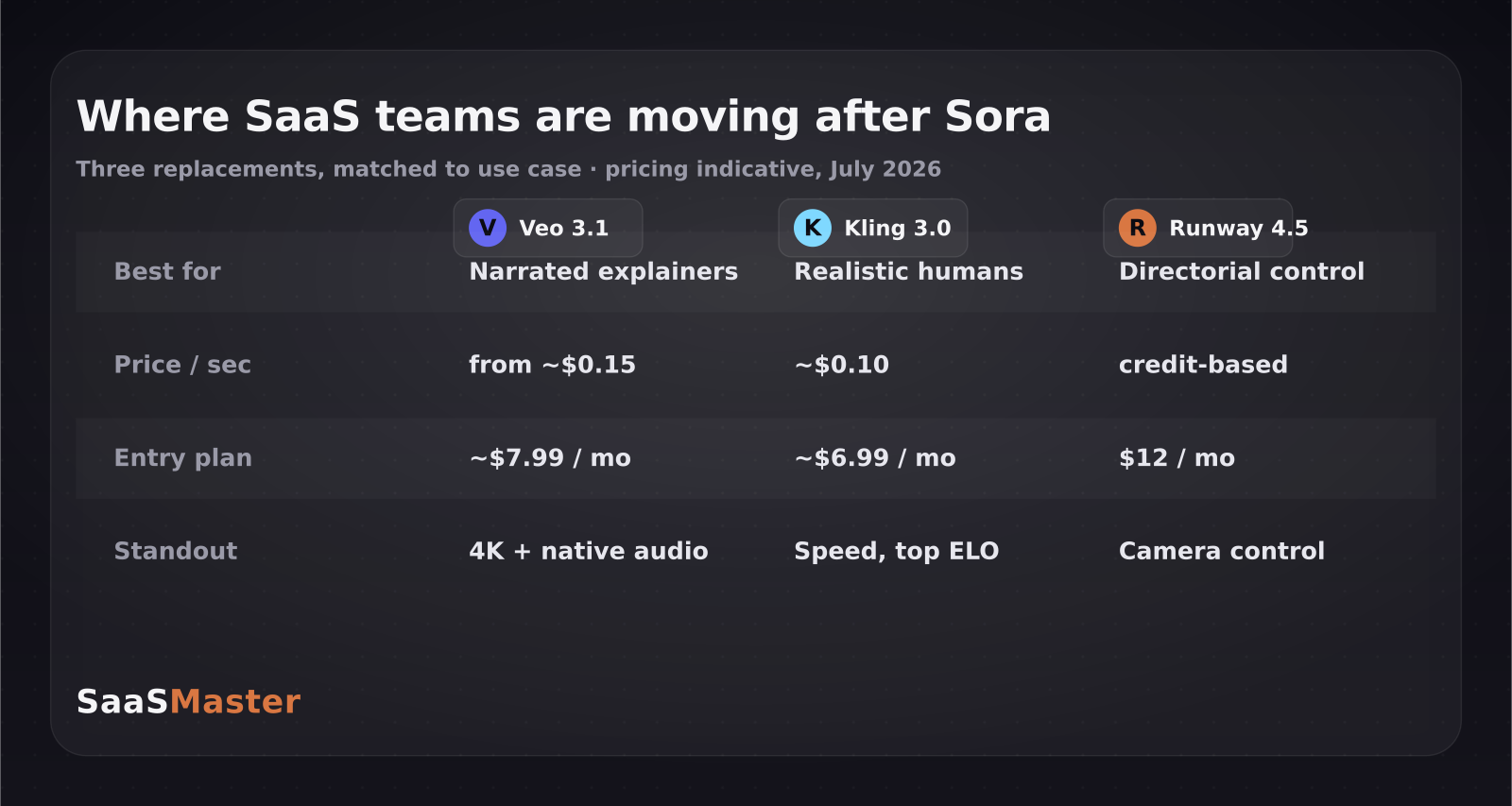
Google Veo 3.1 is the pick for narrated explainers and product marketing. It is currently the only major model generating native 4K with 48kHz dialogue and matching lip movement, not just background sound. In a May 2026 benchmark it followed detailed prompts correctly 87 percent of the time, well ahead of the field. A 30-second narrated explainer with sound effects renders in about 4 minutes; stitching the same thing together from a silent generator plus a separate voice tool plus an editor takes 25 to 40 minutes. It is bundled into Google AI Pro at around 7.99 dollars a month, and API fast mode starts near 0.15 dollars a second.
Kling 3.0 is the value and realism pick. Released February 5, 2026, it holds the top overall ELO score and is known for lifelike human motion and fast renders. At roughly 0.10 dollars a second and plans from about 6.99 dollars a month, it is the cheapest of the three. If your videos put people front and center, Kling is hard to beat on price.
Runway Gen-4.5 is the control pick. If you need the same character to stay consistent across multiple shots, or you want to paint a precise motion path with a motion brush, Runway gives you the most directorial control. Plans run from 12 dollars a month up to 95 dollars for unlimited. Its raw prompt adherence sits lower than Veo's, but you are trading some automation for precision.
For context, Sora 2 charged about 0.75 dollars a second, meaningfully more than any of these. Cost was never the reason to stay. I go deeper on each option in my Veo vs Kling vs Runway comparison and a Sora vs Veo vs Runway breakdown.
How do you actually migrate before September 24?
Treat this like any dependency you are retiring, not a creative project. Five steps:
- Audit every place Sora touches your product. Search your codebase for the Videos API and any sora-2 string. Note scheduled jobs, customer-facing features, and internal content tools separately.
- Match each use case to a tool. Narration-heavy explainers go to Veo 3.1. People-focused or budget clips go to Kling 3.0. Multi-shot consistency and camera control go to Runway. You may end up using two.
- Rebuild your prompts. Prompt behavior differs by model, so do not copy and paste your Sora prompts and expect the same output. Budget a day to re-test your top ten recurring prompts against the new model.
- Re-budget on the new pricing. All three price per second or per credit differently than Sora. Model your monthly volume so finance is not surprised.
- Set an internal deadline of mid-August. Give yourself a two-week buffer before the September 24 cutoff for the inevitable edge cases.
If Sora sits behind a customer-facing feature, add a feature flag now so you can swap providers without a redeploy. That is the scalable way to handle a vendor that just proved vendors disappear.
A creator's honest take on the switch
If I could only move one workflow today, I would move narrated product explainers to Veo 3.1 first, because that is where Sora's absence hurts most and where Veo's synced-audio advantage is largest. I would keep Kling 3.0 in the toolkit for volume and for anything with real people, and reach for Runway only when a project genuinely needs shot-to-shot character consistency.
The bigger lesson is architectural. Sora's shutdown is a clean case for not hard-coding a single AI vendor into your product. Abstract the video generation call behind your own interface, and the next deprecation notice becomes a config change instead of a fire drill. It also pays to keep the fundamentals in place, because AI clips still need structure to convert, which is the whole point of a product demo video that converts and the rest of my product video guides. If you want help turning any of these tools into a repeatable workflow, that is exactly the kind of thing I build SaaS explainer videos around.
Frequently asked questions
Is the Sora API still working right now?
Yes. As of July 2026 the Sora 2 models and Videos API still respond, but they are officially deprecated and stop working on September 24, 2026. Any new build should target a different provider from day one.
What is the best free way to replace Sora?
The closest to free is Google Veo 3.1 through the Google AI Pro plan at about 7.99 dollars a month, or Kling 3.0's entry plan near 6.99 dollars a month. There is no genuinely free tier that matches Sora 2's quality, but both are far cheaper than Sora's per-second API cost.
Will OpenAI bring Sora back?
There is no announced plan to. OpenAI framed the shutdown as a discontinuation, not a pause, and has not named a successor video model in its API. Plan as if Sora is gone for good rather than betting on a return.
Was this article helpful?
Jorge Aguilar
Founder & Creator, SaaS Master
Producing SaaS and AI product videos since 2019 — 800+ videos for 200+ brands, covering tutorials, demos, walkthroughs, and explainers. Writing here about the tools, trends, and tactics that actually move the needle. LinkedIn · About · Work with me
Need a product demo, walkthrough, or SaaS explainer?
Client-owned videos that make your product easy to understand — demos, walkthroughs, onboarding, and explainers.
Explore SaaS video productionRelated guides
More Product Demos & Video Marketing →
How to Repurpose One SaaS Video Into a Month of Short-Form Clips
What a B2B SaaS Product Demo Should Show
How to Script a Software Walkthrough Video: A Step-by-Step Framework