Apple vs OpenAI: What the Trade Secret Lawsuit Means for SaaS Teams Building on GPT
In short
Apple sued OpenAI on July 10, 2026 over alleged trade secret theft. Here's what it means, and doesn't mean, for SaaS teams using the OpenAI API.
Apple sued OpenAI on July 10, 2026 in federal court in Northern California, alleging trade secret theft tied to OpenAI's upcoming consumer hardware. The lawsuit doesn't touch GPT's API terms or change how the model works today, but it's a signal every SaaS team building on OpenAI should read: the vendor relationships you're depending on can turn adversarial fast, even between former partners.
Key takeaways
- Apple's complaint accuses OpenAI, including Chief Hardware Officer Tang Tan (a 24-year Apple veteran), of directing recruits to bring "actual parts" from Apple to interviews and coaching departing employees to evade security processes.
- A named former Apple engineer, Chang Liu, is accused of keeping a work laptop after leaving Apple and using a bug to access Apple's cloud storage while employed at OpenAI, then downloading confidential files.
- Apple is seeking a court order barring OpenAI from using the alleged trade secrets, the return of confidential materials, and evidence preservation, not monetary damages as the primary ask.
- OpenAI has publicly denied interest in "other companies' trade secrets" but hasn't detailed a substantive rebuttal to the specific allegations yet.
- The dispute is about hardware IP, not the ChatGPT API or OpenAI's SaaS-facing products, so there's no direct legal exposure for companies building on GPT today.
What is Apple actually accusing OpenAI of?
Apple's complaint alleges that "at every level, from members of its Technical Staff to its Chief Hardware Officer, and in coordination with business partners, OpenAI has been stealing Apple's trade secrets and confidential information." The filing centers on OpenAI's push into consumer AI hardware, a category Apple has closely guarded IP around for the iPhone and Apple Watch.
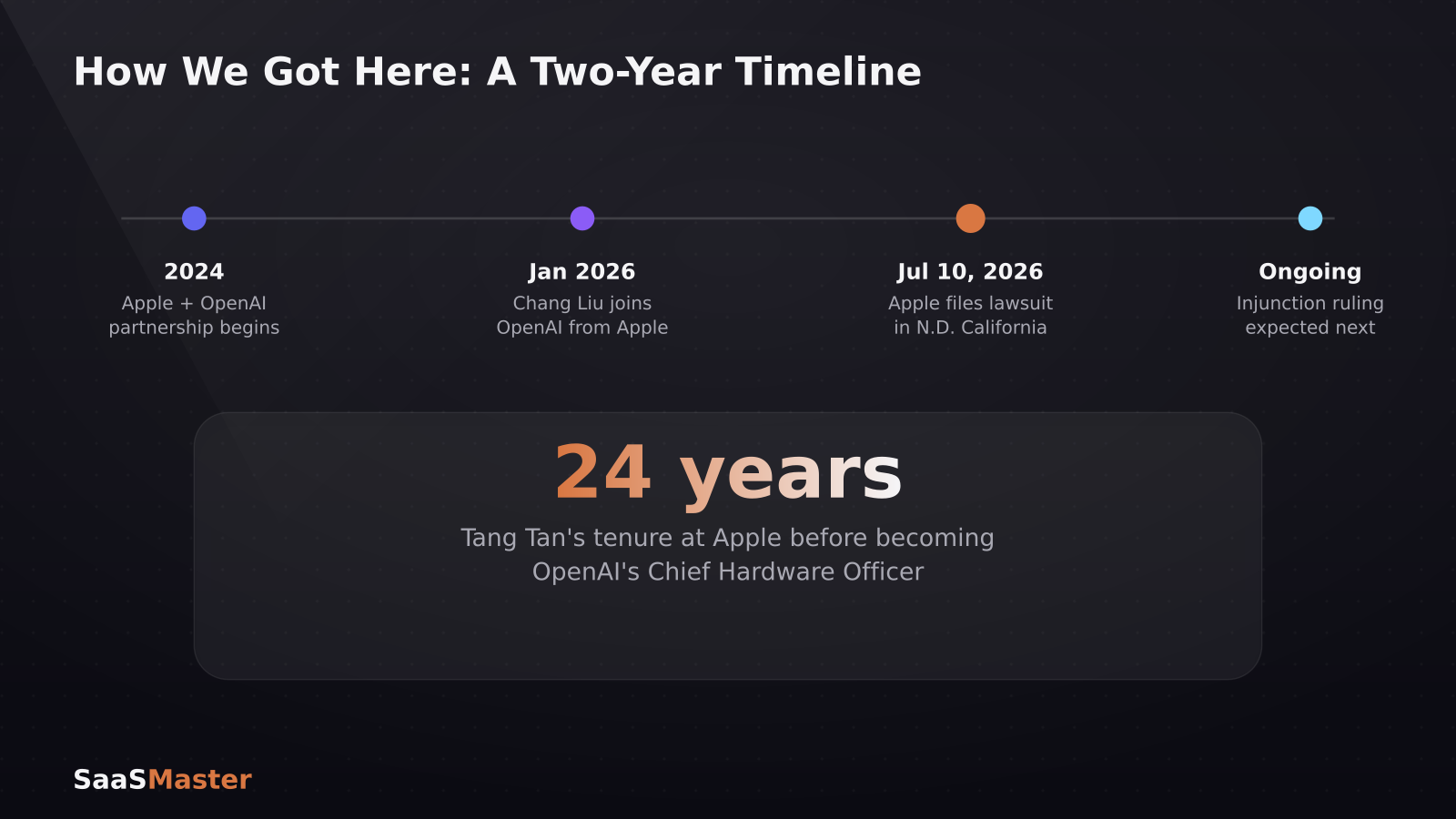
Two individuals feature prominently. Tang Tan spent 24 years at Apple, most recently as VP of product design for iPhone and Apple Watch, before becoming OpenAI's Chief Hardware Officer. Apple alleges he directed job candidates still working at Apple to bring "actual parts" to interviews for "show and tell" sessions designed to extract confidential design information. Chang Liu, a former eight-year Apple senior system electrical engineer who joined OpenAI in January 2026, is separately accused of retaining a work-issued Apple laptop, discovering a bug that let him access Apple's cloud file storage after leaving, and downloading dozens of files labeled confidential while working on hardware for OpenAI.
TechCrunch, CNBC, Bloomberg, and Fortune have all covered the filing in detail as of this week, and the specific allegations (stolen laptops, recruiting-as-espionage, coached security evasion) read more like a corporate espionage case than a typical IP dispute, which is part of why it's gotten unusually wide coverage for a trade secrets filing.
Does this affect companies building products on GPT or the OpenAI API?
Not directly, and that distinction matters. This lawsuit is about OpenAI's hardware division allegedly poaching Apple's device design secrets, not about the ChatGPT API, GPT-5.6 model access, or OpenAI's terms of service for developers. If your SaaS product calls the OpenAI API today, nothing in this filing changes your contract, your rate limits, or your data handling terms.
What it should change is how you think about platform risk. OpenAI is currently defending litigation from a former close partner (Apple and OpenAI had a high-profile 2024 partnership before this reversal) over allegations of systematically extracting confidential information through hiring practices. That's a data point about organizational behavior and legal exposure, not just model quality, and it belongs in the same risk conversation as pricing changes, API deprecations, and rate limit shifts when you're choosing which AI vendor to build critical product features on.
How should SaaS teams think about AI vendor risk after this?
Three practical steps, none of which require panic or migration:
- Read your AI vendor's terms of service for what happens to your product if the vendor faces a business disruption (litigation, leadership departure, acquisition). Most SaaS teams have never actually done this.
- Avoid hard-coding a single model provider into your architecture where you can help it. An abstraction layer that lets you swap Claude, GPT, or Gemini with a config change costs a little more engineering time upfront and buys real flexibility later.
- Separate "is this the best model" from "is this a stable company to build on." Both questions matter, but they're answered with different evidence, benchmarks for the first, litigation, leadership turnover, and financial disclosures for the second.
Our AI deployment playbook for small SaaS teams covers how to structure a rollout that doesn't leave you dependent on a single vendor's stability. If you'd rather reduce vendor dependency altogether, our guide to self-hosted AI stacks walks through what that tradeoff actually looks like in practice.
What happens next in the case?
Apple's primary ask is injunctive: a court order barring OpenAI from using or disclosing the alleged trade secrets, a requirement to return confidential materials, and an order preserving evidence for the litigation. That's a faster, narrower ask than a damages trial, and California trade secret cases with strong documentary evidence (which this appears to have, given the specificity of the laptop and file-access allegations) can move relatively quickly on preliminary injunction requests. Watch for an early ruling on whether Apple gets a temporary restraining order or preliminary injunction, that will be the first real signal of how strong the court thinks the evidence is.
How did the Apple-OpenAI relationship get here?
Apple and OpenAI entered a high-profile partnership in 2024, integrating ChatGPT into Siri and Apple's operating systems as part of Apple Intelligence. That partnership made this lawsuit an unusually sharp reversal, the companies went from public collaborators to Apple accusing OpenAI's leadership of running a systematic scheme to extract its confidential hardware designs in roughly two years.
The alleged recruiting pattern described in Apple's filing, hiring away senior Apple hardware talent and using those hires to pull design details, isn't new to Silicon Valley IP disputes in general, but the specificity of the claims (a named laptop, a named security bug, "show and tell" interview sessions) is unusually detailed for a complaint's opening filing. That level of detail typically signals the plaintiff already has strong internal evidence, likely from its own security and HR investigations, before filing.
Are other AI vendors facing similar scrutiny?
This isn't happening in isolation. Regulators have been tightening oversight of major AI vendors more broadly this year. The European Central Bank gave every significant European bank until October 31, 2026 to demonstrate resilience against AI-related disruption, and UK regulators placed AWS, Google Cloud, Microsoft, and Oracle under the kind of supervision usually reserved for institutions considered too systemically important to fail. Separately, cybersecurity agencies from the US, Australia, Canada, New Zealand, and the UK jointly published guidance this month on "careful adoption of agentic AI services," flagging five categories of risk: privilege, design and configuration, behavior, structural, and accountability.
None of that is directly tied to the Apple lawsuit, but together they paint a consistent picture for 2026: the regulatory and legal environment around major AI vendors is tightening across multiple fronts at once. That's one more reason vendor flexibility, not just picking the best-performing model, deserves a place in your planning.
The bottom line
Nothing here requires you to rip out your OpenAI integration today. But if part of your product's value proposition rests on "we use the best AI model available," it's worth having an honest conversation with your team about how quickly you could pivot if a vendor relationship became legally or operationally messy. The teams best positioned aren't the ones betting on a single model forever, they're the ones who built flexibility in from the start.
If explaining how your product handles AI vendor choices, or how you evaluate and swap models, is a story your customers would find reassuring, that's exactly the kind of trust-building content a short explainer video does better than a blog post. See how we approach that in our AI tool video production work, and for more on choosing tools without getting locked into one vendor's roadmap, read our AI tool selection framework.
Frequently asked questions
Does the Apple vs OpenAI lawsuit affect the ChatGPT API or GPT-5.6 pricing?
No. The lawsuit concerns alleged trade secret theft related to OpenAI's consumer hardware division, not its API products. There's no indication of any planned changes to API pricing, access, or terms tied to this litigation.
What is Apple asking the court to do?
Apple is primarily seeking injunctive relief: an order barring OpenAI from using or disclosing Apple's alleged trade secrets, a requirement to return confidential materials, and preservation of evidence relevant to the case, rather than leading with a damages claim.
Who are the main individuals named in the lawsuit?
Tang Tan, OpenAI's Chief Hardware Officer and a 24-year Apple veteran, and Chang Liu, a former Apple senior system electrical engineer who joined OpenAI in January 2026 and is accused of retaining a work laptop and accessing Apple's cloud storage after leaving.
Was this article helpful?
Jorge Aguilar
Founder & Creator, SaaS Master
Producing SaaS and AI product videos since 2019 — 800+ videos for 200+ brands, covering tutorials, demos, walkthroughs, and explainers. Writing here about the tools, trends, and tactics that actually move the needle. LinkedIn · About · Work with me
Building an AI product that needs a clearer onboarding flow?
Client-owned videos that make your product easy to understand — demos, walkthroughs, onboarding, and explainers.
Explore AI product video productionRelated guides
More AI Tools & AI Workflows →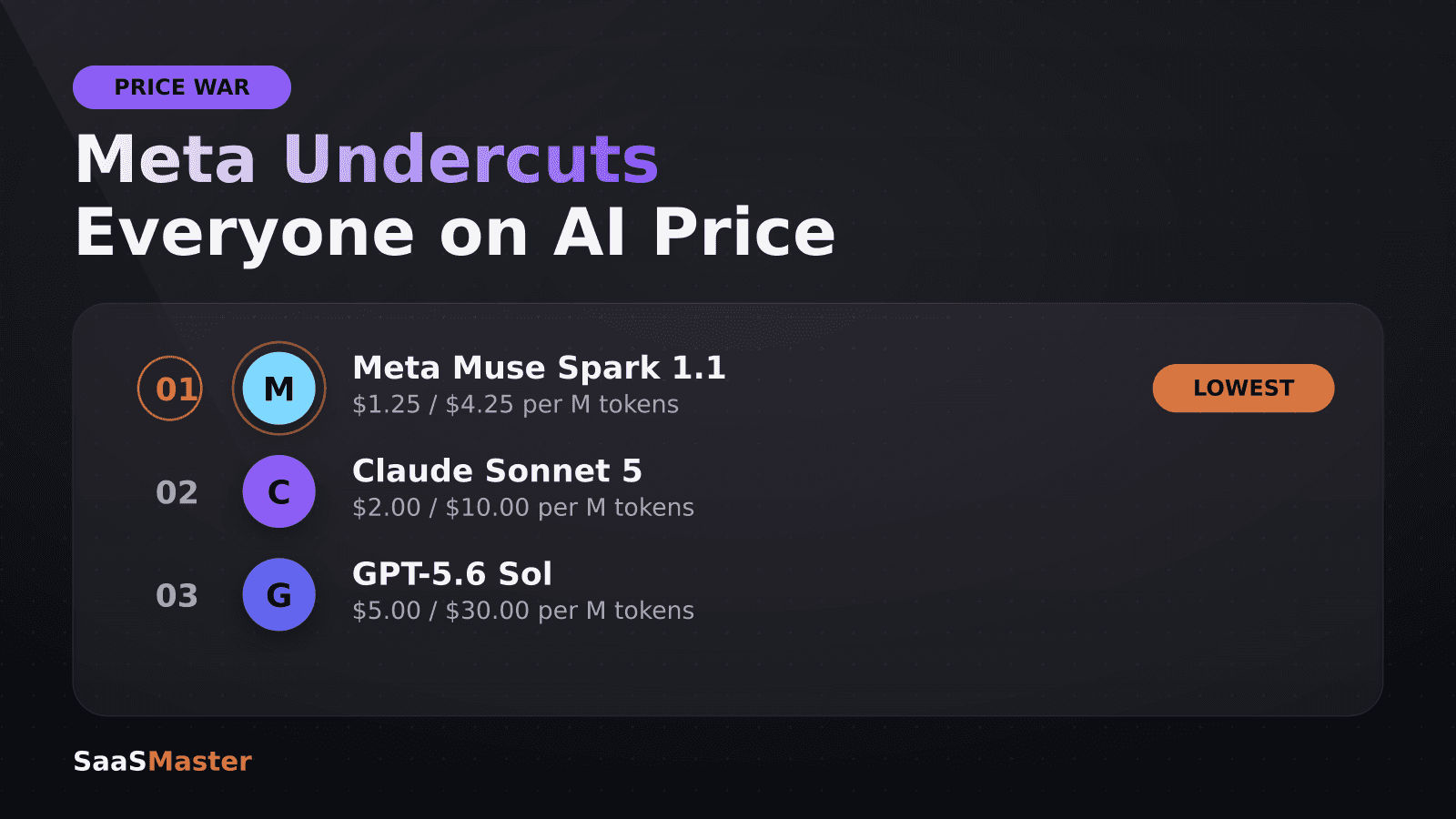
Meta Muse Spark 1.1 vs Claude Sonnet 5 vs GPT-5.6: Meta's $1.25 Model Undercuts Everyone on Price
You Don't Need Amazon's $1 Billion AI Team: A Practical AI Deployment Playbook for Small SaaS Companies
Claude Sonnet 5 vs GPT-5.6 Terra: The Mid-Tier AI Showdown With a Deadline