Meta Muse Spark 1.1 vs Claude Sonnet 5 vs GPT-5.6: Meta's $1.25 Model Undercuts Everyone on Price
In short
Meta's Muse Spark 1.1 prices agentic coding at $1.25/$4.25 per million tokens. Compare it to Claude Sonnet 5 and GPT-5.6 on cost, context, and benchmarks.
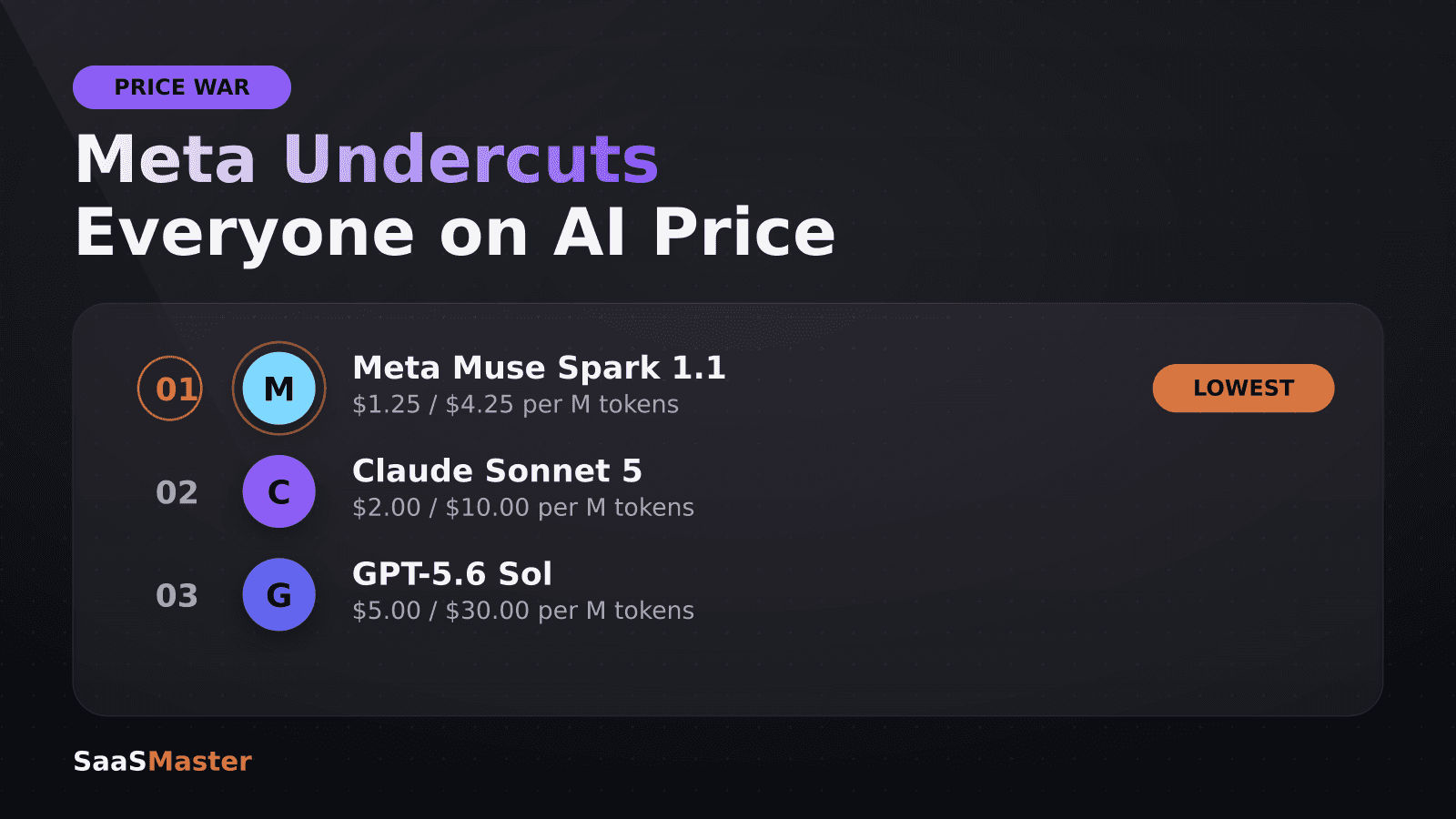
Meta dropped Muse Spark 1.1 on July 9, 2026, and undercut every major lab on price: $1.25 per million input tokens and $4.25 per million output, against $2/$10 for Claude Sonnet 5 and $5/$30 for GPT-5.6 Sol. If you're picking a model for agentic coding or tool-calling workloads, price-to-performance just shifted hard in Meta's favor, but it isn't the whole story.
Key takeaways
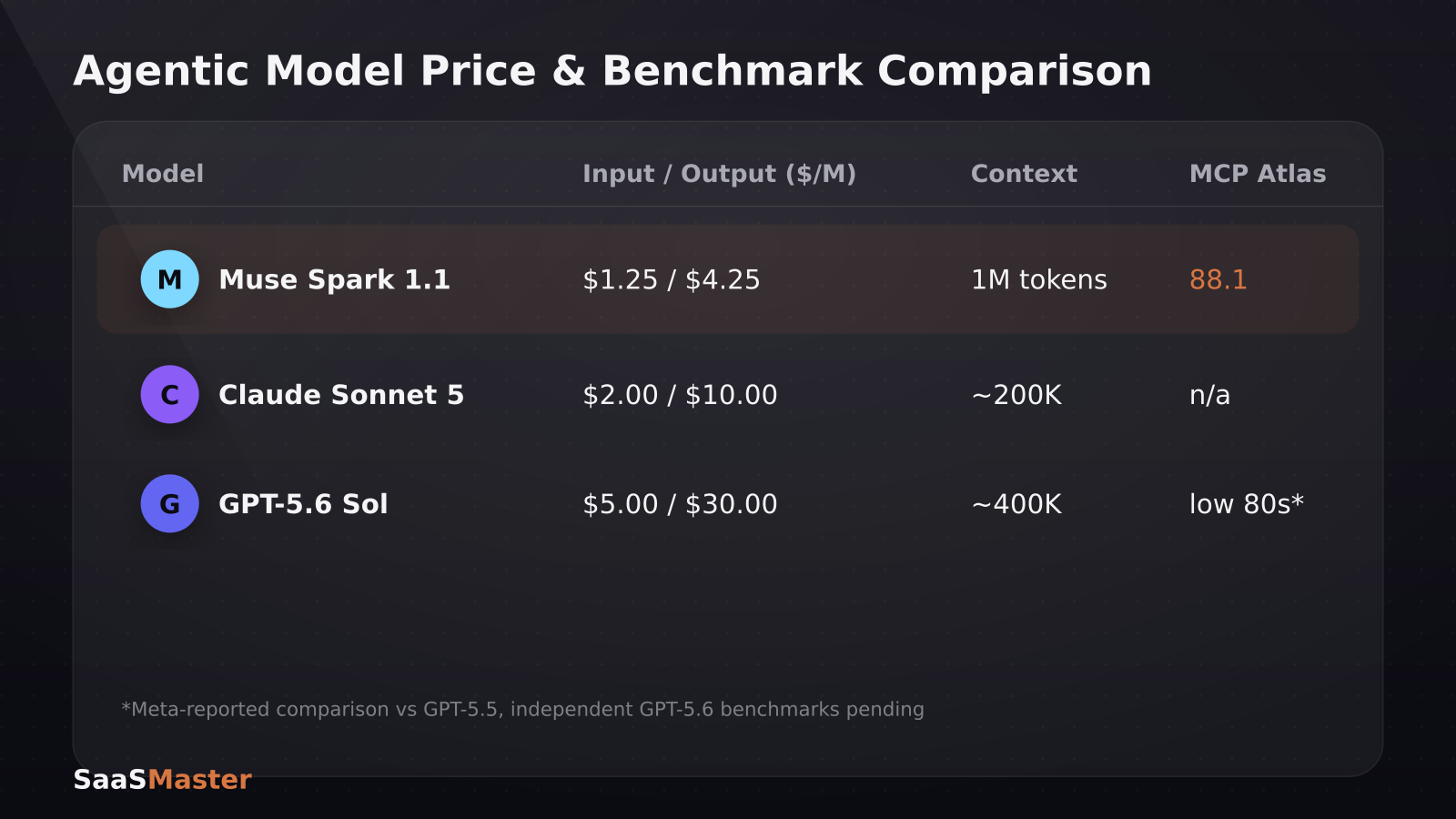
- Muse Spark 1.1 costs $1.25/$4.25 per million tokens (input/output), roughly 40% cheaper than Claude Sonnet 5's introductory $2/$10 rate and 75%+ cheaper than GPT-5.6 Sol's $5/$30.
- Muse Spark scores 88.1 on MCP Atlas, a tool-use benchmark, ahead of Claude Opus 4.8 and GPT-5.5 in the high 70s to low 80s, per Meta's own published numbers.
- It ships with a 1M-token context window and runs parallel subagents instead of working sequentially, which speeds up multi-step agent tasks.
- The Meta Model API natively supports OpenAI's Chat Completions format and Anthropic's Messages format, so switching doesn't mean rewriting your integration.
- Availability is limited to US developers in public preview, with $20 in free credits per new account.
What is Meta Muse Spark 1.1?
Muse Spark 1.1 is Meta's multimodal reasoning model built specifically for agentic work: planning multi-step tasks, calling tools, orchestrating other agents, and writing code. It launched in US public preview on July 9, 2026, positioned less as a general chatbot model and more as infrastructure for teams building AI agents into their products.
The headline feature isn't a benchmark score, it's the API compatibility. Meta built the Model API to accept requests in both OpenAI's Chat Completions format and Anthropic's Messages format natively. If your SaaS product already calls GPT or Claude, you can point the same request shape at Muse Spark and test it without a rewrite. That's a deliberate move to lower the switching cost that normally keeps teams locked into whichever API they integrated first.
How does Muse Spark 1.1 compare to Claude Sonnet 5 on price?
Claude Sonnet 5, which Anthropic released June 30, 2026, is priced at an introductory $2 per million input tokens and $10 per million output tokens through August 31, 2026, rising to $3/$15 after that. Muse Spark 1.1 comes in under even the introductory rate at $1.25/$4.25.
For a SaaS team running an agent that processes, say, 50 million input tokens and 10 million output tokens a month, that's the difference between roughly $162 (Muse Spark) and $200 (Sonnet 5 at introductory pricing) or $275 (Sonnet 5 after the September price increase). At higher volumes the gap compounds fast, which is exactly the enterprise cost-sensitivity Meta is targeting. Computerworld and other outlets covering the launch framed it explicitly as Meta pricing into a moment when "enterprise AI spending comes under scrutiny."
Price isn't the only variable. Sonnet 5 has a longer track record in production agent frameworks, and Anthropic's tool-use ecosystem (Claude Code, MCP support, established SDKs) is more mature. Muse Spark is brand new; teams should expect some rough edges in preview.
How does it compare to GPT-5.6 on cost and capability?
GPT-5.6 Sol, OpenAI's top-tier variant for high-end reasoning and coding, runs $5 per million input tokens and $30 per million output tokens, more than 4x and 7x Muse Spark's rates respectively. The cheaper GPT-5.6 tiers, Terra and Luna, close some of that gap, but Sol is the variant most directly comparable to Muse Spark's agentic-coding target use case.
On the MCP Atlas tool-use benchmark, Meta reports Muse Spark scoring 88.1, which it says beats GPT-5.5 (high 70s to low 80s range). Note that's a comparison against GPT-5.5, not the newer GPT-5.6, so treat that specific number as directional rather than a clean apples-to-apples read until independent benchmarks land. Early third-party evaluations from sites like artificialanalysis.ai are worth checking before you commit a production workload.
Should your SaaS team switch to Muse Spark 1.1?
If you're currently spending meaningfully on GPT-5.6 or Claude Sonnet 5 for agentic or tool-calling workloads, and your integration is already built around OpenAI- or Anthropic-shaped requests, testing Muse Spark 1.1 costs you almost nothing beyond engineering time. The $20 free credit covers a real evaluation, and the API compatibility means you're not rebuilding your request layer to try it.
Where it makes less sense yet: production systems that lean on ecosystem tooling specific to Claude or GPT (fine-tuned prompt libraries, established agent frameworks, vendor support SLAs), or anything outside the US, since the preview is US-only at launch. For a deeper look at how to weigh these tradeoffs systematically rather than chasing every new price cut, our AI tool selection framework walks through the decision criteria that actually matter for a small SaaS team.
We've also covered how Claude Sonnet 5 stacks up against GPT-5.6 Terra directly, and how Claude Opus 4.8 compares to GPT-5.5 on benchmarks and pricing if you want the fuller competitive picture before Muse Spark entered the race.
What does the MCP Atlas benchmark actually measure?
MCP Atlas tests scaled tool use, essentially how well a model plans and executes multi-step tasks that require calling external tools and APIs in the right sequence, rather than just answering questions from its training data. That matters more for SaaS agent products than traditional reasoning benchmarks, because most production agents spend the bulk of their time deciding which tool to call next, not generating prose.
A high MCP Atlas score is a reasonable signal that a model will handle real agentic workflows (looking up a customer record, then updating a CRM field, then sending a confirmation email) more reliably. It's not a guarantee, benchmark performance and production reliability under your specific tool schema and prompt structure can diverge, which is exactly why a real evaluation against your workload matters more than the published number.
A practical checklist for evaluating Muse Spark 1.1
If you're considering a test, here's a reasonable way to structure it without disrupting your production traffic:
- Route a small percentage of non-critical agent traffic (internal tooling, not customer-facing flows) to Muse Spark 1.1 for a two-week trial.
- Compare actual task completion rates and error rates against your current model, not just cost per token, a cheaper model that fails more often costs more in support time.
- Check latency under your real tool schema. Meta's parallel-subagent architecture is designed to speed up complex multi-step tasks, but simple single-tool calls may not see the same benefit.
- Confirm your logging and monitoring stack captures Muse Spark responses correctly, since it's a new provider your existing observability tooling may need configuration updates.
- Only expand to customer-facing flows once you have at least two weeks of stable internal data.
The bottom line
Muse Spark 1.1 is the cheapest credible agentic-coding model from a major lab right now, and its dual API compatibility makes it unusually easy to trial. But "cheapest" and "best for your product" aren't the same question. Run your own eval against your actual workload before moving spend, especially since this is a US-only public preview and Meta's benchmark comparisons are still self-reported.
If you're building or explaining an AI-powered product to customers, showing how these models actually behave inside your tool, not just quoting price sheets, is often what convinces a buyer. That's the gap our AI tool product videos are built to close, walking your audience through real capability instead of a spec comparison.
For more on the broader shift toward agentic AI in business software, see our breakdown of Gartner's $234 billion agentic AI forecast and the risks it flags for SaaS teams, and our running list of the best AI tools for SaaS teams if you're building a broader stack, not just picking one model.
Frequently asked questions
Is Meta Muse Spark 1.1 available outside the US?
Not yet. The public preview launched July 9, 2026 and is limited to US developers. Meta hasn't announced an international rollout date.
Can I use my existing OpenAI or Anthropic code with Muse Spark 1.1?
Largely yes. The Meta Model API accepts both OpenAI's Chat Completions format and Anthropic's Messages format natively, so most existing request code needs only endpoint and auth changes rather than a full rewrite. Test thoroughly before shipping to production, since response formatting and tool-call behavior can still differ in edge cases.
How much cheaper is Muse Spark 1.1 than Claude Sonnet 5 and GPT-5.6?
At $1.25/$4.25 per million tokens, Muse Spark 1.1 runs about 35-40% cheaper than Claude Sonnet 5's introductory pricing ($2/$10) and roughly 75-85% cheaper than GPT-5.6 Sol ($5/$30). Actual savings depend on your input-to-output token ratio and whether you're using caching or batch discounts on the other platforms.
Was this article helpful?
Jorge Aguilar
Founder & Creator, SaaS Master
Producing SaaS and AI product videos since 2019 — 800+ videos for 200+ brands, covering tutorials, demos, walkthroughs, and explainers. Writing here about the tools, trends, and tactics that actually move the needle. LinkedIn · About · Work with me
Building an AI product that needs a clearer onboarding flow?
Client-owned videos that make your product easy to understand — demos, walkthroughs, onboarding, and explainers.
Explore AI product video productionRelated guides
More AI Tools & AI Workflows →
Apple vs OpenAI: What the Trade Secret Lawsuit Means for SaaS Teams Building on GPT
You Don't Need Amazon's $1 Billion AI Team: A Practical AI Deployment Playbook for Small SaaS Companies
Claude Sonnet 5 vs GPT-5.6 Terra: The Mid-Tier AI Showdown With a Deadline