ChatGPT Go vs Plus in 2026: The $12 Gap That Changes Everything
In short
ChatGPT Go at $8/month vs Plus at $20/month in 2026 — what you actually get, what you lose, and which plan is right for your workflow and budget.
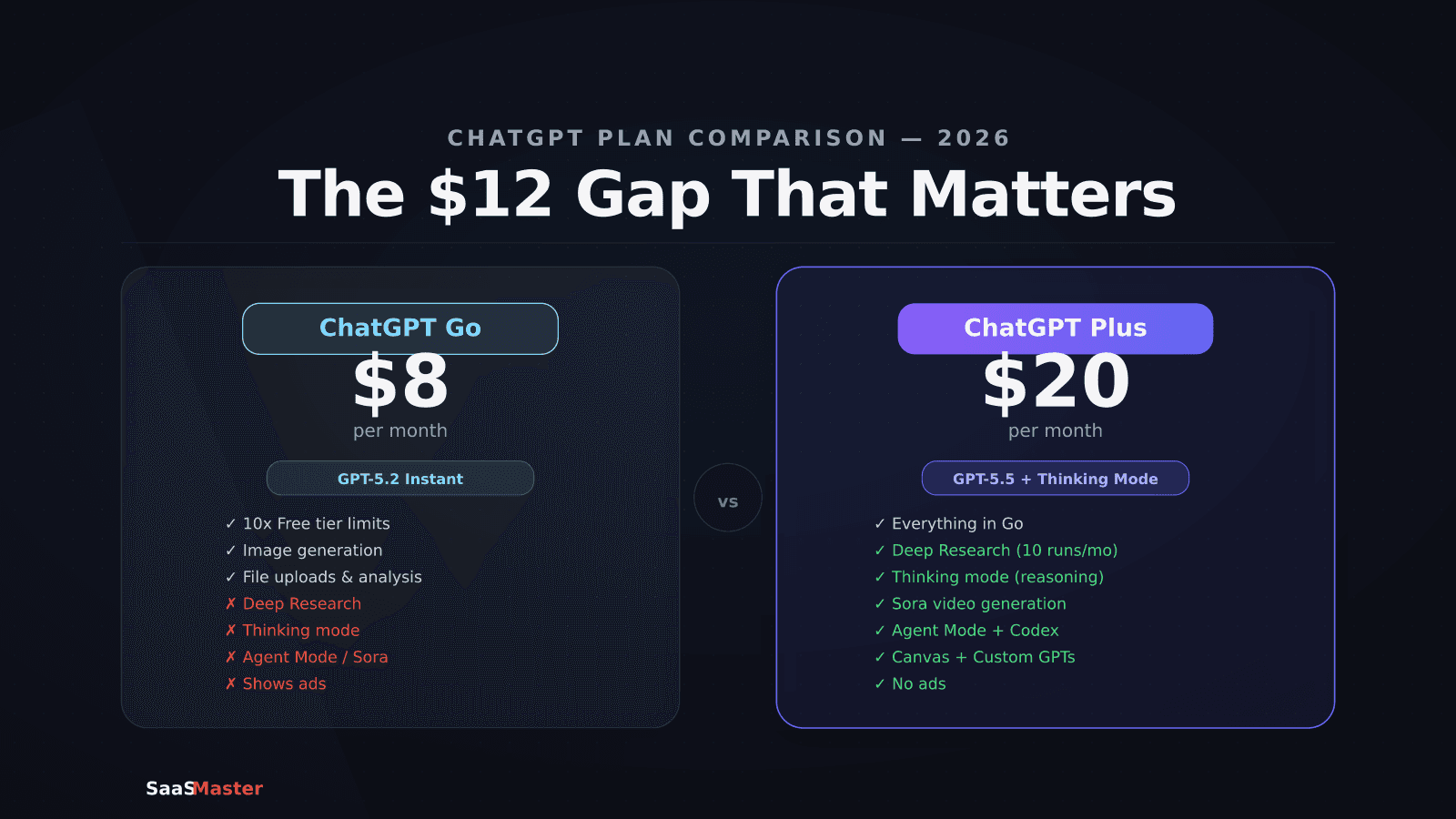
OpenAI launched ChatGPT Go on January 15, 2026, as a $8-per-month tier sitting between Free and Plus. It made sense as a strategy: give people who want more than the free tier a lower-friction entry point than the $20 Plus plan. But the feature gap between Go and Plus is larger than the price gap suggests. Here's what you actually get at each level, and which one you should choose.
Key Takeaways
- ChatGPT Go ($8/month) runs on GPT-5.2 Instant and gives 10x the Free tier's usage limits — but shows ads and lacks advanced features
- ChatGPT Plus ($20/month) includes GPT-5.5 Thinking mode, Deep Research (10 runs/month), Sora video generation, Codex coding agent, Agent Mode, Canvas, and no ads
- The Free and Go tiers show ads in responses (in the US, since February 2026)
- Go does not include Advanced Voice Mode, Deep Research, ChatGPT Agent, Canvas, or Custom GPT creation
- For $12 more per month, Plus adds a disproportionately large feature set relative to the price difference
- Go is worth it if your use is mostly drafting, summarizing, and image generation without needing reasoning, research, or automation
How ChatGPT's Tiers Work in 2026
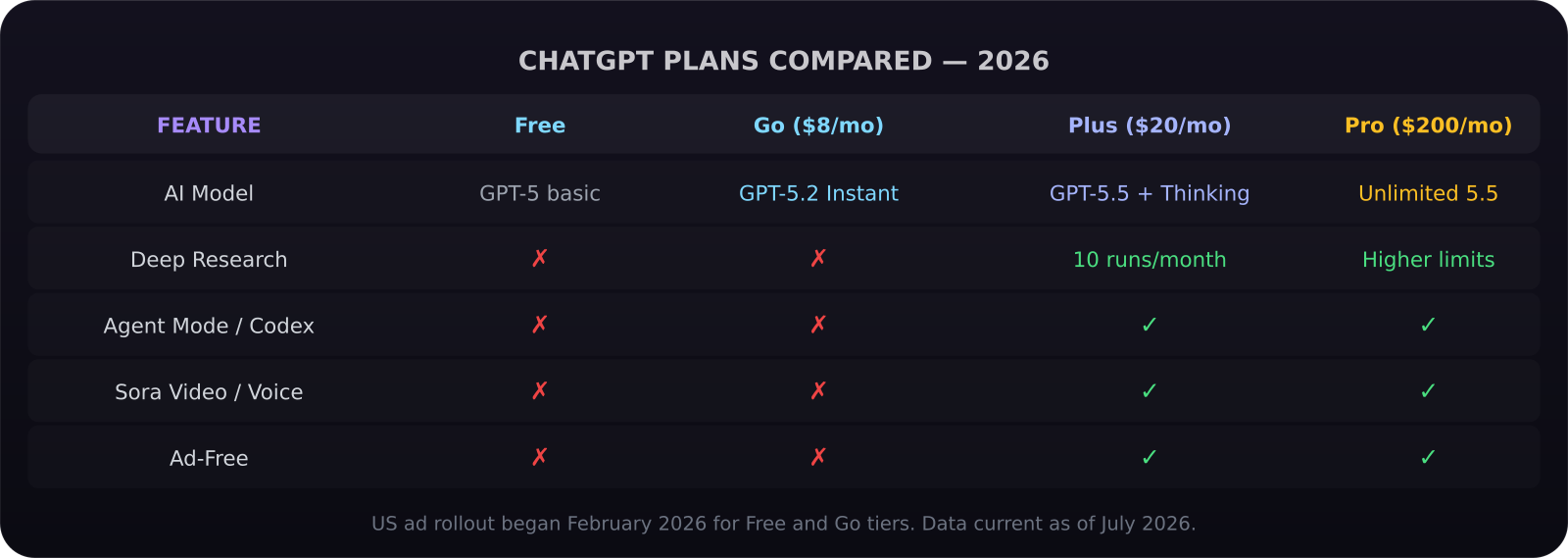
OpenAI's current plan structure has five main consumer tiers:
Free: Basic GPT-5 access, usage-capped, shows ads in the US as of February 2026.
Go ($8/month): Launched globally in January 2026, runs on GPT-5.2 Instant, gives 10x Free tier limits on messages, image uploads, and file uploads. Still shows ads. Does not include reasoning mode, Deep Research, voice, video, agents, or Canvas.
Plus ($20/month): GPT-5.5 with Thinking mode (advanced reasoning), Deep Research (10 autonomous research runs per month), Sora video generation, Codex coding agent, Agent Mode, Advanced Voice Mode, no ads, Canvas for document editing, and Custom GPT creation.
Pro ($200/month): Unlimited GPT-5.5 usage, higher Deep Research limits, o3 access.
Team and Enterprise: Per-seat pricing with admin controls and privacy guarantees.
Go sits in an awkward middle ground — it removes the usage frustration of the free tier but doesn't unlock any of the features that define what Plus can actually do.
What GPT-5.2 Instant vs GPT-5.5 Actually Means
The model gap between Go and Plus is real. GPT-5.2 Instant is OpenAI's fast, cost-efficient inference tier — optimized for quick responses on standard tasks like drafting, summarizing, translating, and image captioning. It's capable for these tasks.
GPT-5.5 is OpenAI's flagship reasoning model, and when you activate Thinking mode on Plus, you're accessing extended chain-of-thought reasoning — the same category of capability that made o1 notable, now integrated into the main model. For tasks that require multi-step analysis, complex problem-solving, nuanced writing, or code that has to actually work, GPT-5.5 in Thinking mode performs measurably better than GPT-5.2 Instant.
The practical difference: Go is good at drafting an email, summarizing a document, or generating a social post. Plus is good at analyzing a contract, debugging a multi-file Python project, reasoning through a business strategy, or generating a research brief from 20 sources. If your use stays in the first category, Go's model is sufficient.
Deep Research: The Biggest Gap
The single biggest feature difference between Go and Plus is Deep Research — ChatGPT's autonomous multi-source research agent. You give it a question or topic, it spends several minutes searching the web, reading sources, cross-referencing information, and returns a synthesized, cited report.
Deep Research is not available on Go. It requires Plus ($20/month) or Pro ($200/month).
For anyone doing competitive research, market analysis, due diligence, or topic research for content, this is the feature that justifies the Plus premium on its own. Ten Deep Research runs per month on Plus is enough for most professionals. If you need more, Pro's higher limits are available.
The Ads Question
One of the more significant developments of early 2026 was OpenAI introducing ads into responses for Free and Go tier users in the US (February 2026). The ads appear at the bottom of responses in the form of sponsored links and short promotional units.
Plus and above are ad-free. This is not just a convenience difference — ads in AI responses raise questions about whether the suggestions and recommendations within responses could be influenced by commercial relationships. OpenAI's stated policy is that ads do not influence the content of responses, only appear after them. But from a professional standpoint, many users find paying $12 more per month for an ad-free experience in a work tool straightforward to justify.
What Go Actually Includes
To be fair to the $8 tier, Go isn't nothing. Here's what you get:
- GPT-5.2 Instant access with 10x Free tier usage limits
- Image generation (DALL-E based)
- File uploads and analysis (PDFs, spreadsheets, images)
- Code generation and debugging (without the Codex agent)
- Web browsing / search integration
- Memory features
- Access to the mobile apps
For a freelancer who uses ChatGPT primarily for drafting copy, summarizing client documents, or generating social media content a few times a day, Go is a reasonable upgrade from Free. The usage limits are high enough for moderate daily use.
What You Lose Going With Go Instead of Plus
- GPT-5.5 Thinking mode (advanced reasoning on complex problems)
- Deep Research (autonomous multi-source research, 10 runs/month)
- Sora video generation
- Codex coding agent (structured, multi-step code execution)
- Agent Mode (autonomous task completion across tools)
- Advanced Voice Mode (real-time conversation with emotional context)
- Canvas (document and code editing interface)
- Custom GPT creation
- Ad-free experience
That's a significant list for $12. The items that matter most depend on your workflow, but Deep Research and Thinking mode are broadly useful across professional use cases.
Who Should Get Go
Go at $8/month makes sense if:
- You use ChatGPT primarily for drafting, translation, summarization, or light creative writing
- You're a student on a tight budget who needs more than the free tier's limits
- You want image generation without committing to the full Plus price
- You tried the free tier and hit the usage cap regularly, but don't need reasoning or research features
It's not the right choice if: you do research for work, write code regularly, want voice interaction, or generate video content. For all of those use cases, the $12 difference to Plus pays for itself quickly.
Who Should Get Plus
Plus at $20/month makes sense for:
- Professionals who use AI for research, analysis, or complex writing daily
- Developers who want the Codex agent and Thinking mode for code review
- Teams using Agent Mode to automate multi-step workflows
- Anyone who relies on Deep Research for competitive or market intelligence
- Users who want an ad-free, professional tool experience
For SaaS founders and product teams specifically, Plus's Deep Research and Agent Mode capabilities are directly applicable to product research, competitive analysis, onboarding documentation, and content creation. You can explore how AI tools like this integrate into a full SaaS content strategy in our AI tools hub and our breakdown of how the latest AI models compare in 2026. If you're using AI to accelerate SaaS content production, our SaaS explainer video services pair well with an AI research and writing stack.
The Go + Perplexity Pro Strategy
One combination that's grown popular in 2026: ChatGPT Go ($8/month) for drafting and creative work, paired with Perplexity Pro ($20/month) for research and citations.
Perplexity Pro includes unlimited Pro Search queries and 20 Deep Research reports per day with full inline citations. If your primary need for Plus was Deep Research, getting Perplexity Pro alongside ChatGPT Go gives you arguably better research output (Perplexity's citation accuracy is the highest in the category) plus ChatGPT's strength in creative and drafting tasks, for $28 combined versus $20 for Plus alone.
The gap closes: for $8 more than Plus, you get two specialized tools. For $12 less than Plus, you get Go only, without research capability. The math mostly favors Go + Perplexity over Go alone, depending on your budget.
Verdict
The $12 gap between ChatGPT Go and ChatGPT Plus is misleading when you look at features. Go is a solid upgrade from Free for light daily use. Plus is a categorically different product — a professional AI tool with reasoning, research, agents, voice, and video. If you use AI for work, Plus at $20/month is almost certainly the right tier. If you use AI occasionally and mostly for writing tasks, Go is a reasonable value. Don't let the modest price difference make the decision seem trivial — the feature gap is not proportional.
Frequently Asked Questions
Can ChatGPT Go users access the same GPT model as Plus users?
No. Go runs on GPT-5.2 Instant, which is one model generation behind Plus's GPT-5.5. Go does not include access to GPT-5.5 Thinking mode, which is the advanced reasoning capability that makes Plus notably more capable on complex analytical and coding tasks.
Does ChatGPT Go show ads everywhere or only in certain countries?
As of July 2026, ads in ChatGPT responses have been rolled out to US users on the Free and Go tiers, with expansion to additional markets through 2026. Plus and Pro subscribers are ad-free globally. OpenAI has stated that ads only appear as contextual units at the end of responses and do not influence the AI's actual output.
Is there a monthly limit on how much I can use ChatGPT Go?
Go gives you approximately 10x the Free tier's usage limits, which OpenAI describes in terms of message volume rather than a published hard number. In practice, Go users report comfortable daily use for drafting, summarizing, and image generation without hitting limits. Heavy users — those doing dozens of AI-assisted tasks per day — will encounter rate limiting during peak periods, where Plus users receive priority access.
Was this article helpful?
Jorge Aguilar
Founder & Creator, SaaS Master
Producing SaaS and AI product videos since 2019 — 800+ videos for 200+ brands, covering tutorials, demos, walkthroughs, and explainers. Writing here about the tools, trends, and tactics that actually move the needle. LinkedIn · About · Work with me
Building an AI product that needs a clearer onboarding flow?
Client-owned videos that make your product easy to understand — demos, walkthroughs, onboarding, and explainers.
Explore AI product video productionRelated guides
More AI Tools & AI Workflows →
How to Get Your SaaS Tool Recommended by AI Engines
Cursor vs Claude Code vs GitHub Copilot in 2026: Which AI Coding Tool Is Worth Your Money?
Taja AI Review 2026: Turn Your YouTube Videos Into a Full Content Machine