GEO for SaaS: How to Get Your Software Brand Cited by AI Engines
In short
Generative Engine Optimization for SaaS: the practical steps to get your software brand cited by ChatGPT, Perplexity, and Gemini — structured content, authority signals, and the checklist to audit your readiness.
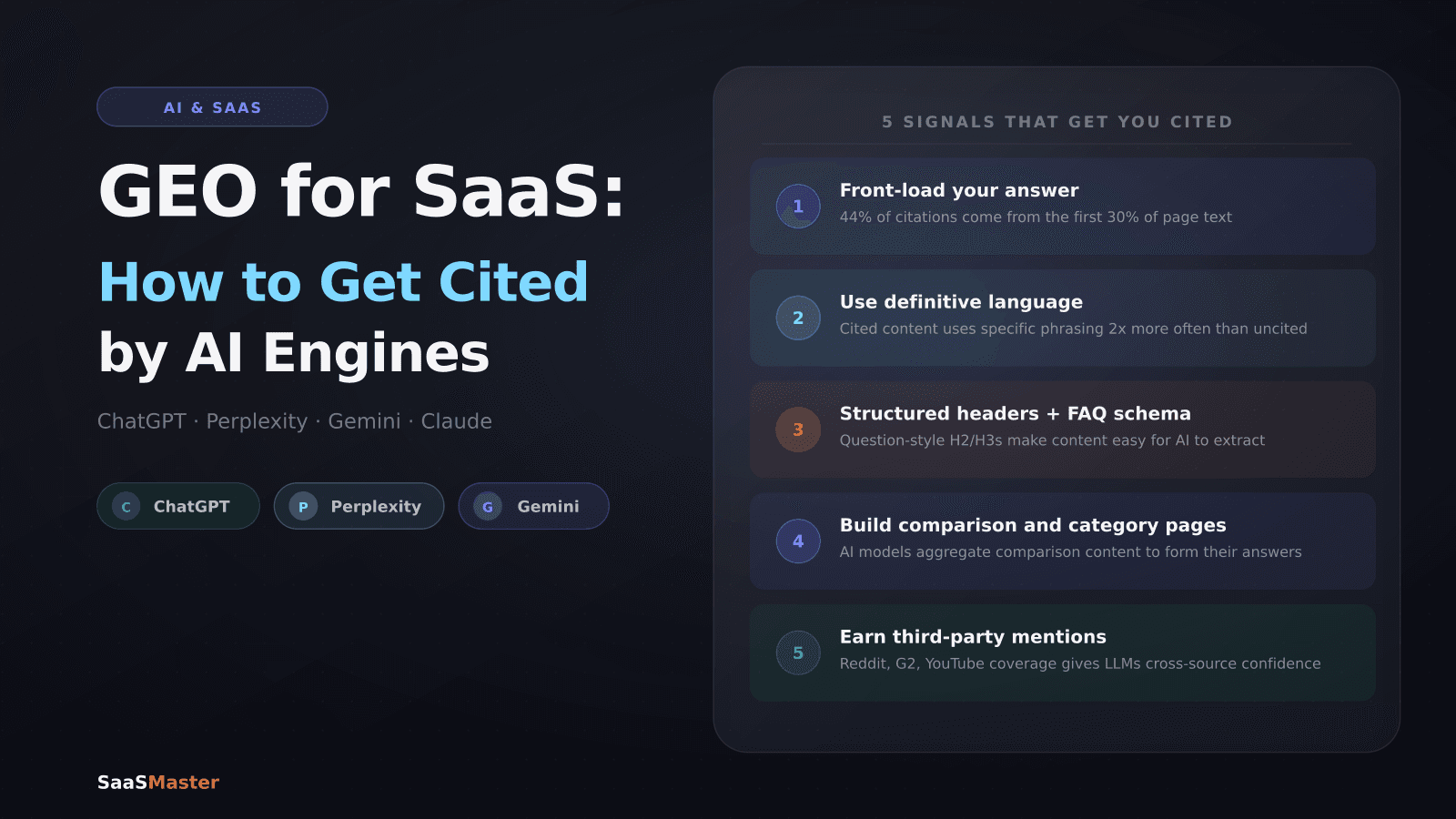
When a potential customer types "what's the best tool for X" into ChatGPT or Perplexity, your software either shows up or it doesn't. Getting cited in that answer is a meaningful acquisition channel — and it's one most SaaS companies aren't optimizing for yet. This guide covers how it actually works and what you can do about it starting today.
Key takeaways:
- GEO (Generative Engine Optimization) is about structuring content so AI engines cite your brand in their answers
- Front-loading your core answer in the first paragraph matters: 44% of ChatGPT citations come from the first 30% of page text
- Confident, specific language ("the fastest way," "the three steps are") gets cited more than hedged copy
- Third-party signals — Reddit mentions, G2 reviews, YouTube coverage — matter as much as on-site content
- GEO and SEO share most of the same inputs; the main shift is in structure and positioning
What Is GEO and Why Does It Matter for SaaS?
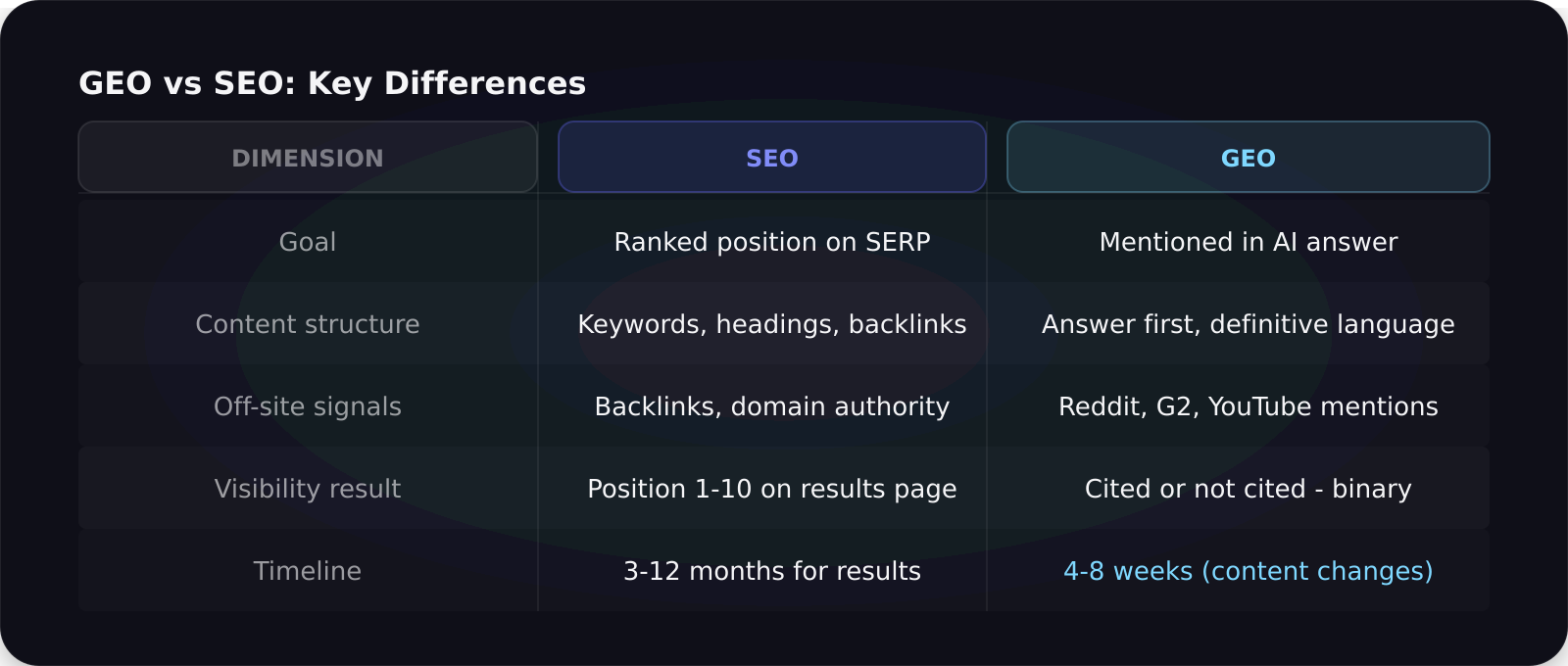
Generative Engine Optimization is the practice of structuring your content so that AI engines — ChatGPT, Perplexity, Gemini, Claude — cite your brand when users ask questions in your category. It's different from traditional SEO, where the goal is a ranked position on a results page. In AI-generated answers, you either get mentioned or you don't. There's no position 3.
This matters more every year. G2's 2026 research shows 51% of B2B buyers now start their software research with an AI chatbot more often than with Google. Gartner forecasts that traditional search volume will decline 25% as queries shift to conversational AI. The buyers you want are increasingly asking AI systems for recommendations — and those systems cite the sources they trust.
For SaaS companies in competitive categories, showing up in AI recommendations is becoming as important as showing up on Google page one.
How AI Engines Actually Decide What to Cite
Understanding the mechanism helps you optimize correctly.
Large language models don't index your pages in real time. They're trained on large bodies of text, and updated on a schedule. But retrieval-augmented systems like Perplexity and ChatGPT with web search do pull from live sources when generating answers — which means recent content and current domain authority both matter.
What AI systems look for when deciding what to cite:
Authoritative structure. LLMs favor content structured like documentation: clear headings, direct answers up front, numbered steps, and comparison tables. Research from Princeton and Georgia Tech on GEO shows that adding statistics, citations, and quotations to content can increase an AI engine's citation likelihood by 30-40%.
Definitive language. Cited content uses specific, confident phrasing at nearly twice the rate of uncited content (36% vs 20% in one major analysis). "The three steps to configure X are..." beats "There are several approaches you might consider..." every time.
Answer placement. 44% of ChatGPT citations come from the first 30% of a page's text. If your core answer is buried below a long introduction, it won't get cited — even if the content further down is excellent.
Third-party mentions. High mention volume on Reddit, G2, Capterra, and Quora correlates with a 4x increase in AI citation frequency. LLMs calibrate confidence by checking agreement across multiple independent sources. If 20 Reddit threads recommend your tool, that carries more weight than a well-written page on your own domain.
What GEO Means in Practice for SaaS Content
You don't need a completely separate GEO strategy. Most of the inputs — good writing, domain authority, structured content — are the same as effective SEO. The key shifts are in structure and positioning.
Write the Answer First
Every page or article should open with a direct, specific answer to the question it targets. Two or three sentences maximum. AI engines are trained to extract the answer, and they prefer content that makes extraction easy. Long preambles and keyword-stuffed introductions hurt your citation chances.
Make Comparison and Category Pages Your Priority
When a buyer asks ChatGPT "what's the best tool for [task]," the model aggregates comparison content. If you have a well-structured "[Your Product] vs [Competitor]" page or a "[Category] tools" guide, you're much more likely to be cited — not just as an option, but as a context-setter for the whole answer.
This is how smart SaaS companies become the frame through which buyers see the entire category. They define the comparison criteria. They explain what "good" looks like. That content gets cited when the AI is building its answer.
Use Structured Headers and FAQ Schema
Use clear H2 and H3 headings that match how buyers would phrase a question. "How does [Product] handle [workflow]?" as a heading on your docs page is a citation magnet. FAQ sections with direct answers are particularly well-suited to extraction by AI systems.
Add FAQ schema markup to your pages. It's a small technical step that makes your content explicitly parseable by AI systems and also captures featured snippets in traditional search.
Get Mentioned Off Your Own Site
No amount of great content on your domain compensates for thin off-site presence. The practical priorities: get reviewed on G2, Capterra, and Product Hunt; get mentioned in comparison and roundup posts on high-authority domains; participate in Reddit and Quora discussions where your tool is genuinely useful; get featured in YouTube videos and podcasts in your category.
Each of these generates the independent, third-party signal that LLMs use to calibrate trust.
Video and GEO: a Non-Obvious Opportunity
YouTube is indexed by Google, and Google surfaces video content in AI Overviews. A well-structured tutorial video with a thorough description, chapters, and timestamped key points creates another citation surface. The same reason you'd want a great walkthrough video showing how your product works is also a GEO signal — it demonstrates that credible, third-party content exists around your brand.
This is one of the reasons SaaS video production is increasingly a GEO play, not just a conversion play. A well-produced video that gets embedded in third-party blogs, linked from Reddit, and discussed on YouTube channels generates the exact citation signals that matter.
The Short GEO Checklist
Here's a simple way to audit your current content for GEO readiness:
- Does every major page open with a direct answer in the first paragraph?
- Do you have well-structured comparison pages for your key competitors?
- Do your product pages and docs use FAQ-style headings with concise, direct answers?
- Is your FAQ content marked up with schema?
- Do you have active, positive mentions on Reddit, G2, Quora, and Capterra?
- Do you have third-party YouTube videos, blog posts, or review content featuring your product?
If the answer to most of these is yes, you're in better shape than most SaaS companies. If not, start with the fastest fixes: restructure existing pages so the answer comes first, and prioritize getting third-party coverage.
For deeper context on how content and video work together to drive SaaS growth, the Complete SaaS Video Marketing Strategy Guide covers the full picture of which videos belong at which stage of the buyer journey. And for more on AI-first workflows and tools for SaaS teams, the AI Tools hub has practical guides across every layer of the stack.
Frequently asked questions
How is GEO different from SEO?
SEO optimizes for ranked positions on a search results page. GEO optimizes for inclusion in an AI-generated answer. Many of the inputs overlap — good content, strong domain authority, structured pages — but GEO prioritizes direct answers placed early, confident specific language, and third-party citation signals in a way traditional SEO doesn't emphasize as much.
How long does it take to see results from GEO?
Most brands see measurable improvement in AI citation frequency within 4-8 weeks of making structural content changes. Off-site signals like G2 reviews and Reddit mentions build more slowly — expect 2-4 months for those to compound meaningfully. Early mover advantage in your category is significant: brands that establish GEO presence now are harder to displace later.
Do I need separate tools to track GEO performance?
Traditional analytics don't capture AI referrals reliably. Manual spot-checking — searching for your category in ChatGPT and Perplexity monthly and tracking whether you're named — is the simplest method. Tools like SE Ranking's GEO tracking module also offer more structured monitoring. Direct referral tracking from AI engines is improving but still limited. The simplest starting metric: search for "[your category] tools" in ChatGPT and Perplexity monthly and note whether you appear.
Was this article helpful?
Jorge Aguilar
Founder & Creator, SaaS Master
Producing SaaS and AI product videos since 2019 — 800+ videos for 200+ brands, covering tutorials, demos, walkthroughs, and explainers. Writing here about the tools, trends, and tactics that actually move the needle. LinkedIn · About · Work with me
Building an AI product that needs a clearer onboarding flow?
Client-owned videos that make your product easy to understand — demos, walkthroughs, onboarding, and explainers.
Explore AI product video productionRelated guides
More AI Tools & AI Workflows →
Venice AI Review 2026: The Privacy-First AI Platform That Hit $1B Without Storing Your Data
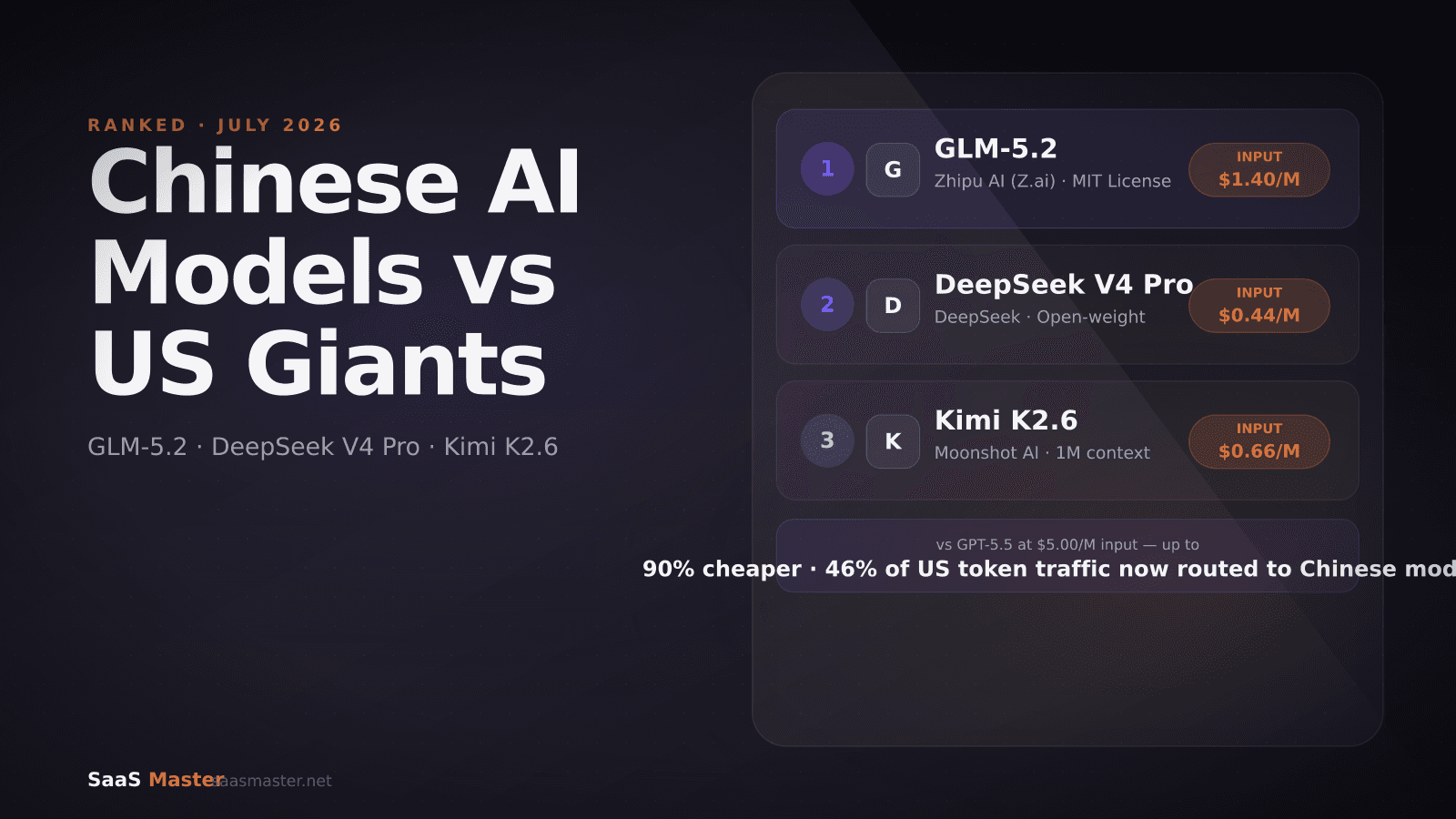
GLM-5.2, DeepSeek V4 Pro, and Kimi K2.6: The Chinese AI Models Cutting SaaS API Costs by 90%
Veo 3.1 vs Kling 3.0 vs Runway Gen-4.5: Best AI Video Generator in 2026 (Sora Is Gone)