GPT-5.6 Sol vs Terra vs Luna: Which Tier Should SaaS Teams Actually Pick?
In short
GPT-5.6 ships as Sol ($5/$30), Terra ($2.50/$15), and Luna ($1/$6) per million tokens. Here's which tier fits each SaaS use case, budget, and API volume.
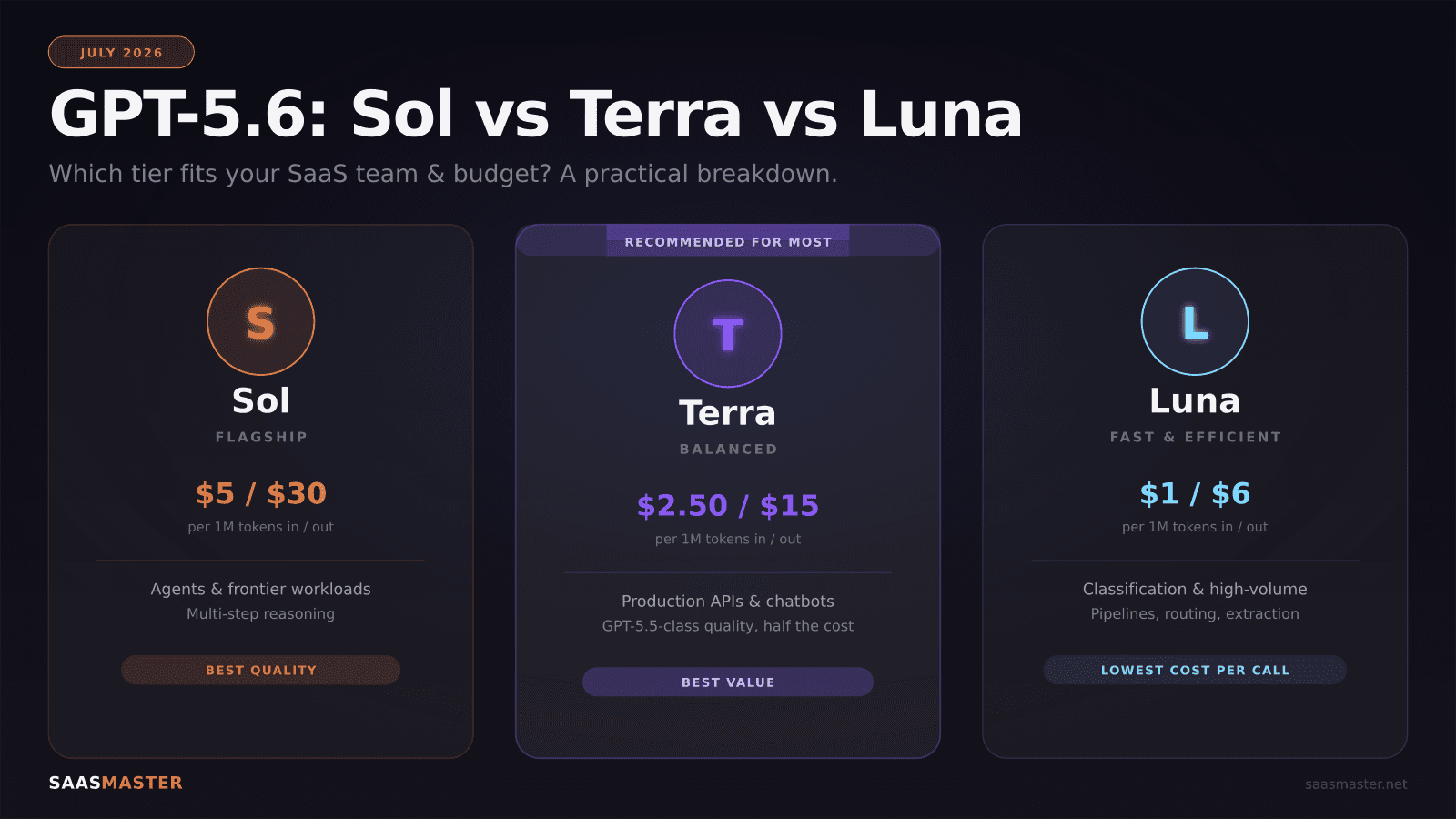
OpenAI shipped GPT-5.6 on July 9, 2026, and for the first time, "which model should I use?" became a three-way decision before you write a single line of code. GPT-5.6 is not one model — it is three: Sol, Terra, and Luna. The price gap between Sol and Luna is 5x on both input and output. The benchmark gap is often a fraction of that.
Here is what most SaaS teams need to decide right now: which tier to default to, which to route heavy workloads to, and whether mixing tiers is worth building a router.
Key takeaways: - GPT-5.6 ships as Sol ($5/$30), Terra ($2.50/$15), and Luna ($1/$6) per million tokens - Terra matches GPT-5.5-level quality at half the price — it is the default for most production workloads - Luna is best for classification, routing, extraction, and first-pass drafting at high volume - Sol is for autonomous agents, frontier research, and tasks where quality is non-negotiable - Mixing tiers with a simple router can cut API spend by 40–60% with no user-facing quality loss
What is GPT-5.6 and why does it have three tiers?
OpenAI began previewing GPT-5.6 in late June under a limited government-vetted program. General availability rolled out globally on July 9 across ChatGPT, Codex, and the API. The naming — Sol, Terra, Luna — signals what OpenAI is calling "durable capability tiers that can advance on their own cadence." Each tier gets its own update schedule: Sol receives new frontier capabilities first, Luna focuses on cost and speed improvements.
This is not a temporary launch structure. It is a product bet that different workloads have different quality ceilings they actually need — and that pricing all of them identically has been leaving money on the table.
For context, Sol's $5/$30 per million tokens is identical to GPT-5.5's launch price in April 2026. OpenAI absorbed a full generation of capability improvements and held the flagship price flat.
Which tier is cheapest, and by how much?
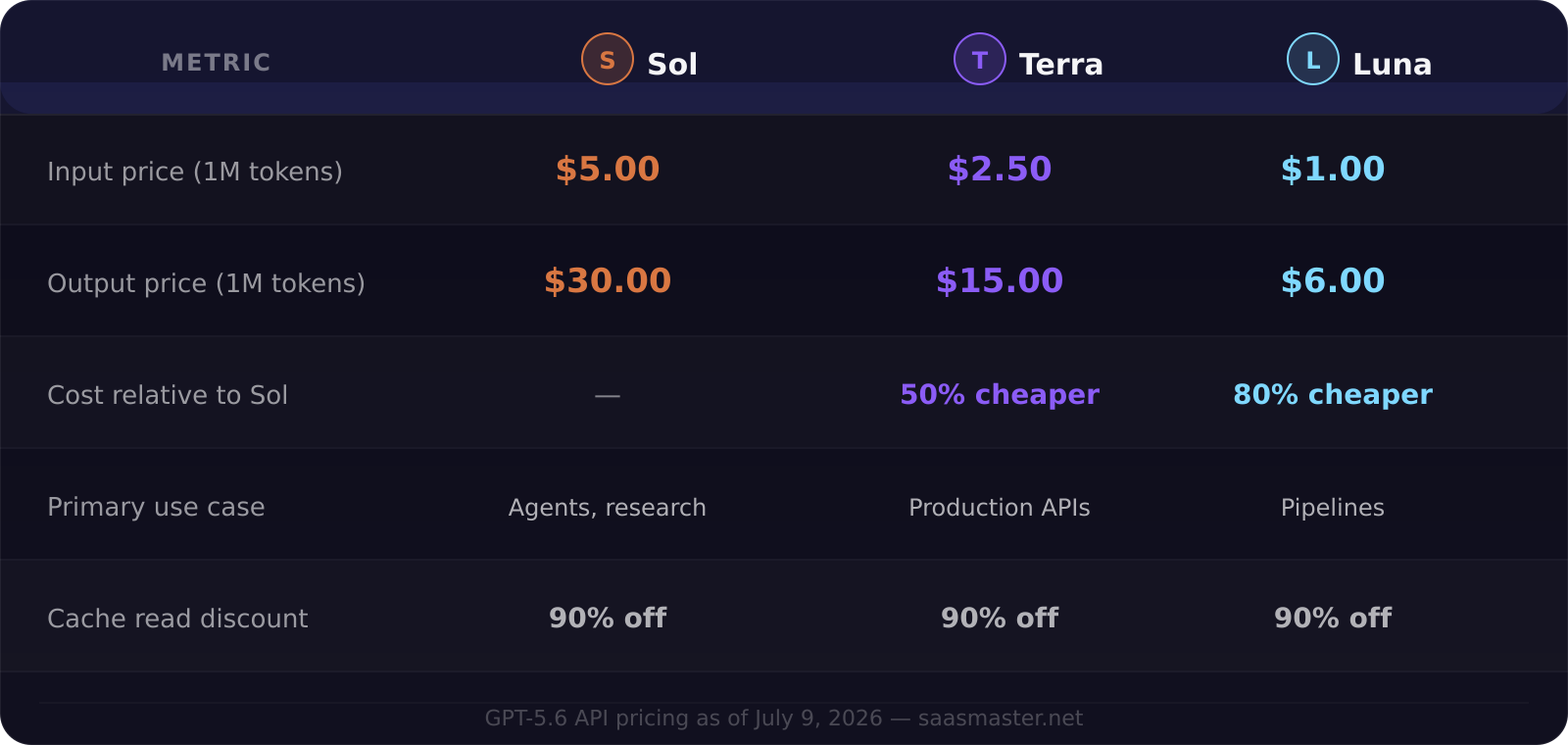
The math is straightforward. Luna at $1/$6 per million tokens costs one fifth of Sol on both input and output. Terra lands exactly in between at $2.50/$15. Cached reads get a 90% discount across all three tiers. Cache writes cost 1.25x the standard input rate, also consistent across tiers.
A team running 10 million API calls per month at 200 input tokens and 100 output tokens per call would pay roughly $5,000/month on Sol, $2,500 on Terra, and $1,000 on Luna — before caching discounts, which can dramatically shift that math for repetitive workloads.
How do Sol, Terra, and Luna actually compare on benchmarks?
The benchmark gap is smaller than the price gap suggests, and that is partly the point. Luna scores 84.3% on Terminal-Bench 2.1, which is actually higher than Terra on that specific benchmark. Sol leads on abstract reasoning and long-context retrieval: 94.8% on a long-context recall benchmark versus 77.3% for Gemini 3.5 Flash on the same test.
Terra delivers roughly GPT-5.5-class performance. If GPT-5.5 handled your workload in April 2026, Terra handles it today at half the price. According to OpenAI's positioning, Terra is the designated successor for production workloads that were previously running on GPT-5.5.
The honest framing: Luna and Terra are not Sol with the quality dialed down. They are models trained specifically for their price tier. The quality gap shows up most clearly on tasks that require deep multi-step reasoning and long-context synthesis — which is precisely the workload Sol targets.
Which tier fits which SaaS use case?
Sol — when quality is the only metric
Sol is for workloads where a wrong answer has a real cost. Autonomous agents running multi-step workflows. Long-context document analysis where precision matters. Frontier research, scientific tasks, compliance drafting, or any output that a human reviews and signs off on. At $5/$30, Sol is expensive for high volume — but for tasks where you make one careful call and need it right, the premium is justified.
Terra — the production default for most SaaS teams
Terra is where most teams should land by default. It delivers GPT-5.5-level output on customer-facing chatbots, RAG pipelines, content generation, summarization, and standard production API calls — at $2.50/$15 per million tokens. For a product that was using GPT-5.5 at $5/$30 in April, Terra is a 50% cost reduction with no meaningful regression on most tasks.
This is the tier I would start with for any new SaaS feature that requires natural language generation with production quality requirements.
Luna — high volume, lower stakes
Luna at $1/$6 is designed for tasks where you would rather run 20 cheap, fast requests than one expensive one. Classification, intent routing, entity extraction, first-pass drafting, structured data parsing — anything that feeds into a downstream step or human review. Luna is not a downgrade; it is a tool optimized for a different job.
Should you mix tiers?
Yes, if you are running significant API volume. A routing layer that sends complex or ambiguous requests to Terra or Sol, and routes classification and extraction to Luna, can reduce your average cost per request by 40–60% without users noticing any quality change.
The cleanest pattern: use Luna to classify intent and extract structured data, use Terra to generate responses, and escalate to Sol for multi-step planning or document-heavy reasoning tasks that require frontier accuracy.
I have been testing a version of this pattern on a content pipeline that generates explainer scripts for SaaS products. Luna handles topic extraction and brief parsing. Terra writes the draft. Sol only enters the picture for technical topics where accuracy genuinely matters. The cost difference versus running everything on Terra is meaningful at scale, and the output quality is indistinguishable for most scripts.
For a deeper look at AI tools for SaaS teams and creators, the AI tools hub covers more comparisons and model reviews.
Frequently asked questions
Is GPT-5.6 Terra better than GPT-5.5?
Terra is designed to match GPT-5.5-class quality at half the price. OpenAI positions it as the direct successor for production workloads previously running on GPT-5.5, making the upgrade a cost reduction rather than a tradeoff.
Can you use multiple GPT-5.6 tiers in the same application?
Yes. The three tiers are separate models in the API — gpt-5.6-sol, gpt-5.6-terra, gpt-5.6-luna — and can be called independently or combined in a single application using a routing layer.
How does GPT-5.6 Luna compare to Claude Haiku 4.5?
Both are priced at roughly $1 per million input tokens. Luna ($1/$6) and Claude Haiku 4.5 ($1/$5) are within pennies on input; Luna is marginally more expensive on output. Luna edges ahead on long-context recall; Haiku has stronger multilingual benchmarks. For most SaaS teams the practical difference is small — choose based on which provider ecosystem you are already building in.
Was this article helpful?
Jorge Aguilar
Founder & Creator, SaaS Master
Producing SaaS and AI product videos since 2019 — 800+ videos for 200+ brands, covering tutorials, demos, walkthroughs, and explainers. Writing here about the tools, trends, and tactics that actually move the needle. LinkedIn · About · Work with me
Building an AI product that needs a clearer onboarding flow?
Client-owned videos that make your product easy to understand — demos, walkthroughs, onboarding, and explainers.
Explore AI product video productionRelated guides
More AI Tools & AI Workflows →
Qwen Just Hit 1 Billion Downloads. The Open-Source AI World Has a New Leader.
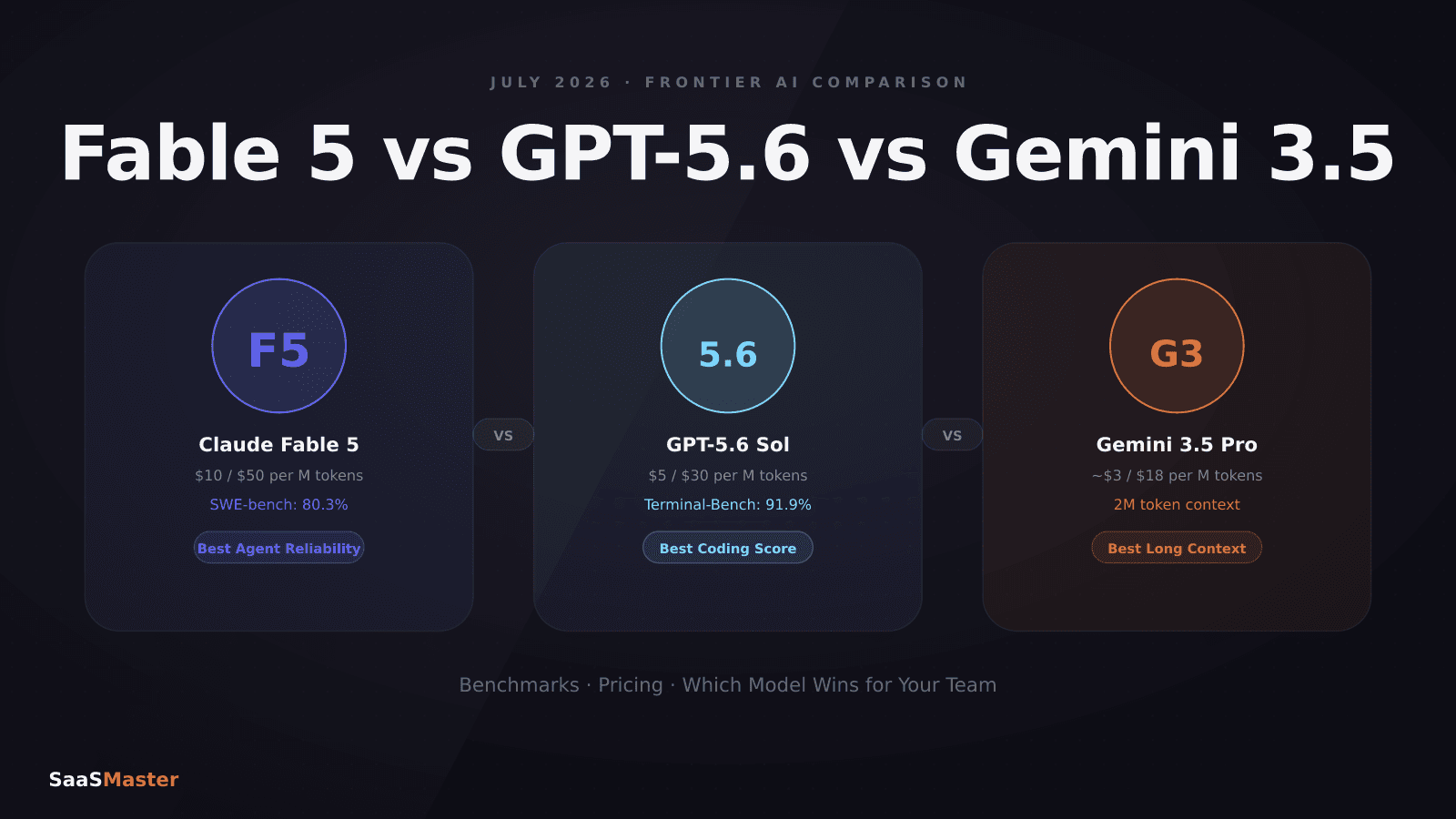
Claude Fable 5 vs GPT-5.6 vs Gemini 3.5 Pro: Which AI Model Wins in July 2026?
Notion AI in 2026: Custom Agents, Pricing Changes, and the Honest Verdict