Qwen Just Hit 1 Billion Downloads. The Open-Source AI World Has a New Leader.
In short
Alibaba's Qwen crossed 1 billion downloads on Hugging Face, overtaking Meta's Llama. Here's what the open-source AI shift means for SaaS developers in 2026.
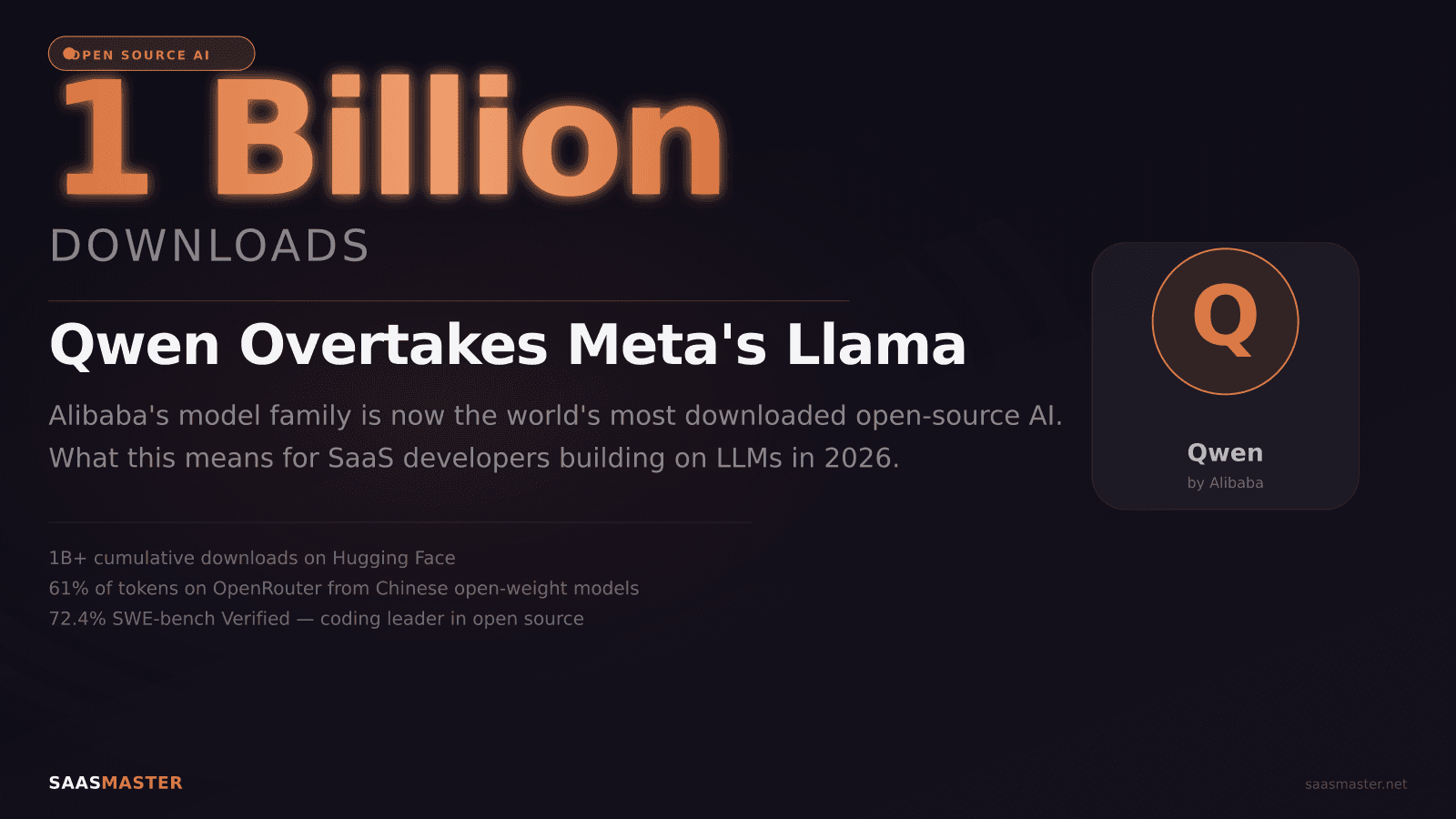
The most downloaded open-source AI model family in the world is no longer built by Meta. Alibaba's Qwen crossed 1 billion cumulative downloads on Hugging Face this month — surpassing Meta's Llama to become the most popular open-weight model franchise on Earth. In a single recent month, Qwen's download count exceeded the combined total of its next eight competitors: Meta, DeepSeek, OpenAI, Mistral, Nvidia, Zhipu.AI, Moonshot, and MiniMax.
That is not a close race. For SaaS developers choosing which open-source foundation to build on in 2026, this shift matters more than any individual benchmark.
Key takeaways: - Qwen crossed 1 billion cumulative downloads on Hugging Face, overtaking Meta's Llama - Qwen leads open-source coding benchmarks: 76.4% on SWE-bench Verified vs Llama 4's 43.4% - The shift began with Qwen 2.5 in September 2024 and accelerated sharply through 2025 - Chinese open-weight models now represent ~61% of all tokens consumed on OpenRouter - Qwen's specialized variants (Coder, Math, VL) give it practical coverage Llama's generalist approach lacks
How Qwen got to 1 billion downloads
The story starts in September 2024 with Qwen 2.5 — the release that first demonstrated Alibaba could ship a model competitive with Western frontier labs on coding and reasoning benchmarks. By the time Meta released Llama 4 in early 2026, Qwen 3.5 had already surpassed Llama on the benchmarks that matter most to developers building production products.
Qwen overtook Llama in total cumulative downloads by October 2025 and has extended the lead every month since. The billion-download milestone arrived in July 2026, roughly nine months after Qwen first took the top spot.
The acceleration was not accidental. Alibaba simultaneously released specialized variants — Qwen-Coder for developers, Qwen-Math for scientific and data work, Qwen-VL for vision-language tasks — giving developers purpose-built tools rather than asking them to fine-tune a general model themselves.
Why did Qwen beat Llama?
Three reasons compound each other.
First: specialization. While Meta iterated on its general-purpose architecture, Alibaba shipped purpose-built variants optimized for specific developer workflows. Qwen-Coder and Qwen-Math let developers reach for a model that was already optimized for their task rather than adapting a general-purpose base.
Second: multilingual performance. Early Llama models were heavily optimized for English. Qwen was built from the ground up for massive multilingual support — which gave it a structural advantage in Asia, Latin America, and Europe that had nothing to do with raw benchmark scores. Developers building for non-English markets found Qwen more capable out of the box.
Third: efficiency. Qwen 3.5's flagship 397B model activates only 17B parameters per token through a mixture-of-experts architecture. The smaller Qwen 3.6-35B-A3B activates just 3B parameters per token while scoring 73.4% on SWE-bench Verified. Running competitive AI locally became dramatically cheaper for teams who cannot afford cloud inference at scale.
How does Qwen 3.5 actually benchmark against Llama 4?
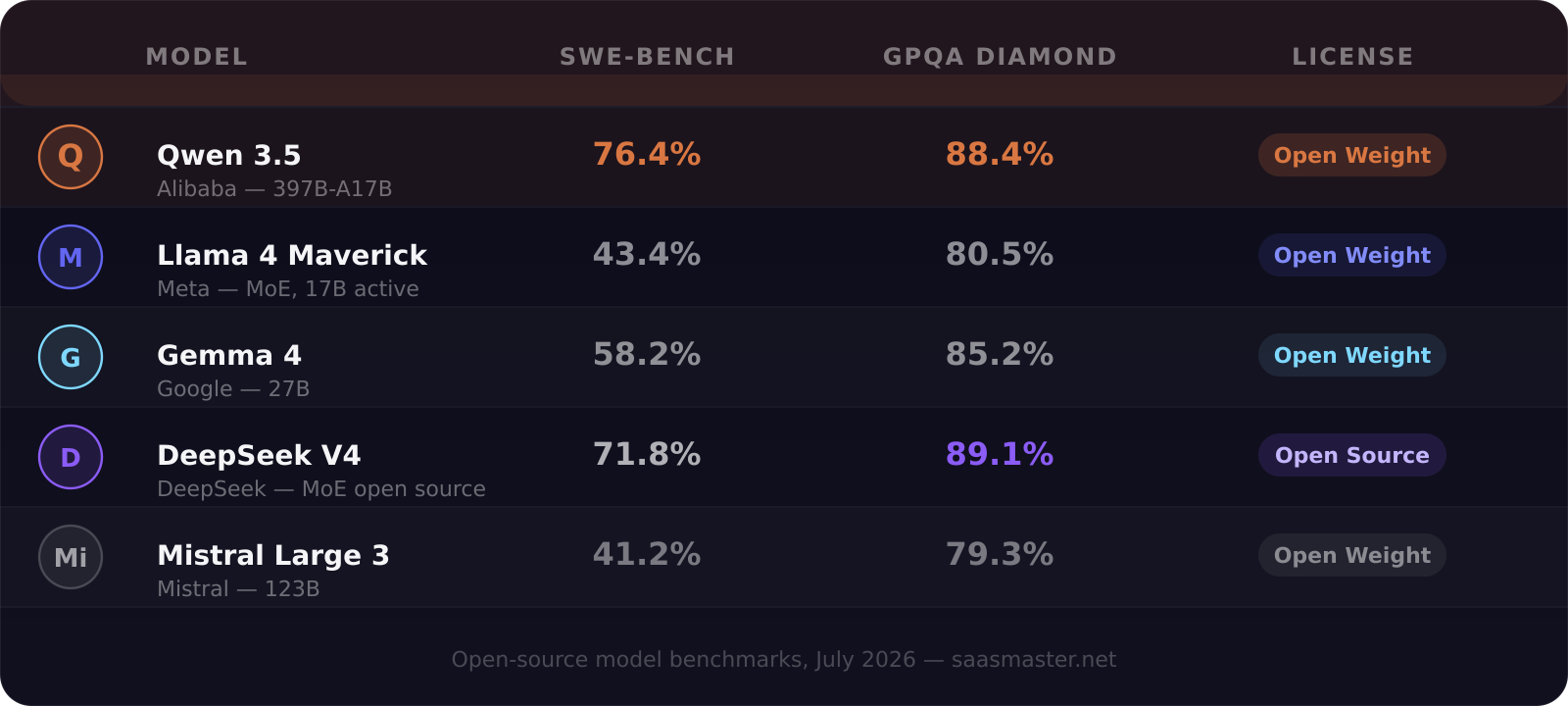
The coding gap is the most striking number. Qwen 3.5's 397B flagship scores 76.4% on SWE-bench Verified — the benchmark that evaluates real GitHub issue resolution rather than synthetic coding puzzles. Llama 4 Maverick, despite having roughly 13x more total parameters, scores 43.4% on the same test.
On reasoning benchmarks, Qwen 3.5 scores 88.4% on GPQA Diamond with only 17B active parameters. DeepSeek V4, which is the strongest Chinese open-source model on reasoning overall, edges Qwen out at 89.1% on GPQA Diamond — but Qwen leads on coding.
For SaaS developers, SWE-bench Verified is arguably the most relevant benchmark because it measures what developers actually need: the ability to find and fix real bugs in real codebases, not to solve abstract math problems.
Is this just downloads, or does it reflect real production usage?
Downloads on Hugging Face are not equivalent to production API calls. A model can accumulate downloads from developers experimenting locally with no production deployment. That caveat is worth flagging.
But two data points suggest Qwen's dominance is not purely a download-farming story. By May 2026, Chinese open-weight models represented roughly 61% of all tokens consumed on OpenRouter, the largest neutral LLM router — and Qwen leads that category. Second, the fine-tuning and LoRA adapter ecosystem on Hugging Face follows Qwen more than Llama now. Derivative models track production intent more reliably than raw download counts.
Which open-source model should SaaS developers pick in 2026?
For coding-heavy applications — AI code review, IDE features, developer tools — Qwen 3.5 or Qwen-Coder is the strongest open-weight option. The SWE-bench gap versus Llama 4 is too large to ignore.
For general-purpose SaaS features — summarization, classification, content generation — Qwen 3.5 27B is a safe default. It is efficient, widely supported, and has a large and active fine-tuning ecosystem.
For local or on-device deployment with hardware constraints, Qwen 3.6-35B-A3B's 3B active parameters per token makes it the most deployable option in the Qwen family. Competitive output at a fraction of the compute cost.
For teams already committed to Llama 4, the switch cost matters. If you have production fine-tunes or a pipeline built on Llama 4, the benchmark gap does not automatically justify a migration. Evaluate on your own eval set before changing base models.
For a broader view of how open-weight models compare to closed frontier models, the MiniMax M3 review covers another strong open-weight option worth tracking, and the AI tools hub has more model comparisons.
If you are building an AI tool and want to show it off with a clear, well-scripted video, AI tool video production is how we help SaaS and AI companies make their products click.
Frequently asked questions
Is Qwen open source or just open weight?
Qwen models are released as open-weight models under the Qwen License, which permits free commercial use up to a threshold of monthly active users. The weights are freely downloadable, but training data and code remain proprietary — similar in structure to Meta's Llama license.
Can I use Qwen in a production SaaS product commercially?
Yes for most companies. Qwen's commercial license permits production use, with restrictions kicking in above very high monthly active user thresholds. Check the specific version's license before deploying at large scale.
How does Qwen compare to DeepSeek V4 for SaaS use cases?
DeepSeek V4 leads Qwen on raw reasoning depth (89.1% vs 88.4% on GPQA Diamond) and is the stronger choice for complex multi-step analytical tasks. Qwen 3.5 leads on coding (76.4% vs 71.8% on SWE-bench). For most SaaS teams, Qwen's broader specialist ecosystem — Coder, Math, VL — gives it more practical coverage across different product features.
Was this article helpful?
Jorge Aguilar
Founder & Creator, SaaS Master
Producing SaaS and AI product videos since 2019 — 800+ videos for 200+ brands, covering tutorials, demos, walkthroughs, and explainers. Writing here about the tools, trends, and tactics that actually move the needle. LinkedIn · About · Work with me
Building an AI product that needs a clearer onboarding flow?
Client-owned videos that make your product easy to understand — demos, walkthroughs, onboarding, and explainers.
Explore AI product video productionRelated guides
More AI Tools & AI Workflows →
GPT-5.6 Sol vs Terra vs Luna: Which Tier Should SaaS Teams Actually Pick?
Claude Fable 5 vs GPT-5.6 vs Gemini 3.5 Pro: Which AI Model Wins in July 2026?
Notion AI in 2026: Custom Agents, Pricing Changes, and the Honest Verdict