Cursor vs Claude Code vs Devin Desktop 2026: Which AI Coding Tool Wins?
In short
Cursor vs Claude Code vs Devin Desktop compared on SWE-bench scores, pricing, and real workflow fit in 2026. Each tool wins in a different scenario — here is how to pick yours.
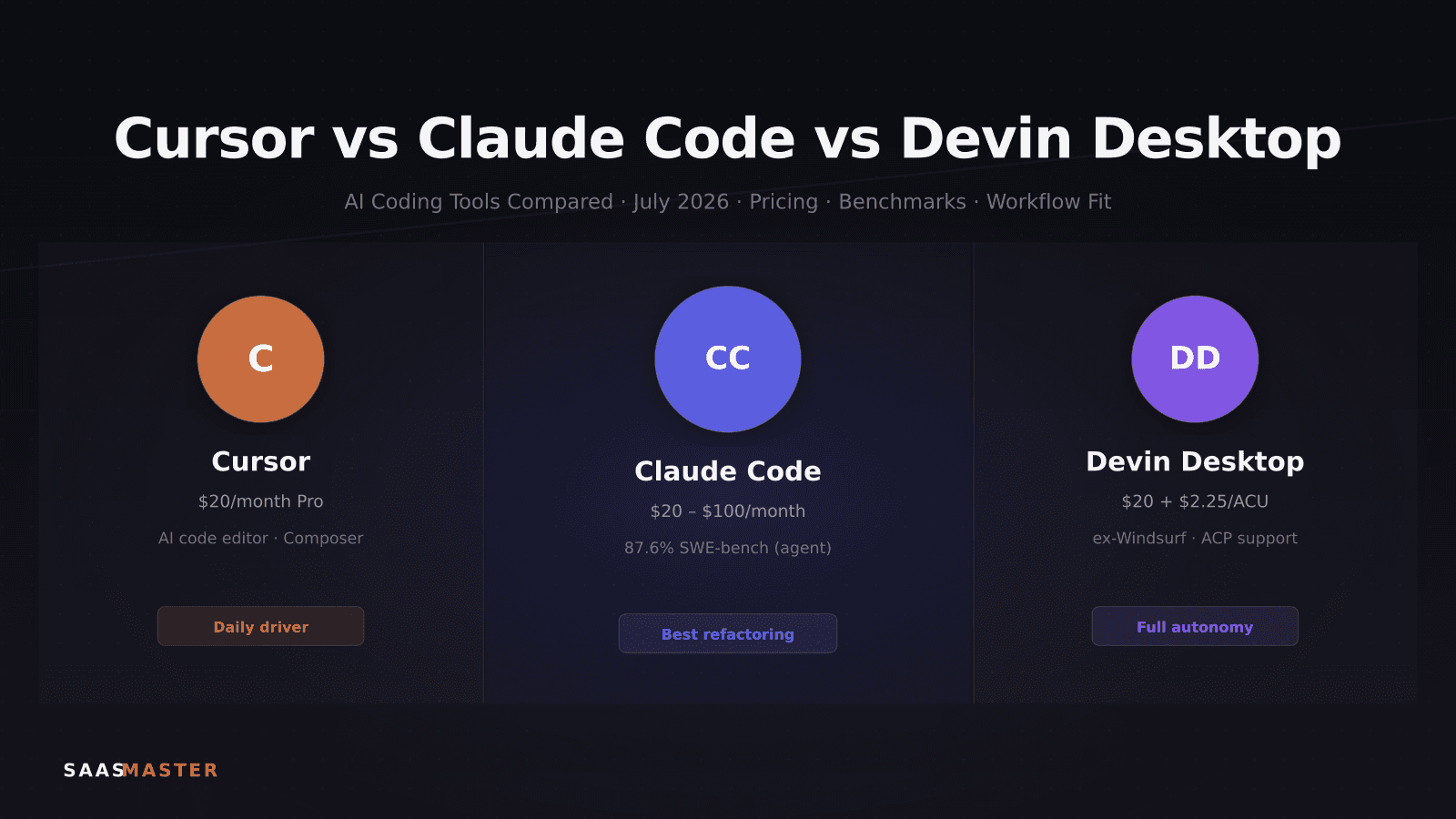
There are now three distinct tiers of AI coding tools in 2026 — and Cursor, Claude Code, and Devin Desktop sit at the top of each one. Cursor is the best-in-class AI code editor for everyday development. Claude Code is the strongest terminal-based coding agent for complex multi-file work. Devin Desktop, the platform formerly known as Windsurf, has rebranded into a full autonomous agent orchestration system. Each solves a different problem, and most serious developers use at least two of them.
This comparison covers their current pricing as of July 2026, their real benchmark scores, and the specific workflow scenarios where each one is the right choice.
Key takeaways
- Cursor: $20 per month Pro (credit-based), best for daily coding with autocomplete and multi-file edits
- Claude Code: $20 per month base, $100 per month Max 5x, fastest on complex multi-file tasks
- Devin Desktop: $20 per month plus $2.25 per ACU, 5 to 10x more expensive per task but fully autonomous
- Claude Code Remote achieves 87.6% on SWE-bench Verified — the highest score in agentic mode
- Cursor and Claude Code together at $40 per month is the sweet spot for most developers
- Devin Desktop (formerly Windsurf, renamed June 2, 2026) now supports Agent Client Protocol to run other agents inside it
- OpenCode is a free MIT-licensed alternative worth considering for budget-conscious teams
What is each tool, exactly?
Cursor is an AI-first code editor built on VS Code. It has Supermaven-powered autocomplete, multi-model support including Claude and GPT, and Composer mode for making edits across your entire project. It is the tool most developers have open on their screen all day for primary coding.
Claude Code is Anthropic's terminal-based coding agent. It works in your existing terminal, connects to your codebase, and can plan and execute multi-step tasks autonomously. Unlike Cursor's editor interface, Claude Code is built for the tasks where you hand off a problem and let it run — large refactors, security audits, multi-file migrations.
Devin Desktop is the rebranded version of Windsurf, renamed on June 2, 2026. It has evolved from an AI code editor into an autonomous agent platform. Its Agent Command Center manages local and cloud agents, and Spaces allow related agents to share context. It now supports the Agent Client Protocol, meaning you can run Cursor, Claude Code, OpenCode, and other ACP-compatible agents inside Devin Desktop.
How do the prices compare in 2026?
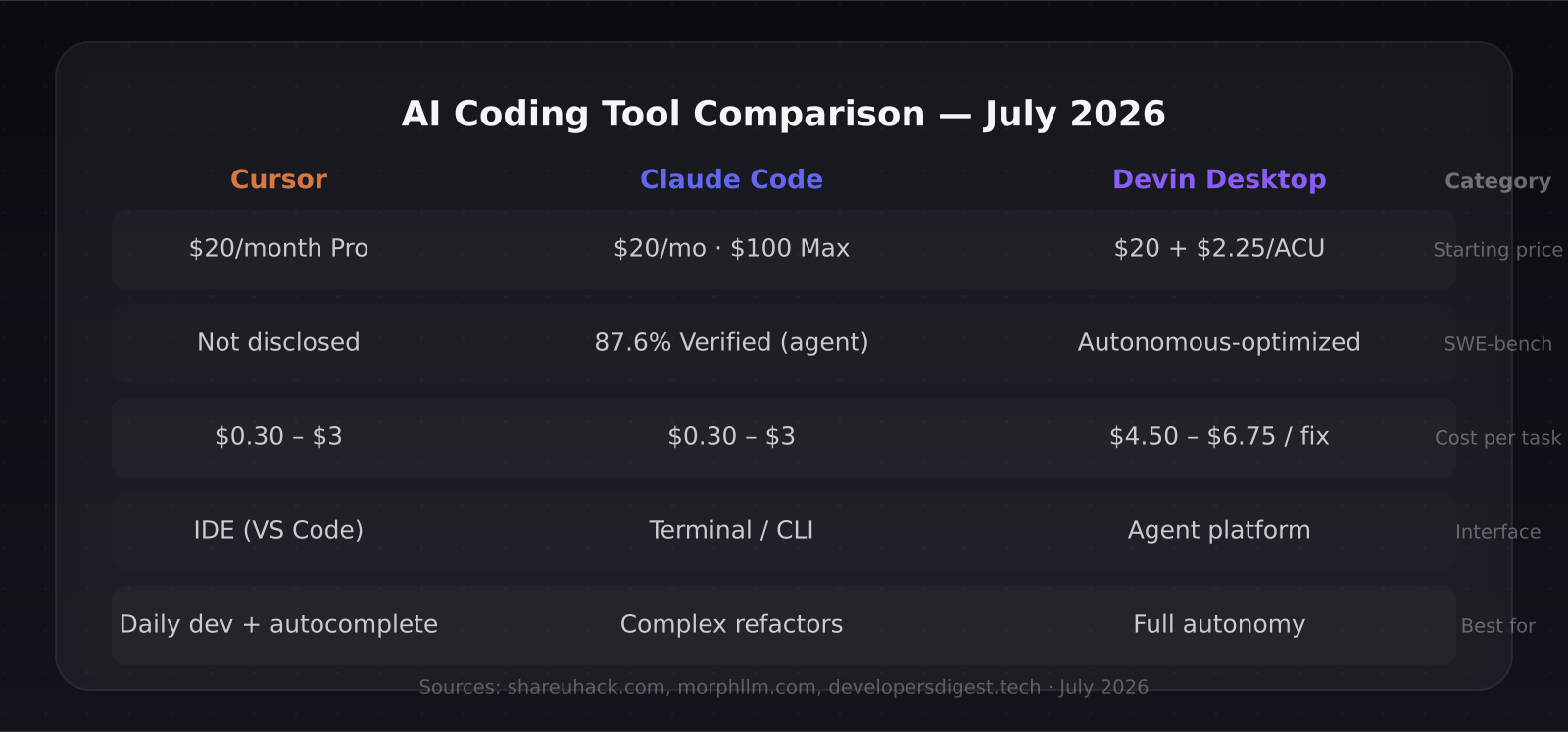
Cursor recently switched to a credit-based billing model. The $20 per month Pro plan includes a $20 credit pool. Standard autocomplete and chat draws credits slowly; Composer mode and heavy Agent use burns through them faster. The Team Standard plan is $32 to $40 per seat per month depending on whether you pay annually or monthly, and Team Premium is $96 to $120 per seat per month with 5x the usage of Standard.
Claude Code starts at $20 per month for the standard plan. Claude Code Max at $100 per month gives 5x the usage limits and is the value sweet spot for heavy users. At $100 per month pointed at Claude Fable 5, you are using the highest SWE-bench scoring model in the highest-performing agentic configuration available in 2026.
Devin Desktop is $20 per month base plus $2.25 per Agent Compute Unit. A typical bug fix requires 2 to 3 ACUs, costing $4.50 to $6.75 per task. The Team plan is $500 per month including 250 ACUs. For teams delegating 20 tasks per day, costs can exceed $2,000 per month. Devin is 5 to 10 times more expensive per task than Cursor or Claude Code when billed on model tokens.
OpenCode is worth noting separately. It is free, MIT-licensed, terminal-based, and supports 75+ model providers. It has over 150,000 GitHub stars as of mid-2026. When pointed at Claude Fable 5, it achieves the same 88.6% SWE-bench Verified score as paid tools. For developers who want maximum control and are comfortable in the terminal, it is a legitimate option alongside Claude Code and saves the $20 monthly subscription cost.
What do the benchmarks actually say?
On SWE-bench Verified, the standard industry benchmark for real GitHub issue resolution:
Claude Code Remote scores 87.6% in agentic mode using Fable 5. Cursor does not publish results at this benchmark level. Devin performs well on fully autonomous multi-step sequences but is optimized for a different use-case profile than single-session coding.
On SWE-bench Pro, the harder variant: Claude Fable 5 scores 80.3%, Opus 4.8 at 69.2%, GPT-5.5 at 58.6%.
In head-to-head task timing tests reported across multiple comparisons: Claude Code completes complex multi-file tasks in approximately 23 minutes on average versus 47 minutes for Cursor — a significant advantage on the long-tail refactoring tasks that consume developer time.
When should you use each tool?
Use Cursor when you want an IDE-like experience with AI deeply integrated into every keystroke. Autocomplete, inline suggestions, and multi-file Composer mode make Cursor the daily driver for most developers who want AI assistance without context-switching to a separate tool.
Use Claude Code for the hard problems. Large refactors, security audits, complex migrations, and any task where you want to hand off an objective and come back to a finished result. Its performance on multi-file tasks and the SWE-bench lead make it the strongest autonomous agent for software engineering in July 2026. For a broader look at how Claude Code compares to other free AI coding options, see the MiniMax M3 and Claude Code review.
Use Devin Desktop if you are managing multiple AI agents and want them to share context and work concurrently. The ACP integration means you are not locked into Devin's own agents — you can run Claude Code inside it. The higher per-task cost is justified when the value of full autonomy and coordination across a team of agents outweighs the billing premium.
The recommended combination for most developers: Cursor for daily coding plus Claude Code for refactors and complex tasks. Total cost is $40 to $220 per month depending on plan tier. For teams building SaaS products or internal tools, this stack covers the vast majority of engineering scenarios without Devin's per-ACU overhead.
What happened with Cursor and the SpaceX acquisition?
SpaceX announced a $60 billion all-stock deal to acquire Anysphere, the company behind Cursor, on June 16, 2026. The deal is expected to close in Q3 2026. Since the announcement, Cursor's market share as measured by Ramp spending data dropped from approximately 41% to 26%, while Anthropic's share climbed toward 50%.
Whether the acquisition closes or not, the uncertainty has pushed developers to evaluate alternatives — and Claude Code has been the primary beneficiary. For now, Cursor continues shipping updates and support has not changed, but the organizational uncertainty is a legitimate factor in a build-vs-buy decision for 2026.
The AI tools hub has more context on how these tools fit into a broader AI-assisted development workflow.
Frequently asked questions
Can I use Claude Code and Cursor at the same time?
Yes, and most power users do exactly this. Cursor stays open as the editor with autocomplete and Composer mode for smaller edits. Claude Code runs in a separate terminal for the larger autonomous tasks — refactors, migrations, and anything requiring multi-step reasoning across many files. The two tools complement each other well.
Is Windsurf still supported now that it is Devin Desktop?
Windsurf was officially renamed Devin Desktop on June 2, 2026. Existing Windsurf users were migrated to the Devin Desktop platform. Cognition is the company behind Devin, and they acquired Windsurf to build their Agent Command Center and ACP integration. Support is active, but the product direction has shifted toward autonomous multi-agent orchestration rather than being purely an AI code editor.
What is OpenCode and should I use it instead of Claude Code?
OpenCode is a free, open-source, MIT-licensed terminal-based coding agent with 75+ model providers and over 150,000 GitHub stars. It bills only for model inference with no tool subscription fee, and when pointed at Claude Fable 5 it achieves the same SWE-bench Verified score as Claude Code. It is a strong option for developers who want maximum flexibility and do not need Anthropic's managed platform features.
Was this article helpful?
Jorge Aguilar
Founder & Creator, SaaS Master
Producing SaaS and AI product videos since 2019 — 800+ videos for 200+ brands, covering tutorials, demos, walkthroughs, and explainers. Writing here about the tools, trends, and tactics that actually move the needle. LinkedIn · About · Work with me
Building an AI product that needs a clearer onboarding flow?
Client-owned videos that make your product easy to understand — demos, walkthroughs, onboarding, and explainers.
Explore AI product video productionRelated guides
More AI Tools & AI Workflows →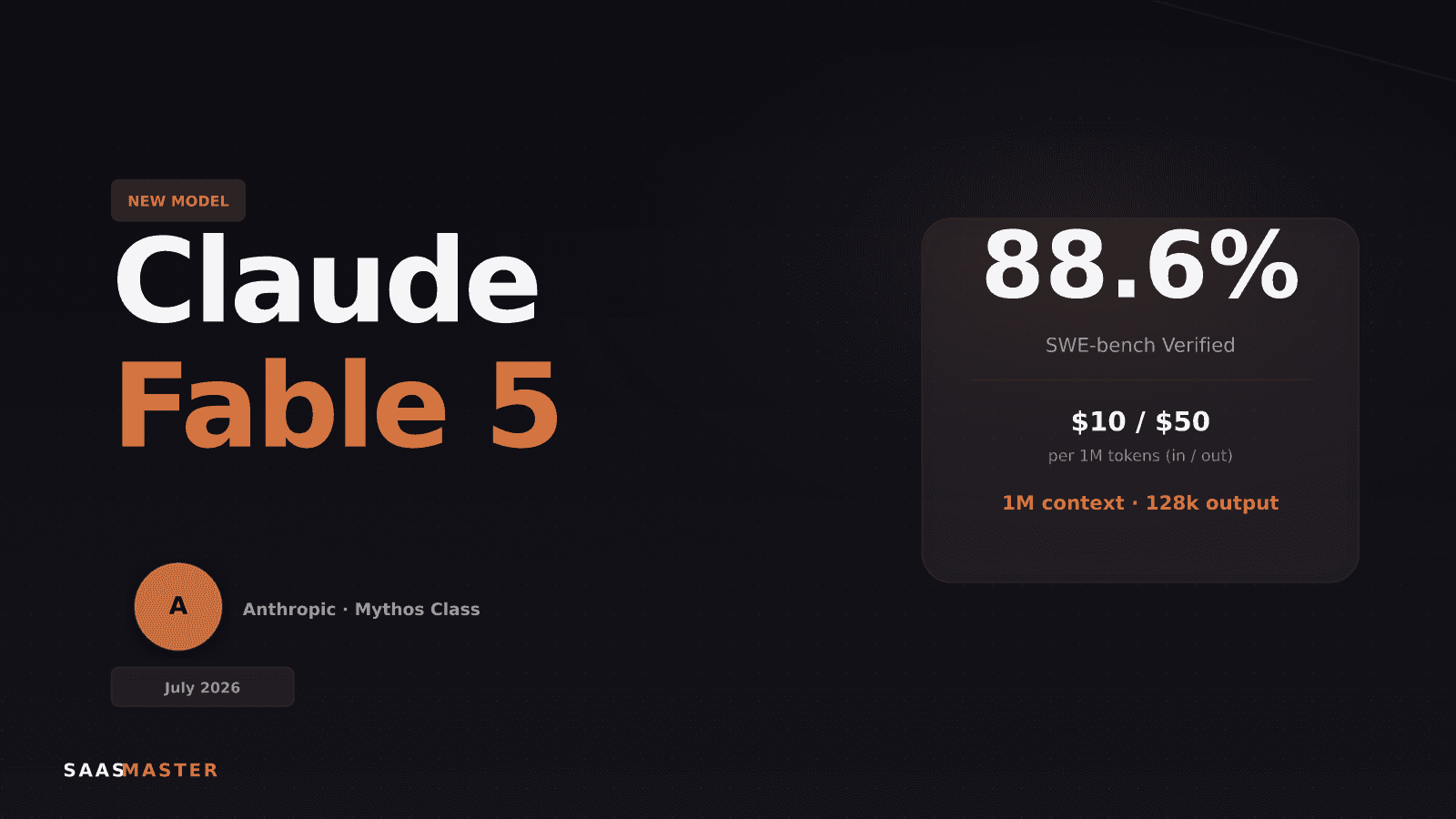
Claude Fable 5 Review: Anthropic's First Mythos-Class Model Arrives

GEO for SaaS: How to Get Your Software Brand Cited by AI Engines

Venice AI Review 2026: The Privacy-First AI Platform That Hit $1B Without Storing Your Data