Claude Fable 5 Review: Anthropic's First Mythos-Class Model Arrives
In short
Claude Fable 5 is Anthropic's first Mythos-class model with 88.6% on SWE-bench Verified, a 1M token context window, and $10 per million input tokens. Here is what it does and who should use it.
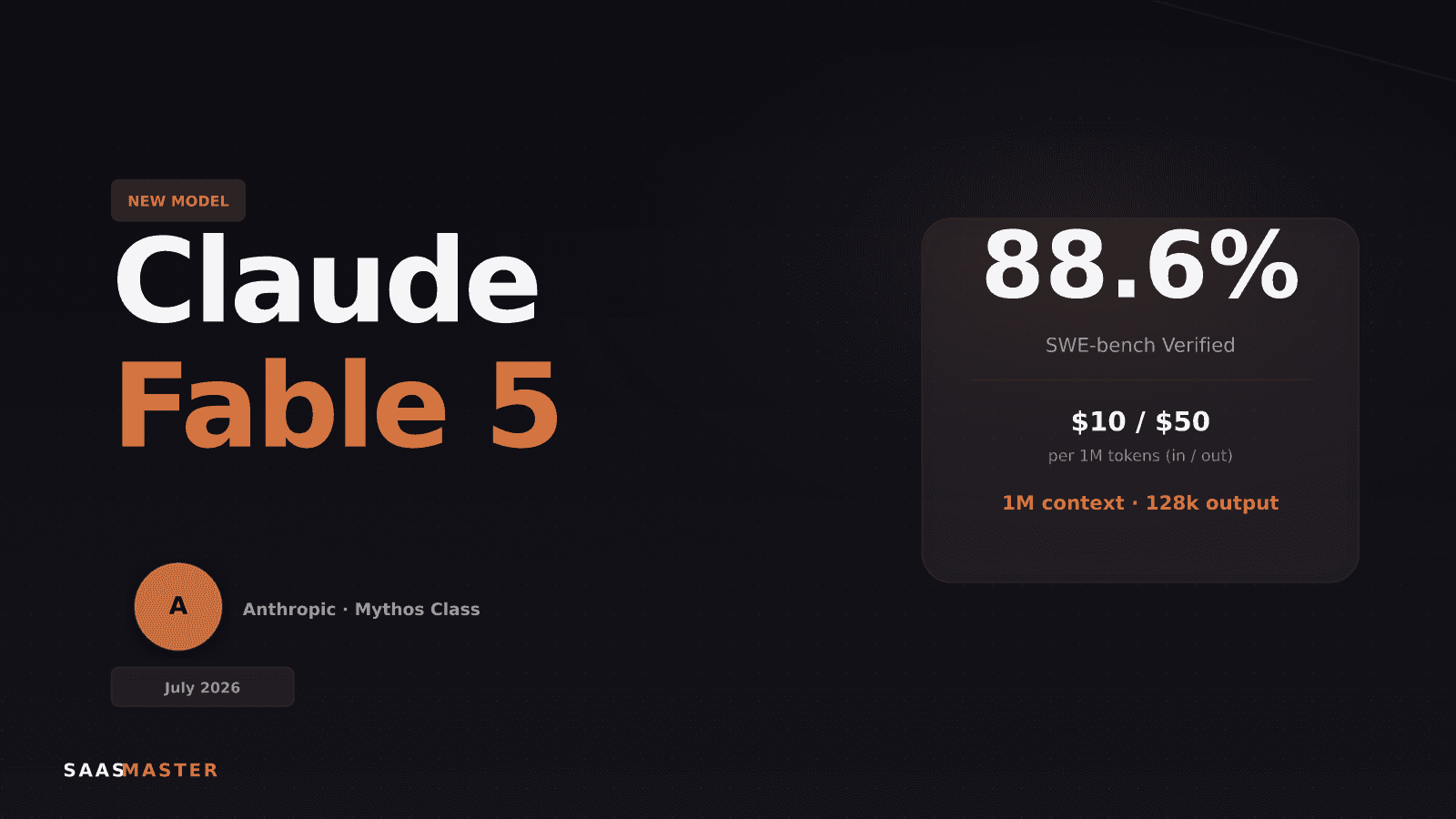
Claude Fable 5 is Anthropic's first Mythos-class model, and it arrived with a legitimate case for being the strongest coding and long-horizon reasoning model available in July 2026. On SWE-bench Verified — the most widely cited benchmark for real-world software engineering — it scores 88.6%, which is the highest of any publicly accessible model. On the harder SWE-bench Pro, it scores 80.3%, eleven points ahead of Opus 4.8 and more than twenty points ahead of GPT-5.5.
The relevant question is not whether Fable 5 is capable. It clearly is. The question is whether its pricing at $10 per million input tokens and $50 per million output tokens makes it the right tool for your actual workflow — and when Claude Sonnet 5 at $2 per million input tokens is actually the smarter choice.
Key takeaways
- 88.6% on SWE-bench Verified — highest of any publicly available model in July 2026
- 80.3% on SWE-bench Pro — 11 points ahead of Claude Opus 4.8, 21+ points ahead of GPT-5.5
- $10 per million input tokens, $50 per million output tokens via API
- 1 million token context window, up to 128,000 output tokens per request
- Prompt caching reduces input token costs by up to 90%
- Designed for large-scale autonomous coding: migrations, multi-day sessions, writing its own tests
- Safety classifiers included — Claude Mythos 5 omits them for research environments
- Metered usage credits began July 13, 2026 (was included in Pro/Max plans until July 12)
What makes Fable 5 a Mythos-class model?
The "Mythos" class is Anthropic's designation for its frontier-tier models — those positioned above the standard Opus, Sonnet, and Haiku hierarchy. Fable 5 is the first Mythos-class model made widely available to developers and enterprise customers. Claude Mythos 5, a separate model in the same class, is available without safety classifiers for controlled research environments.
The architectural advances in Fable 5 center on long-horizon reasoning and the ability to generalize to unfamiliar tools. In autonomous coding sessions, Fable 5 can write its own tests, implement designs with high fidelity, and continue working across multi-day agentic sessions without losing context.
It also demonstrates strong multimodal understanding of structured documents. Diagrams, charts, and tables embedded in PDFs and image files are understood in context — which makes it effective for tasks that combine code review with technical documentation analysis.
How does Claude Fable 5 score on benchmarks?
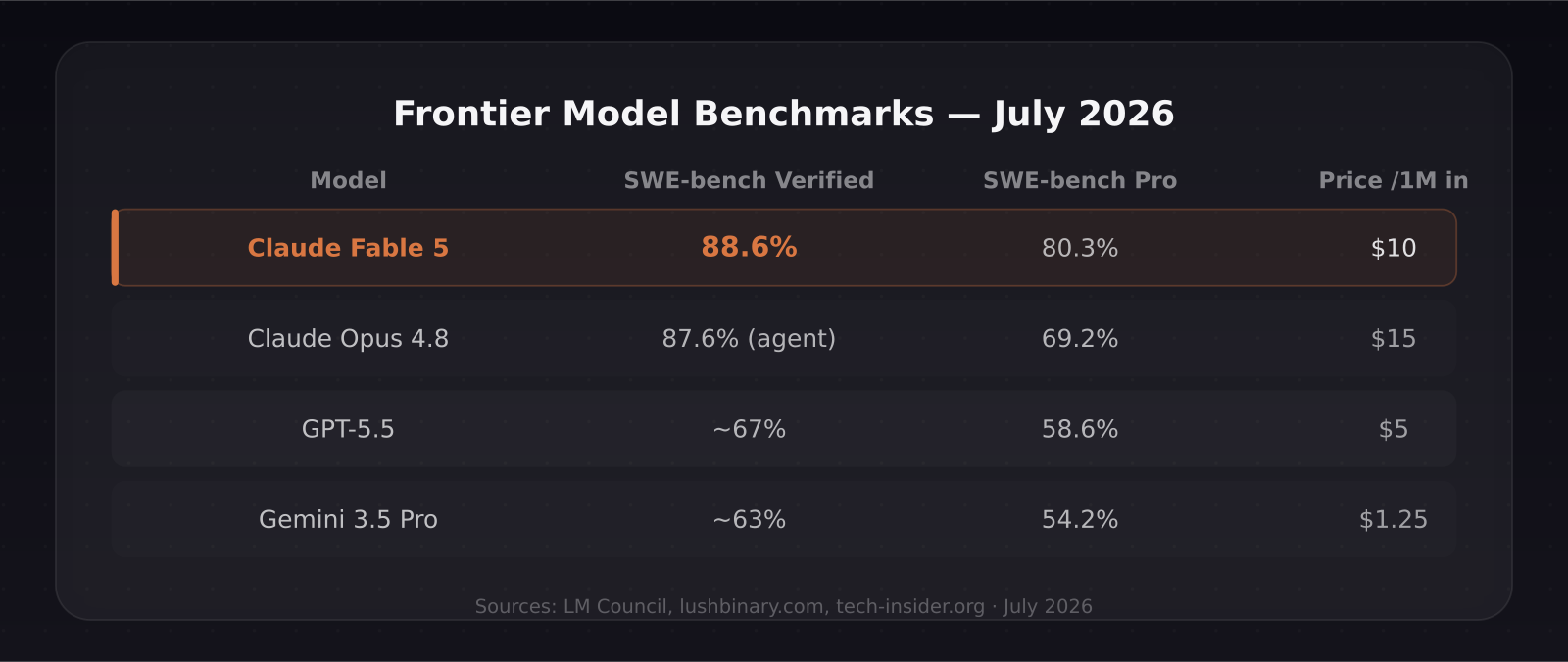
On SWE-bench Verified — which measures a model's ability to solve real GitHub issues — Fable 5 scores 88.6%, putting it clearly at the top of what is available in July 2026. Claude Code Remote, using Fable 5 as its underlying model in agentic mode, achieves 87.6%.
On SWE-bench Pro, the harder variant: Fable 5 scores 80.3%. Claude Opus 4.8 follows at 69.2%, GPT-5.5 at 58.6%, and Gemini 3.1 Pro at 54.2%. The gap between Fable 5 and the next best model on this benchmark is eleven points — a meaningful difference on the hardest real-world coding tasks.
On MMLU, a general knowledge and reasoning benchmark, Fable 5 achieves 88.7%, and Anthropic reports a 60% reduction in hallucination rate compared to GPT-5.4.
On FrontierBench, Cognition's challenging frontier coding evaluation, Fable 5 is currently the highest-scoring model publicly available.
What does Claude Fable 5 cost?
Via the Anthropic API, Fable 5 is priced at $10 per million input tokens and $50 per million output tokens. The context window is 1 million tokens, with a maximum of 128,000 output tokens per request.
Prompt caching is available and reduces input token costs by up to 90% when you are sending the same large system prompt or document repeatedly. For applications that involve large codebases as context, prompt caching can change the economics significantly.
As of July 13, 2026, Anthropic moved from included Fable 5 access — which was bundled into Pro, Max, Team, and select Enterprise plans at up to 50% of weekly limits — to metered usage credits. If you are on a paid plan, check your credits dashboard. Fable 5 use now draws from your credits balance rather than the flat monthly allowance.
Compared to the other frontier models: GPT-5.5 is priced at $5 per million input and $30 per million output. Gemini 3.5 Pro is $1.25 per million input and $10 per million output. Claude Sonnet 5 is available at $2 per million input tokens as the introductory price through August 31, 2026. Fable 5 is the most capable but also the most expensive option at the frontier tier.
Who should be using Claude Fable 5?
Fable 5 is the right choice when getting the task exactly right the first time matters more than the cost per token.
Large codebase migrations are the clearest use case. The 1M token context window means you can load an entire large application codebase and have the model reason across it coherently. If you are migrating a monolith to microservices or modernizing a legacy stack, the context advantage is real.
Multi-day autonomous coding projects are where Fable 5 was explicitly designed to perform. In combination with Claude Code, it is the underlying model powering the highest SWE-bench scores in agentic configuration. You can read about the Claude Code and MiniMax M3 free stack if you want to understand how the agentic coding landscape fits together.
Technical document analysis at scale is the third strong use case. Its ability to understand tables, charts, and diagrams embedded in PDFs makes it useful for parsing technical specifications, auditing compliance documents, or extracting structured data from mixed-format files.
For most everyday SaaS product work — writing features, fixing bugs, drafting content — Claude Sonnet 5 at $2 per million input tokens is a better value. Fable 5 is for the hard problems where the extra capability justifies the cost.
The AI tools hub on this site has comparisons of the current frontier model landscape if you want to see how Fable 5 fits against the broader market. For SaaS companies using AI for product demos and explainer content, the AI tool video production service covers how to show these capabilities clearly.
How does Claude Fable 5 compare to GPT-5.5?
GPT-5.5 is strong on agentic tooling and matches Fable 5 on raw bug-fixing in some head-to-head tests. Its pricing at $5 per million input and $30 per million output tokens is significantly lower. If your primary use case is document generation, web research, or general-purpose tasks with tool use, GPT-5.5 is a reasonable alternative at lower cost.
Where Fable 5 wins clearly: multi-file software engineering tasks, long autonomous sessions, and reasoning over complex technical documents. The SWE-bench Pro gap of more than twenty points is not a marginal difference.
Frequently asked questions
Is Claude Fable 5 available on the free Claude plan?
No. Fable 5 is available on paid plans — Pro, Max, Team, and Enterprise — now on a metered credits basis since July 13, 2026. The free Claude plan uses Claude Sonnet 5 as the default model.
What is the difference between Claude Fable 5 and Claude Mythos 5?
Both are Mythos-class models. Fable 5 includes safety classifiers for cybersecurity and biology topics, making it appropriate for general enterprise and developer use. Mythos 5 omits those classifiers and is designed for controlled research environments where they would restrict the model's usefulness.
Can I use Claude Fable 5 via Claude Code?
Yes. Claude Code supports model selection, and when configured to use Fable 5 it achieves 87.6% on SWE-bench Verified in agentic mode. For complex multi-file refactoring sessions, this is the highest-performing configuration available in July 2026.
Was this article helpful?
Jorge Aguilar
Founder & Creator, SaaS Master
Producing SaaS and AI product videos since 2019 — 800+ videos for 200+ brands, covering tutorials, demos, walkthroughs, and explainers. Writing here about the tools, trends, and tactics that actually move the needle. LinkedIn · About · Work with me
Building an AI product that needs a clearer onboarding flow?
Client-owned videos that make your product easy to understand — demos, walkthroughs, onboarding, and explainers.
Explore AI product video productionRelated guides
More AI Tools & AI Workflows →
Cursor vs Claude Code vs Devin Desktop 2026: Which AI Coding Tool Wins?
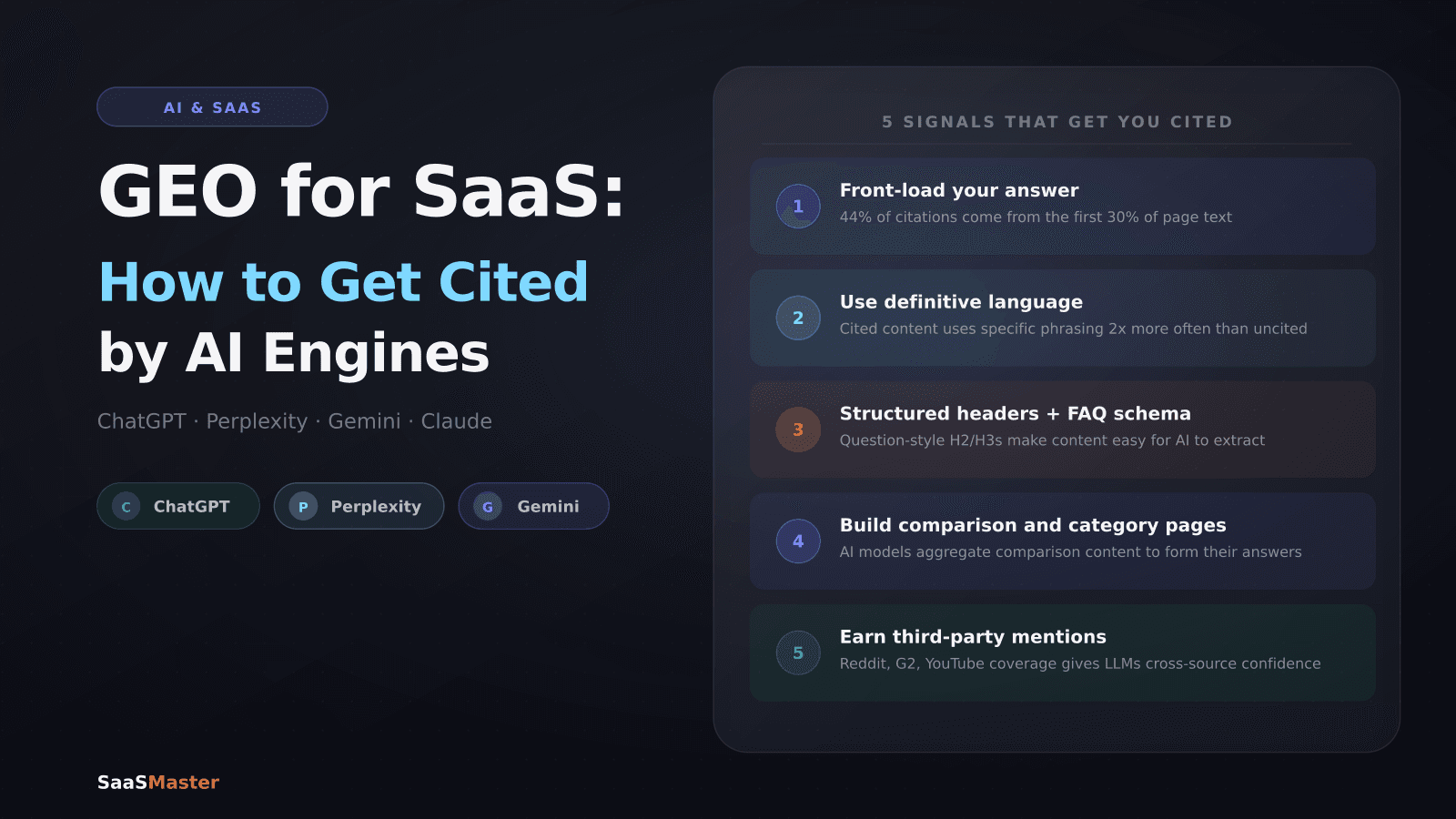
GEO for SaaS: How to Get Your Software Brand Cited by AI Engines
Venice AI Review 2026: The Privacy-First AI Platform That Hit $1B Without Storing Your Data