Kimi K3 vs DeepSeek V4 vs Qwen 3.7 Max: The Best Chinese AI Model in 2026
In short
Kimi K3 vs DeepSeek V4 vs Qwen 3.7 Max compared for 2026: real API pricing, context windows, coding benchmarks, and which Chinese AI model fits your team.
Kimi K3 landed on July 16, 2026 as the largest open-weight AI model ever released — 2.8 trillion parameters, a one-million-token context window, and native support for images and video. If you are choosing between the three big Chinese labs right now, the short answer is this: Kimi K3 is the smartest for hard reasoning and agent work, DeepSeek V4 is by far the cheapest capable option, and Qwen 3.7 Max is the specialist you hand long autonomous coding jobs.
I make videos explaining these tools for a living, so I care less about leaderboard bragging rights and more about which model earns its keep once it is wired into a real workflow. All three are worth your attention, but they win in different lanes. Here is how they compare on price, context, and benchmarks — and which one I would reach for depending on the job.
Key takeaways
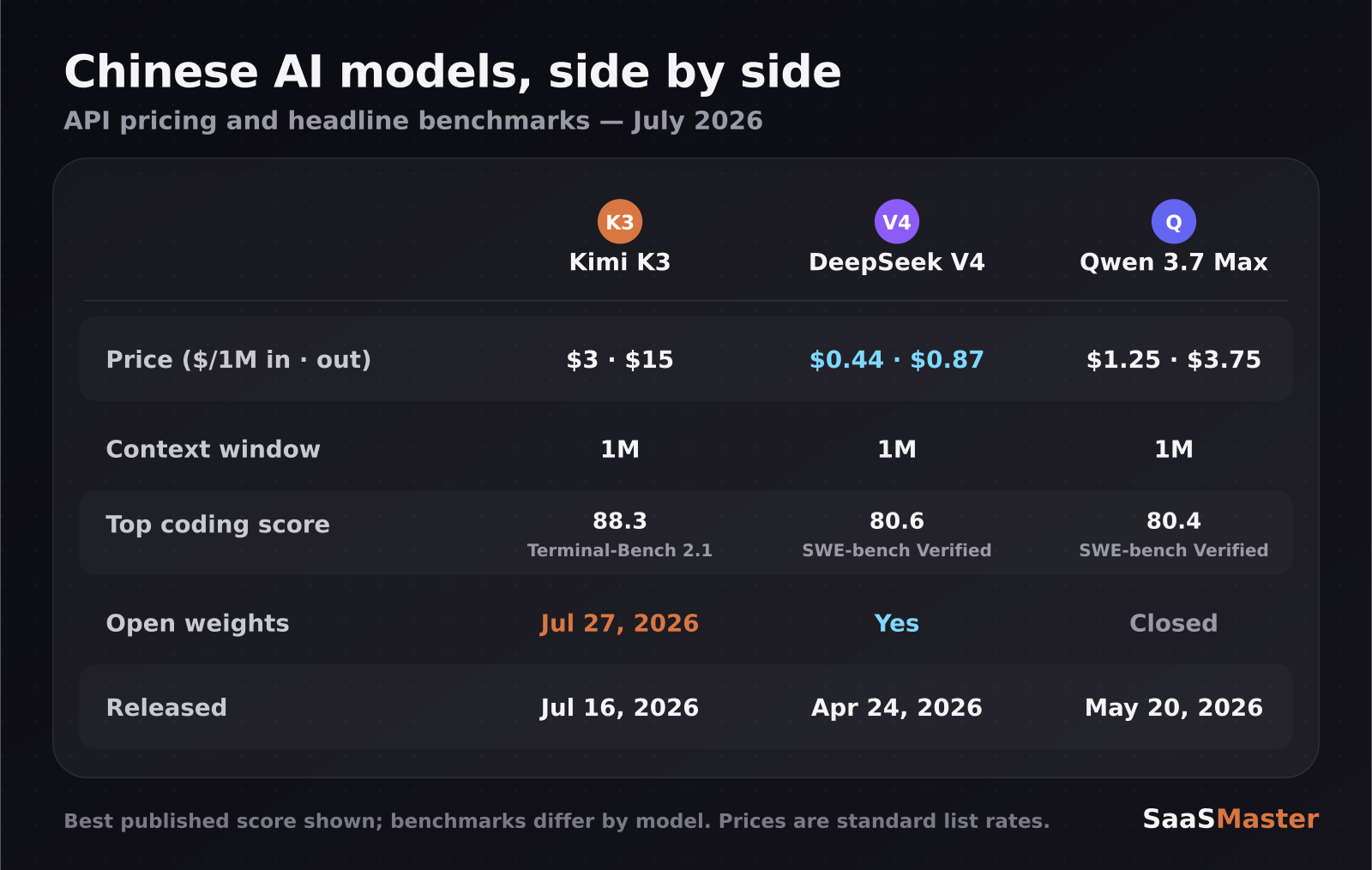
- Kimi K3 (Moonshot AI) tops the group on intelligence and agentic tasks, scoring 57 on Artificial Analysis's Intelligence Index — fourth of 189 models tracked — at $3 input / $15 output per million tokens.
- DeepSeek V4 Pro is the budget king at roughly $0.44 input / $0.87 output per million tokens, about 3–4x cheaper than Kimi, and still scores 80.6% on SWE-bench Verified.
- Qwen 3.7 Max is the agentic coding specialist: 80.4% on SWE-bench Verified and a reported 35-hour autonomous coding run — but it is closed-weight.
- All three ship a 1-million-token context window, so document-heavy work is on the table for every option.
- Kimi K3's open weights are promised by July 27, 2026; DeepSeek V4 is already open; Qwen 3.7 Max stays proprietary.
Which Chinese AI model is best right now?
If you only remember one thing: pick by job, not by hype. Kimi K3 currently sits highest on general intelligence and agent benchmarks. On Artificial Analysis's Intelligence Index it scores 57 and ranks fourth of 189 models, behind only Claude Fable 5 and two GPT-5.6 Sol settings. It posted 93.5% on GPQA Diamond — the strongest open-weight result on that test at launch — plus 88.3% on Terminal-Bench 2.1 and a headline 91.2% on BrowseComp, a browsing-agent benchmark where it led every model tracked at release.
DeepSeek V4 Pro is not trying to win the intelligence crown. It is trying to win on cost, and it does. Qwen 3.7 Max sits in between: not the cheapest, not the flashiest reasoner, but a coding workhorse Alibaba tuned for long, tool-heavy agent runs.
How much does each model cost per million tokens?
Price is where these three separate hardest, so this is worth slowing down on.
Kimi K3 costs $3.00 per million fresh input tokens and $15.00 per million output tokens, with cached input dropping to $0.30. That matches Anthropic's standard Claude Sonnet 5 list rate, though it is about 50% more than Sonnet 5's promotional pricing running through August 31, 2026.
DeepSeek V4 Pro is the outlier: about $0.435 per million input and $0.87 per million output, with those rates made permanent on May 22, 2026. There is also a V4 Flash tier at $0.14 input / $0.28 output for high-volume, lighter work. On a blended basis that makes DeepSeek roughly 3–7x cheaper than Kimi K3.
Qwen 3.7 Max lands in the middle at $1.25 per million input and $3.75 per million output, with cached input at $0.25. Its input price has actually dropped 50% over the past 90 days as competition heated up.
For a gut check: if you are pushing millions of tokens a day through summarization or classification, DeepSeek's math is hard to argue with. If you are running a smaller volume of genuinely hard reasoning or agent tasks, Kimi K3's higher token price is easier to justify because you need fewer retries.
Which is best for coding?
This is the question I get most, and the honest answer is that it is close at the top.
Qwen 3.7 Max is the purpose-built coder. It scores 80.4% on SWE-bench Verified, 69.7 on Terminal-Bench 2.0, and ranks third of 78 models on aggregate coding benchmarks with an average of 88.8. Alibaba's internal testing reported a 35-hour autonomous coding run that fired 1,158 tool calls without falling over — the kind of long-horizon reliability that matters when you hand an agent a real feature to build.
DeepSeek V4 Pro is right there at 80.6% on SWE-bench Verified, essentially tied with Qwen and within a fraction of a point of Claude Opus 4.7 — at a small fraction of the price. For cost-sensitive teams that ship a lot of routine code, that combination is tough to beat.
Kimi K3 did not publish a headline SWE-bench Verified figure at launch, but it led the field on SWE Marathon and Program Bench and trailed only GPT-5.6 Sol on Terminal-Bench 2.1 by half a point (88.3%). Its architecture is the interesting part: Kimi Delta Attention, which Moonshot credits with up to 6.3x faster decoding in million-token contexts, so it stays usable when you feed it an entire codebase.
Kimi K3: the new open-weight heavyweight
Kimi K3 is the story of the week. It is a 2.8-trillion-parameter mixture-of-experts model that activates just 16 of 896 experts per token, which is how a model that big stays affordable to run. It is natively multimodal across text, images, and video, and Moonshot has committed to releasing the open weights by July 27, 2026 — which would make it the most capable open model anyone can self-host.
For a creator or small team, the appeal is frontier-class reasoning you can eventually run on your own terms rather than renting forever. The caveat: at launch it is only available through Moonshot's website and API, so the self-hosting promise is still a promise until those weights actually drop.
DeepSeek V4: the cheapest capable option
DeepSeek V4 Pro is a 1.6-trillion-parameter mixture-of-experts model with 49 billion active parameters and a 1-million-token context window. It has been out since April 24, 2026, so it is battle-tested, and it is already fully open-weight with a wide list of hosting providers.
Its pitch is simple and powerful: near-frontier coding at a price that makes high-volume automation viable. If you are building something that calls a model thousands of times a day, DeepSeek is usually the first place I would run the numbers.
Qwen 3.7 Max: the agentic coding specialist
Qwen 3.7 Max launched May 20, 2026 from Alibaba and is built for agents that work unattended. Its strengths are long tool-use chains and coding reliability, and its 1-million-token window means it can hold a big project in view at once.
The trade-off is openness. Unlike DeepSeek and the coming Kimi weights, Qwen 3.7 Max is proprietary — you use it through Alibaba's API, not on your own hardware. If self-hosting or full data control is a hard requirement, that rules it out regardless of how good the coding numbers look.
Which one should you actually pick?
Here is how I would decide, in plain terms:
- Pick Kimi K3 if you want the smartest all-rounder for reasoning, research agents, and multimodal work — and you like the idea of open weights you can host later.
- Pick DeepSeek V4 if cost per token is your top constraint and you are running lots of coding or automation volume.
- Pick Qwen 3.7 Max if your main job is long, autonomous coding agents and you are comfortable staying on a closed API.
None of these is a wrong answer, and the gap to the very best closed models keeps shrinking. If you want more on the open-weight side of this race, see our review of MiniMax M3, another open-weight frontier model, and browse the full AI tools library for deeper comparisons. When you are ready to put one to work, connecting a model to your WordPress site or wiring it into a no-code automation is where the leverage shows up. And if you would rather show people how it works than write another doc, that is exactly what a good AI tool video is for.
Frequently asked questions
Is Kimi K3 actually open source?
Kimi K3 is open-weight, not fully open source. Moonshot AI has said it will release the model weights by July 27, 2026, which lets you download and self-host the model, but that is different from releasing all training data and code. At launch, K3 was available only through Moonshot's own website and API.
Which Chinese AI model is cheapest?
DeepSeek V4 Pro is the cheapest of the three, at roughly $0.435 per million input tokens and $0.87 per million output tokens, with an even cheaper V4 Flash tier. That is several times less expensive than Kimi K3 and comfortably under Qwen 3.7 Max, which is why it is a common pick for high-volume automation.
Are these models safe to use with business data?
Using them through a Chinese lab's hosted API means your prompts leave your infrastructure, so treat them like any third-party cloud service and avoid sending regulated or highly sensitive data. The advantage of the open-weight options — DeepSeek V4 today, Kimi K3 once its weights ship — is that you can self-host and keep data in your own environment.
Was this article helpful?
Jorge Aguilar
Founder & Creator, SaaS Master
Producing SaaS and AI product videos since 2019 — 800+ videos for 200+ brands, covering tutorials, demos, walkthroughs, and explainers. Writing here about the tools, trends, and tactics that actually move the needle. LinkedIn · About · Work with me
Building an AI product that needs a clearer onboarding flow?
Client-owned videos that make your product easy to understand — demos, walkthroughs, onboarding, and explainers.
Explore AI product video production