Gemini 3.5 Pro Is Here: What Google's July 17 Launch Means for SaaS Teams
In short
Google's Gemini 3.5 Pro lands July 17, 2026 with a reported 2M-token context and Deep Think reasoning. Here's what's confirmed and what it means for SaaS teams.
Google's Gemini 3.5 Pro is targeting general availability on July 17, 2026, and it arrives as a near-total rebuild rather than a routine point update. The headline claims are a reported 2-million-token context window (double what Flash offers) and a new Deep Think reasoning layer for multi-step problems. The honest catch: as of launch, Google has not officially confirmed the context number or the pricing, so the smart move for SaaS teams is interest, not a rushed migration.
Key takeaways
- Gemini 3.5 Pro is slated for July 17, 2026, after Google scrapped and rebuilt the base model, which pushed the date back.
- A 2-million-token context window and a Deep Think reasoning mode are the marquee features, but the context figure is reported, not officially confirmed.
- Reported API pricing is around $15 per million input tokens and $60 per million output tokens; Google has not published an official price.
- Early testers suggest Pro trails Claude Fable 5 and GPT-5.6 on the hardest reasoning, coding and long-horizon tasks.
- For most SaaS teams, the right call today is to pilot, not replace a working stack on day one.
What did Google actually launch?
Gemini 3.5 Pro is Google DeepMind's new flagship model, and the story behind it matters. Google delayed the release to July 17 after scrapping its original base model and rebuilding from scratch, which is why the launch slipped from earlier in the year. Reporting also noted that several senior Google researchers left for Anthropic during the same stretch, so this launch carries a bit more pressure than usual.
Two things are consistently described as confirmed: the model exists as a rebuilt Pro tier, and it ships with a Deep Think reasoning layer, Google's version of extended, multi-step reasoning that competes with Anthropic's extended thinking and OpenAI's high-effort modes. One more differentiator keeps coming up: Gemini 3.5 Pro is being positioned as the frontier model without a government access restriction, which could matter for some regulated buyers.
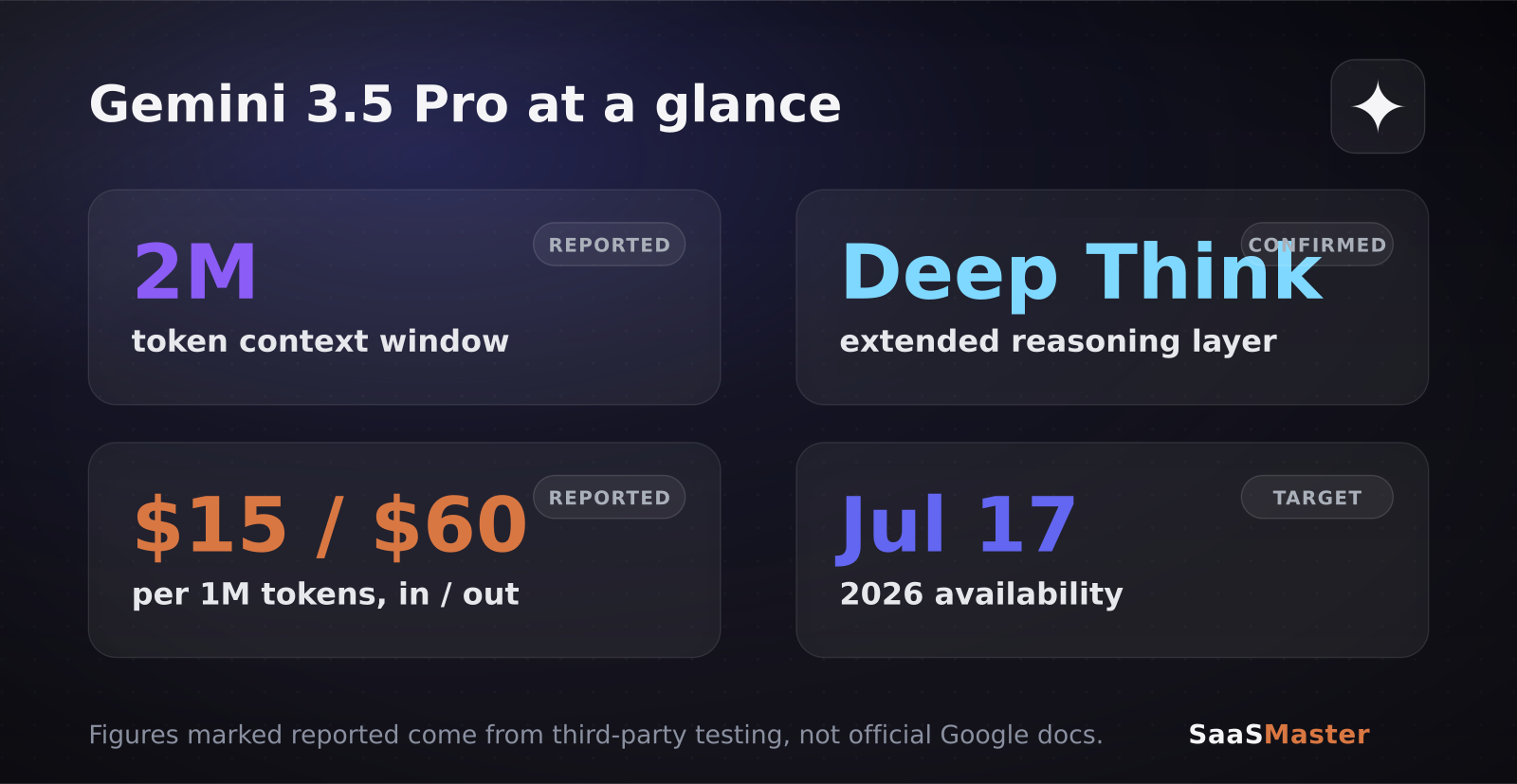
Everything in the card above marked reported comes from third-party testing and unnamed sources, not an official Google spec sheet. That distinction is the whole ballgame right now, and it is exactly the kind of thing I keep separate when I put a tool through my testing process.
Gemini 3.5 Pro vs GPT-5.6 and Claude Sonnet 5: how does it compare?
This model does not land in a vacuum. In 2026, Anthropic's Claude Sonnet 5, OpenAI's GPT-5.6 family (Sol, Terra and Luna) and xAI's Grok 4.5 all shipped within weeks of each other, and Moonshot's open Kimi K3 landed on July 16. The frontier is crowded, and the differences are now about fit, not raw capability alone.
On paper, Gemini 3.5 Pro's pitch is context length and reasoning: a 2-million-token window would be the largest in any production frontier model, which is genuinely useful if you feed models entire codebases or long document sets. The counterpoint is that early-tester reporting suggested Pro trailed Claude Fable 5 and GPT-5.6 on the hardest advanced reasoning, coding and long-horizon tasks. In other words, biggest context does not automatically mean best answers. If you are weighing the broader ecosystem plays, my Gemini Enterprise versus Claude Cowork versus ChatGPT Work comparison breaks down the workspace layer these models sit under.
What is Deep Think, and why does the 2M context matter?
Deep Think is Google's extended-reasoning mode. Instead of answering in one pass, the model spends more compute working through a problem step by step before responding, which tends to help on math, complex coding and logic while costing more time and tokens. If you have used Claude's extended thinking or a high-effort setting elsewhere, it is the same idea with Google's branding.
The catch worth planning for is that Deep Think is not free. Because it burns more tokens and takes longer, you do not want it switched on for every request; the sensible pattern is to reserve extended reasoning for genuinely hard problems and use the standard mode for routine calls, so your bill and your latency stay sane.
The 2-million-token context, if it holds, is the more practical draw for SaaS teams. A window that large means you can drop an entire repository, a full knowledge base, or a stack of long contracts into a single prompt without chunking and retrieval gymnastics. That simplifies a lot of retrieval-augmented pipelines. The caveat is real, though: large context windows often degrade in the middle, so a two-million-token limit is a ceiling, not a promise that the model uses every token equally well.
How does this fit the July 2026 model wave?
Gemini 3.5 Pro is one wave in a very busy month. July 2026 alone brought Moonshot's open Kimi K3, a 2.8-trillion-parameter mixture-of-experts model, on July 16, on top of the recent arrivals of Claude Sonnet 5, the GPT-5.6 family and Grok 4.5. For SaaS teams, the practical effect of this pace is that switching costs matter more than ever: whatever you standardize on today will have a credible challenger within weeks, so favor an architecture that lets you swap models without rewriting your product.
There is a policy backdrop too. Reporting indicates the White House is in advanced talks with OpenAI, Google and Anthropic to finalize voluntary standards for how frontier models are released, with an announcement possibly within days. That will not change your prompt tomorrow, but it points toward a near future where launches like this one come with more disclosure, which is exactly what buyers who are currently relying on reported specs actually need.
Should your SaaS team switch?
My practical advice is to pilot, not migrate. Wire Gemini 3.5 Pro into a non-critical workflow, ideally one that actually benefits from huge context, such as summarizing long documents or reasoning over a big codebase, and compare it head to head against whatever you run today on your own prompts. Public benchmarks are noisy and, right now, partly unconfirmed, so your evaluation on your tasks is the only score that counts.
Hold off on ripping out a working model until Google publishes official pricing and specs, because building on reported numbers is how budgets get surprised. For teams standardizing an AI stack from scratch, the wider AI tools library and my Inkling open-weight model breakdown cover the trade-offs between hosted frontier models and open weights you can run yourself. And when you need to explain your AI features to customers on video, that is where my AI tool video production comes in.
The caveats: what Google hasn't confirmed
To be fair to everyone reading this in a rush: the 2-million-token context, the roughly $15 and $60 per-million-token pricing, and most of the circulating benchmark numbers are not in any official Google documentation at launch. They come from leaks, early testers and third-party trackers. That does not make them wrong, but it does make them provisional. Treat this launch as a strong signal of direction and verify the specifics against Google's own materials before you commit spend or ship it to customers.
Frequently asked questions
When is Gemini 3.5 Pro available?
Gemini 3.5 Pro is targeting general availability on July 17, 2026. The date slipped from earlier in the year because Google scrapped its original base model and rebuilt it. As with any launch, staged rollout means access may reach different regions and tiers over the following days.
How much does Gemini 3.5 Pro cost?
Reported API pricing is roughly $15 per million input tokens and $60 per million output tokens, but Google had not published an official pricing page at launch. Treat those figures as provisional and confirm against Google's own API documentation before budgeting.
Is Gemini 3.5 Pro better than GPT-5.6 or Claude?
Not clearly. Its standout claim is a reported 2-million-token context window, the largest around, but early testers suggested it trailed Claude Fable 5 and GPT-5.6 on the hardest reasoning and coding tasks. The best model depends on your workload, so test it on your own prompts rather than trusting a single benchmark.
Was this article helpful?
Jorge Aguilar
Founder & Creator, SaaS Master
Producing SaaS and AI product videos since 2019 — 800+ videos for 200+ brands, covering tutorials, demos, walkthroughs, and explainers. Writing here about the tools, trends, and tactics that actually move the needle. LinkedIn · About · Work with me
Building an AI product that needs a clearer onboarding flow?
Client-owned videos that make your product easy to understand — demos, walkthroughs, onboarding, and explainers.
Explore AI product video production