Why You Still Need Humans in the Age of AI: A Fiverr Pro Review
In short
A Fiverr Pro review for 2026: where AI freelancing wins, where vetted humans still win, and how Fiverr Go blends both, with real pricing.
You still need humans in the age of AI because the models are brilliant at commodity work and unreliable at the things that carry real risk: judgement, taste, accountability and a brief that isn't fully spelled out. Fiverr Pro is Fiverr's answer to exactly that tension, a vetted layer of professionals for the work you cannot afford to get wrong. After spending time in it, my short verdict is that AI has raised the floor for freelancing, not removed the ceiling.
[[video:SwtbfRUq9_4]]
In the video I make the case on camera. This companion review adds the parts a short clip can't: what Fiverr Pro actually includes, how Fiverr's new AI platform fits in, real 2026 pricing, and a simple rule for deciding when to hand a task to a model versus a person.
Key takeaways
- AI wins on speed, cost and scale; humans still win on judgement, taste and accountability.
- Fiverr Pro is the vetted tier: proficiency assessments, ID verification and client reviews on higher-stakes services.
- Fiverr Go is Fiverr's AI platform, where creators train a personal AI model on their own work and earn when clients use it, from $25 per month for three models.
- Fiverr Pro's Advanced plan runs $129 per month; the Essential plan can be free for a year, then kept by ordering about $1,000 of services annually.
- The smart play in 2026 is AI plus a human, not AI instead of one.
What is Fiverr Pro?
Fiverr Pro is Fiverr's business-focused tier for teams that want vetted freelancers rather than the open marketplace. Where anyone can list a gig on regular Fiverr, Pro sellers pass a rigorous application and have to meet specific quality standards, and the platform layers on account management, team tools, sourcing help and structured payments on top.
The vetting is the product. Fiverr Pro and Fiverr Certified are positioned as segmented talent for higher-stakes services, backed by proficiency assessments, ID verification and real client reviews. If you have ever lost a week to a cheap gig that fell apart on delivery, that curation is what you are paying for.
Fiverr Pro vs regular Fiverr: what is the difference?
The gap between the two tiers is trust and process. On regular Fiverr, anyone can create a gig, prices start low, and the burden of vetting falls entirely on you: reading reviews, testing with a small order, and hoping the delivery matches the portfolio. It is genuinely great for quick, low-risk tasks, and it is where most people start.
Fiverr Pro flips that. Sellers are pre-screened through an application, identity checks and proficiency assessments, and business buyers get account management, team seats and structured payments on top. You pay more, but you are buying down risk on work where a bad outcome costs real money. The rule of thumb I use is simple: regular Fiverr for cheap and reversible, Pro for expensive and consequential.
Where does AI actually win?
Being honest about where the machines are better is what makes the human case credible. AI genuinely wins on the commodity end of creative and knowledge work: fast first drafts, bulk variations, predictable templated tasks, and around-the-clock availability at near-zero marginal cost. If the job is to produce twenty subject-line options or a rough transcript by morning, a model is the right tool and a person is a waste of money.
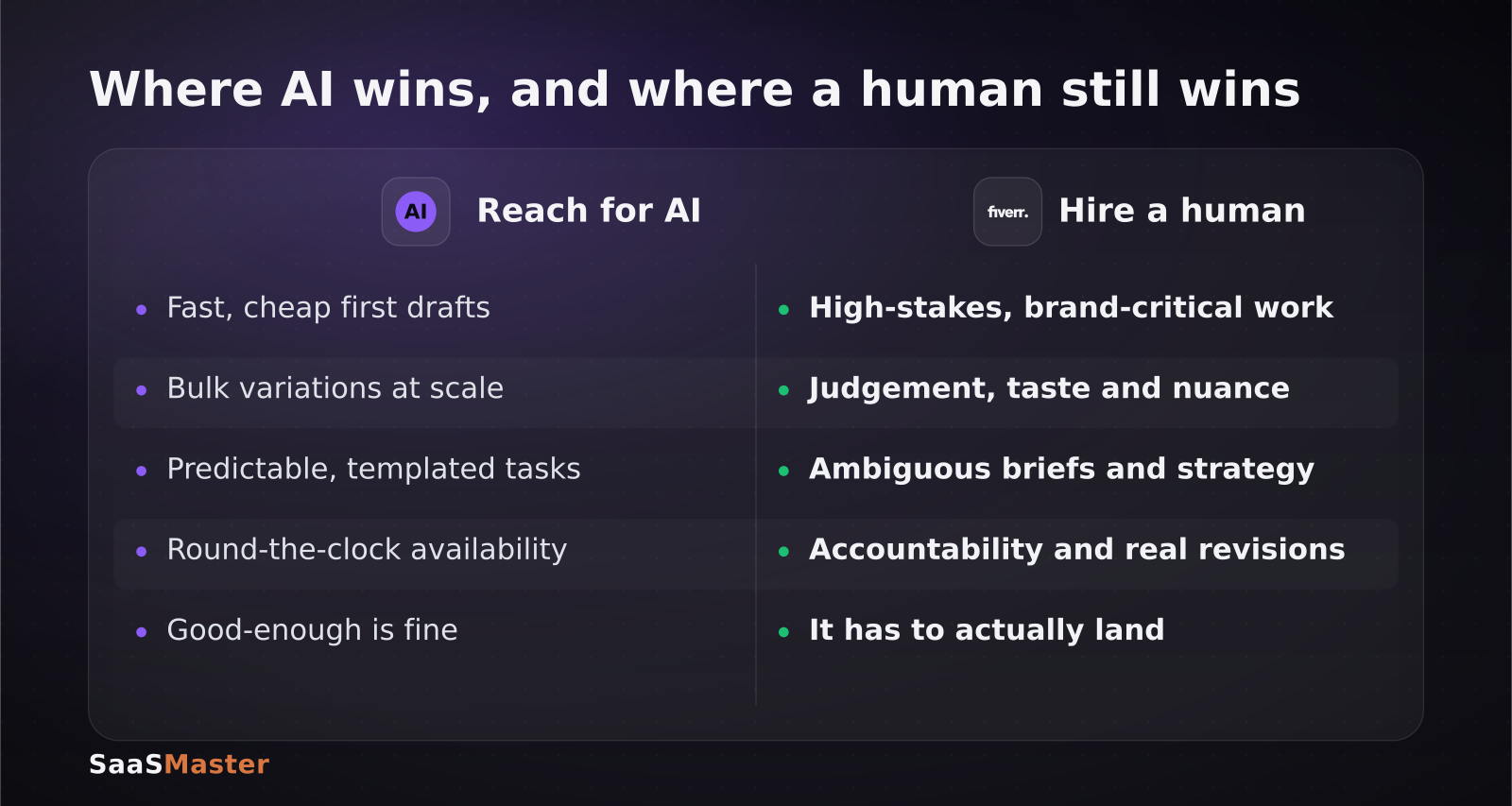
The table above is the rule I actually use. When a task lives in the left column, reach for AI. When it drifts into the right column, where a wrong answer is expensive or the brief is fuzzy, that is when a vetted human earns their rate.
Where do you still need a human?
The ceiling AI keeps bumping into is judgement. A model will confidently produce something plausible for an ambiguous brief; a good freelancer asks the question that reframes the whole project. Humans still own the high-stakes deliverables, the brand voice that has to land with a specific audience, the strategic calls, and, crucially, accountability. When a model is wrong there is no one on the hook. When you hire a Pro, revisions and responsibility come with the invoice.
There is a trust dimension too. For anything a customer or investor will scrutinize, a named professional who stands behind the work carries weight that an anonymous generation never will. That is the same reason a founder-led product demo video that converts still outperforms a purely synthetic one: people buy from people.
What is Fiverr Go, and does it change the answer?
Fiverr's own bet is that the future is both, and Fiverr Go is how they are building it. Launched in 2026, Fiverr Go lets a creator train a personal AI model exclusively on their own body of work, set their own price, keep ownership, and earn every time a client uses it. A companion personal AI assistant learns each freelancer's preferences to handle client communication, routine tasks and business insights.
It is not free labour for a faceless model, which is the important part. Access starts with top, vetted freelancers, the subscription runs about $25 per month for three models, and Fiverr reports its AI package optimizer lifts conversion by roughly 23% and average order value by about 31%. In other words, Fiverr is trying to turn the AI-versus-human question into an AI-plus-human answer, where the human still owns the model and the outcome.
What does Fiverr Pro cost?
Pricing depends on how heavily you lean on it. The Advanced plan is $129 per month for teams that need the full sourcing and management layer. The Essential plan can be accessed with zero upfront cost for a year, after which eligibility is maintained by ordering roughly $1,000 of services annually. On top of the plan you pay for the actual gigs, and Fiverr's service fees apply as usual.
For a small SaaS team, the math is simple: if you are buying enough freelance work that vetting and a single point of contact save you even a few bad hires a year, Pro pays for itself. If you order occasionally, the free Essential tier is the sensible starting point. This is exactly the kind of tool I run through my testing process before recommending it.
My verdict
Fiverr Pro is a strong buy for teams that have felt the pain of the open marketplace and want a guardrail of vetted talent, and Fiverr Go is a genuinely interesting attempt to keep humans in the loop as AI eats the commodity tier. The headline stays the same: in 2026, the winning setup is AI for the volume and a trusted human for the parts that matter. If you are choosing AI tools more broadly, my Gemini Enterprise versus Claude Cowork versus ChatGPT Work comparison and the wider AI tools library are good next stops, and the Inkling open-weight model breakdown covers the infrastructure side. When you need those AI stories told on video, that is what my AI tool video production work is built for.
Frequently asked questions
Is Fiverr Pro worth it in 2026?
It is worth it if you regularly hire freelancers for work you cannot afford to get wrong. The vetting, proficiency assessments and ID verification reduce the risk of a bad delivery, and the account management saves time. Occasional buyers can start on the free Essential tier and upgrade to the $129-per-month Advanced plan when volume justifies it.
Will AI replace Fiverr freelancers?
Not wholesale. AI is replacing the commodity tier, such as rough drafts and bulk variations, but high-stakes, judgement-heavy and accountable work still goes to humans. Fiverr Go is the platform's response, letting freelancers earn from their own AI models rather than being replaced by generic ones.
What is the difference between Fiverr Pro and Fiverr Go?
Fiverr Pro is a tier of vetted human professionals for business buyers. Fiverr Go is an AI platform where creators train a personal AI model on their own work and clients pay to use it, from about $25 per month for three models. Pro is about people; Go is about the AI those people own.
Was this article helpful?
Jorge Aguilar
Founder & Creator, SaaS Master
Producing SaaS and AI product videos since 2019 — 800+ videos for 200+ brands, covering tutorials, demos, walkthroughs, and explainers. Writing here about the tools, trends, and tactics that actually move the needle. LinkedIn · About · Work with me
Building an AI product that needs a clearer onboarding flow?
Client-owned videos that make your product easy to understand — demos, walkthroughs, onboarding, and explainers.
Explore AI product video productionRelated guides
More AI Tools & AI Workflows →
Kimi K3 vs DeepSeek V4 vs Qwen 3.7 Max: The Best Chinese AI Model in 2026
GEO for SaaS: How to Get Your Software Cited in AI Answers
Claude Code vs Cursor vs Windsurf: The Best AI Coding Agent in 2026