GEO for SaaS: How to Get Your Software Cited in AI Answers
In short
GEO for SaaS: how to get your software cited in AI answers from ChatGPT, Perplexity, and Gemini using clear structure, schema, FAQs, and video content.
When a buyer asks ChatGPT or Perplexity for "the best tool to do X," your software is either named in the answer or it is invisible — and generative engine optimization (GEO) is how you tilt that in your favor. GEO is the practice of structuring your content so AI answer engines can find it, trust it, and quote it back to the person asking. The short version: publish genuinely useful pages, structure them so a model can lift a clean answer straight out of them, back every claim with specifics, and make sure the technical basics let AI crawlers read you. Here is how that works for a SaaS brand.
Key takeaways
- GEO optimizes for being quoted in an AI answer; traditional SEO optimizes for being clicked. You need both, and they reinforce each other.
- Structure is the fastest win: descriptive headings, direct question-and-answer pairs, and comparison tables are the easiest things for a model to extract and cite.
- Specific, verifiable claims get cited far more than vague ones — "cut onboarding from 14 days to 5" beats "faster onboarding" every time.
- Schema markup and clean indexing are table stakes; one analysis found most AI-cited pages include structured data.
- Video is a citable surface too. YouTube results and transcripts appear in AI answers, so a clear product video gives engines another place to quote you.
What is GEO, and how is it different from SEO?
The cleanest way to hold the difference in your head: SEO gets you clicked, GEO gets you quoted. Classic SEO aims to rank a blue link that a person then clicks. GEO aims to have your content pulled into the AI's synthesized answer, ideally with a citation next to your name. The two overlap — being crawlable and authoritative helps both — but they are not identical, because an AI engine is deciding which sentences to lift, not which link to show.
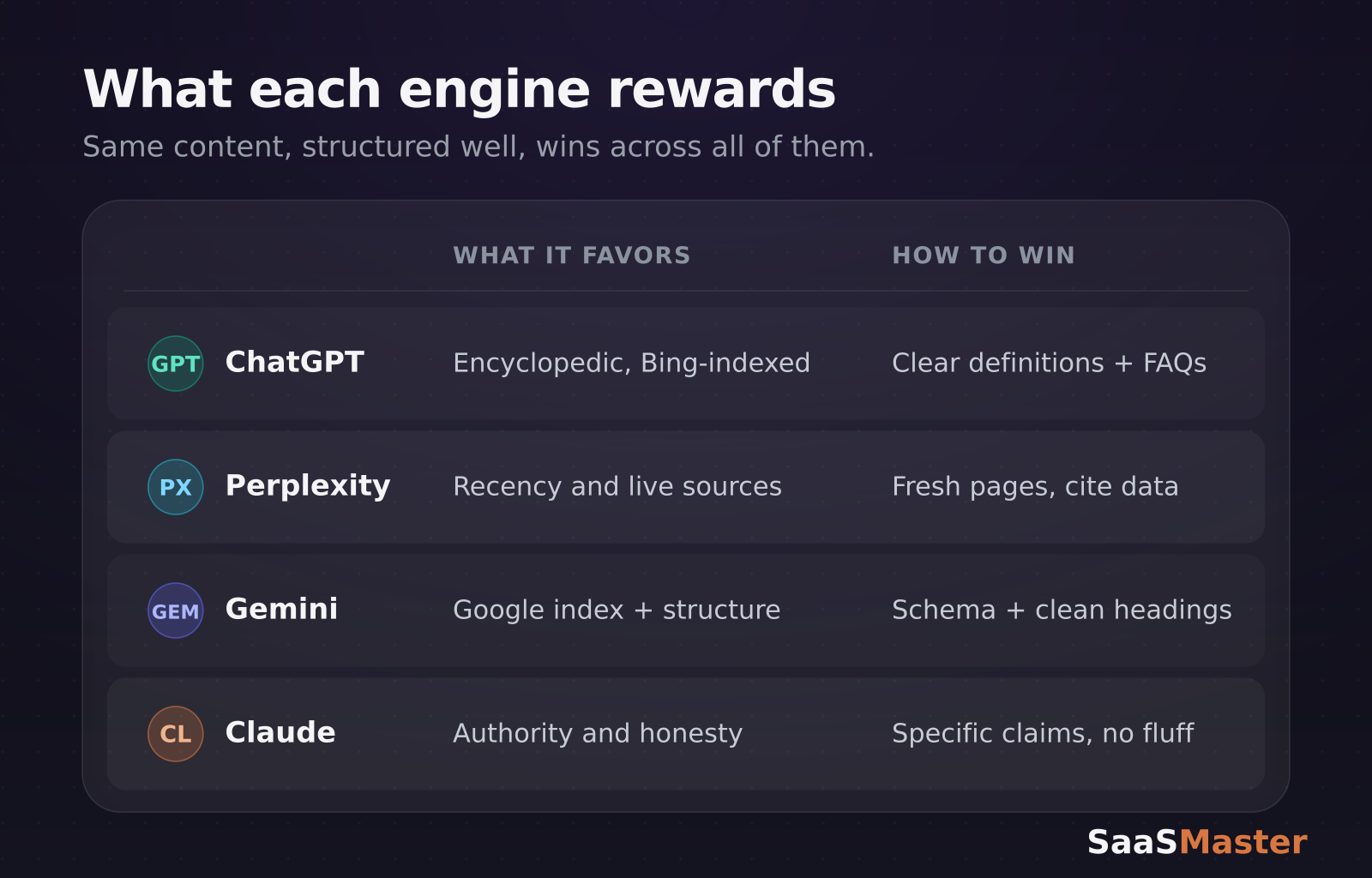
They also are not one single target. Perplexity leans on recency and lists live sources for every answer. ChatGPT tends to favor encyclopedic, well-established explanations and often retrieves through Bing's index. Gemini draws on Google's index and rewards clean structure. The good news is that you do not optimize for each one separately — comprehensive, well-structured, trustworthy content wins across all of them, which is why chasing tricks for a single engine is a waste of time. If you want more of these playbooks, the SaaS growth library collects them in one place.
How do AI answer engines decide what to cite?
Most AI answers are built by retrieving passages that directly answer the question, then synthesizing them. So the engine is not grading your whole page — it is hunting for a specific, quotable chunk that resolves the query. Your job is to make those chunks easy to find and safe to trust. That means answering the actual question in plain language, backing it with a concrete number or example, and doing it in a place the crawler can reach. For a broader look at which AI tools your team should understand as both user and target, see my roundup of the best AI tools for SaaS teams.
How do you structure a page so an AI can quote it?
This is where most of the gains live, and none of it requires a developer:
- Answer the core question in the first two or three sentences. AI engines quote intros, so do not bury the payoff.
- Use question-style headings that mirror how people actually ask, so the model can match a query to the right section.
- Put comparisons in a table. Structured data is easier to parse accurately than the same facts buried in a paragraph.
- Add a real FAQ with direct question-and-answer pairs — these match natural queries and are highly extractable.
- Cut hedging language. Phrases like "I think" and "we believe" raise a model's uncertainty and make your sentence less quotable.
Which schema types matter most for SaaS?
Schema markup is the structured code that tells engines what your page is about, and it is one of the few technical GEO moves with real evidence behind it. One widely cited analysis by SE Ranking found the majority of pages surfaced in AI answers include structured data, and that schema-marked pages had a meaningfully higher chance of being cited. Treat those figures as directional rather than guaranteed, but the direction is clear.
For a SaaS site, four types carry most of the weight: Organization (who you are), SoftwareApplication (what the product is), FAQPage (your question-and-answer blocks), and HowTo (your tutorials and setup guides). Adding Article markup to your blog rounds it out. You do not need all of them everywhere — match the schema to the page.
Where does video fit into AI answers?
More than people expect. AI answers increasingly surface YouTube results, and engines can read video transcripts, which means a clear, well-titled product video becomes another surface you can be quoted from. A walkthrough that plainly states what your software does, in words, gives an engine clean text to lift — and gives a human a reason to trust the citation. This is one reason a documented video system pays off beyond views; the complete SaaS video marketing strategy guide lays out how those assets compound. If you want that video layer built for you, that is what I do on the SaaS video production page.
Do you need an llms.txt file?
Honest answer: not urgently. The llms.txt file is a proposed standard for handing AI crawlers a tidy map of your key content, and it is a reasonable, low-cost thing to add. But it is not a confirmed ranking signal, adoption by the major engines is still limited, and there is no proven correlation between having one and getting cited more. Do the schema and structure work first — those are proven and widely supported — then add llms.txt as a nice-to-have, not a priority.
A 90-day GEO plan for a SaaS team
You do not need a big budget, just a sequence. Reported benchmarks suggest foundation work starts showing up in AI answers within about four to eight weeks, with authority-building taking three to six months, so plan in that rhythm:
- Weeks 1 to 4 — Foundation: add Organization, SoftwareApplication, FAQPage, and HowTo schema; confirm your key pages are indexable; rewrite your most important intros to answer the question up front.
- Weeks 5 to 8 — Content: build comparison pages and pillar guides for the questions buyers actually ask, each with tables and a real FAQ.
- Weeks 9 to 12 — Authority: earn mentions on sites and communities the engines already trust, and publish a clear product video so you are citable in more than one format.
Frequently asked questions
Is GEO replacing SEO?
No — it is extending it. The same fundamentals (crawlable pages, real authority, useful content) feed both. GEO simply adds a layer of structuring and specificity aimed at being quoted, not just ranked. Teams that already do SEO well have a head start.
How do I know if AI engines are citing my SaaS?
Ask them. Run the real questions your buyers would ask into ChatGPT, Perplexity, and Gemini and see whether you appear and how you are described. Perplexity is especially useful here because it lists its sources for every answer, so you can see exactly which page it pulled.
How long does GEO take to work?
Expect early movement in roughly one to two months from foundational fixes like schema and better structure, and three to six months for authority-driven gains. It compounds: the more consistently you publish specific, well-structured content, the more surfaces an engine has to cite.
Was this article helpful?
Jorge Aguilar
Founder & Creator, SaaS Master
Producing SaaS and AI product videos since 2019 — 800+ videos for 200+ brands, covering tutorials, demos, walkthroughs, and explainers. Writing here about the tools, trends, and tactics that actually move the needle. LinkedIn · About · Work with me
Building an AI product that needs a clearer onboarding flow?
Client-owned videos that make your product easy to understand — demos, walkthroughs, onboarding, and explainers.
Explore AI product video productionRelated guides
More AI Tools & AI Workflows →
Kimi K3 vs DeepSeek V4 vs Qwen 3.7 Max: The Best Chinese AI Model in 2026
Claude Code vs Cursor vs Windsurf: The Best AI Coding Agent in 2026
Gemini 3.5 Pro Is Here: What Google's July 17 Launch Means for SaaS Teams