Short-Form Video for SaaS: How to Make Reels and Shorts That Actually Convert
In short
How SaaS companies use YouTube Shorts, Instagram Reels, and TikTok to drive signups—platform strategy, hook formulas, and content formats that work for B2B software.
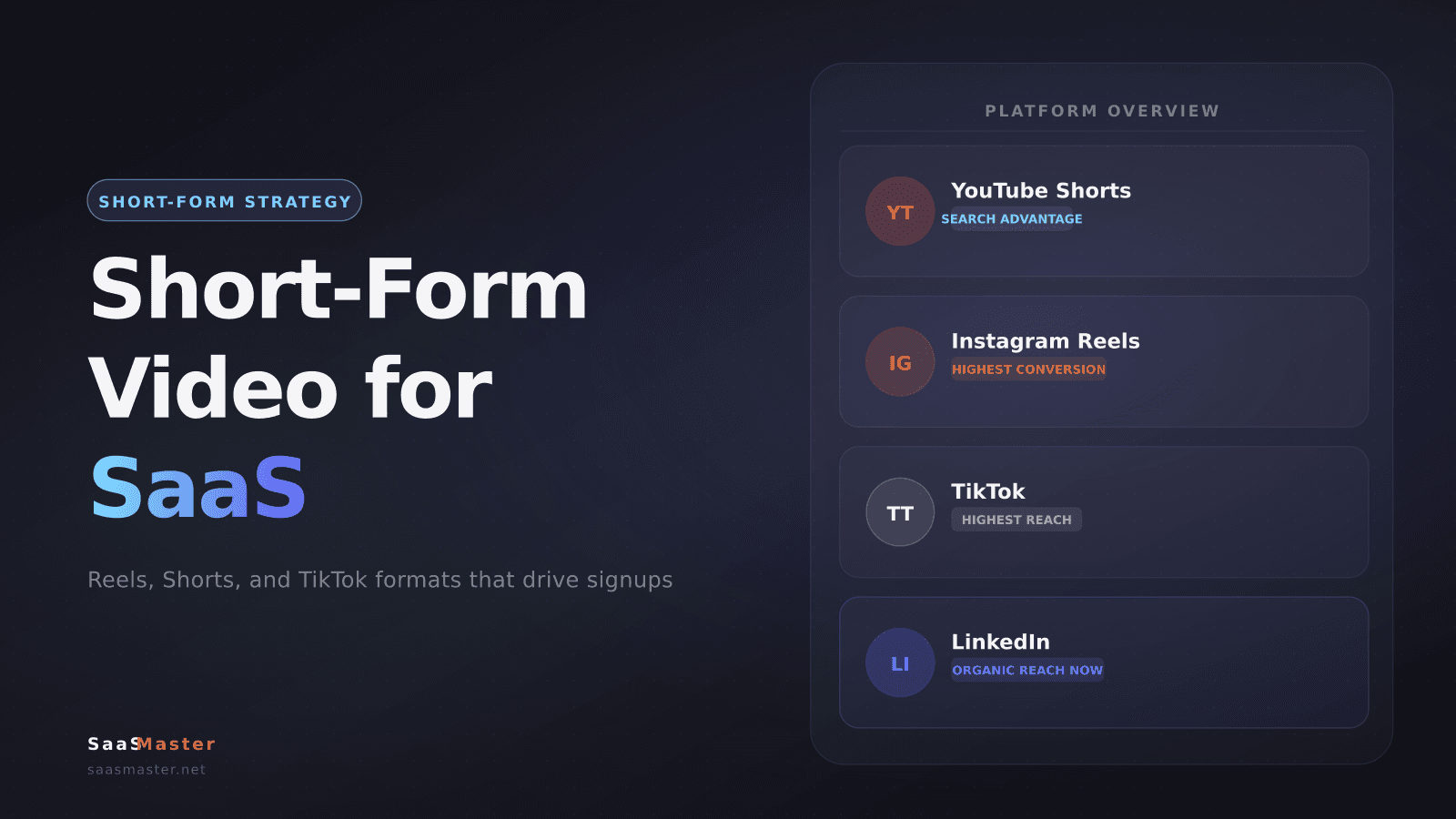
Short-form video is the highest-reach format most SaaS companies still haven't figured out. YouTube Shorts, Instagram Reels, and TikTok aren't just for consumer brands — they're increasingly where buyers first encounter software products, and for B2B companies that get the format right, cost-per-signup from short-form video beats paid ads in almost every category. This guide breaks down exactly how to make short-form video work for software.
Key takeaways
- YouTube Shorts has a search integration advantage no other platform matches — a Short can drive views for years through Google.
- Hook viewers in the first 1.5 seconds; TikTok's algorithm penalizes drop-off in the opening seconds harder than any other signal.
- The best SaaS short-form formats are product micro-demos, problem-solution clips, and one-tip tutorials — not brand awareness plays.
- 31–60 seconds is the optimal length for conversion-focused short-form video.
- Posting 3–5 times per week is the benchmark for algorithm traction on Reels and Shorts.
Why short-form video works differently for SaaS
Most SaaS marketing advice about short-form video comes from B2C playbooks. The hook-and-entertain formula works if you're selling sneakers. For software, the format that converts is different: it's the "magic moment" — a 60-second clip that shows one high-value thing the product can do, in the actual UI, with a clear outcome.
The reason this works is the same reason product demo videos that convert work: buyers need to see the software in motion. A short-form clip does that job in 60 seconds. If someone watches it and thinks "wait, it actually does that?", you've earned a visit to your site.
The trap for SaaS brands is making short-form content designed to go viral — trend audio, dancing, abstract brand messaging. That content gets watched and forgotten. Educational or demonstration content gets saved, shared with teammates, and cited in buying committee conversations. Build for the latter.
Platform breakdown: which one to prioritize
YouTube Shorts
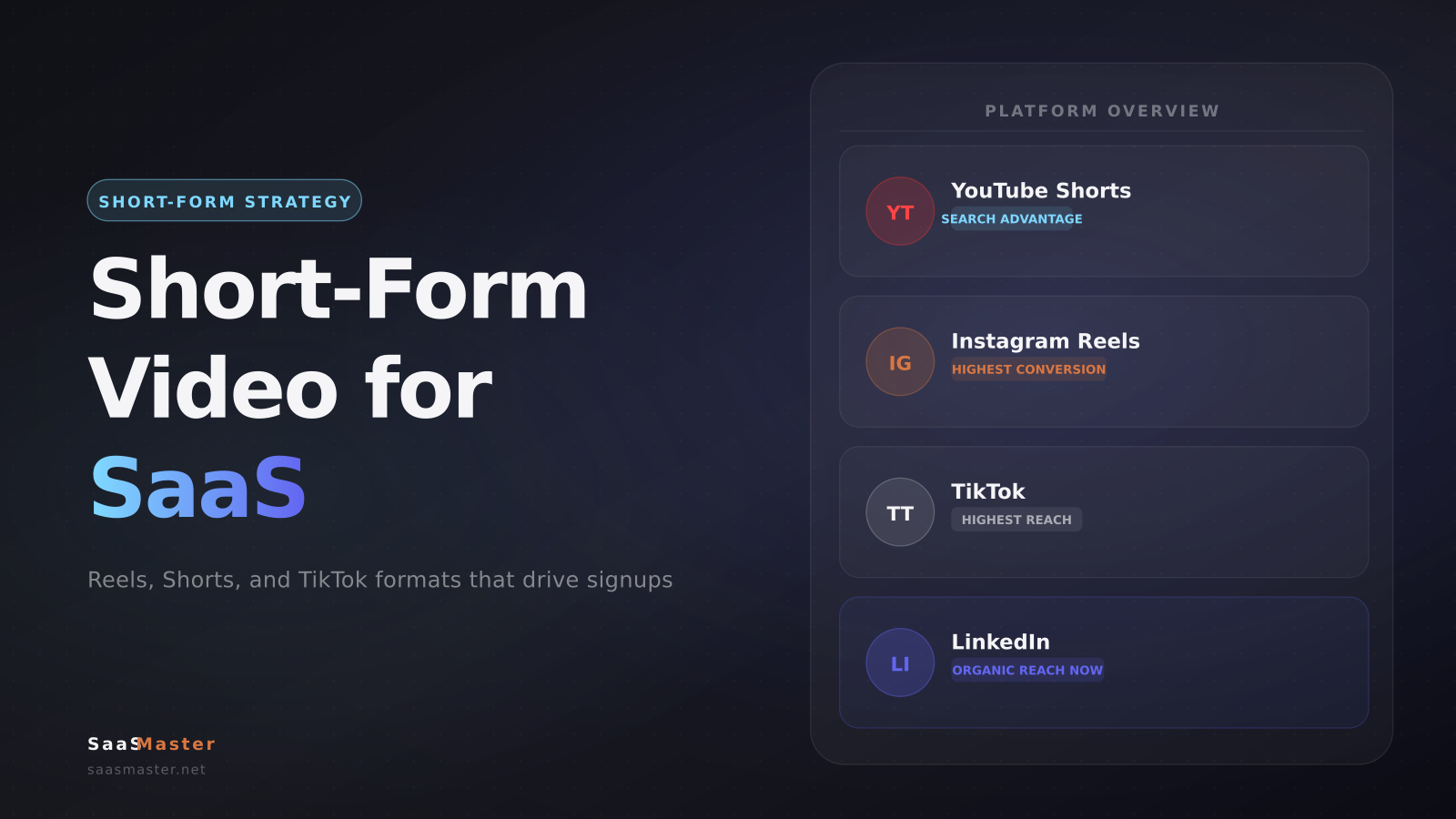
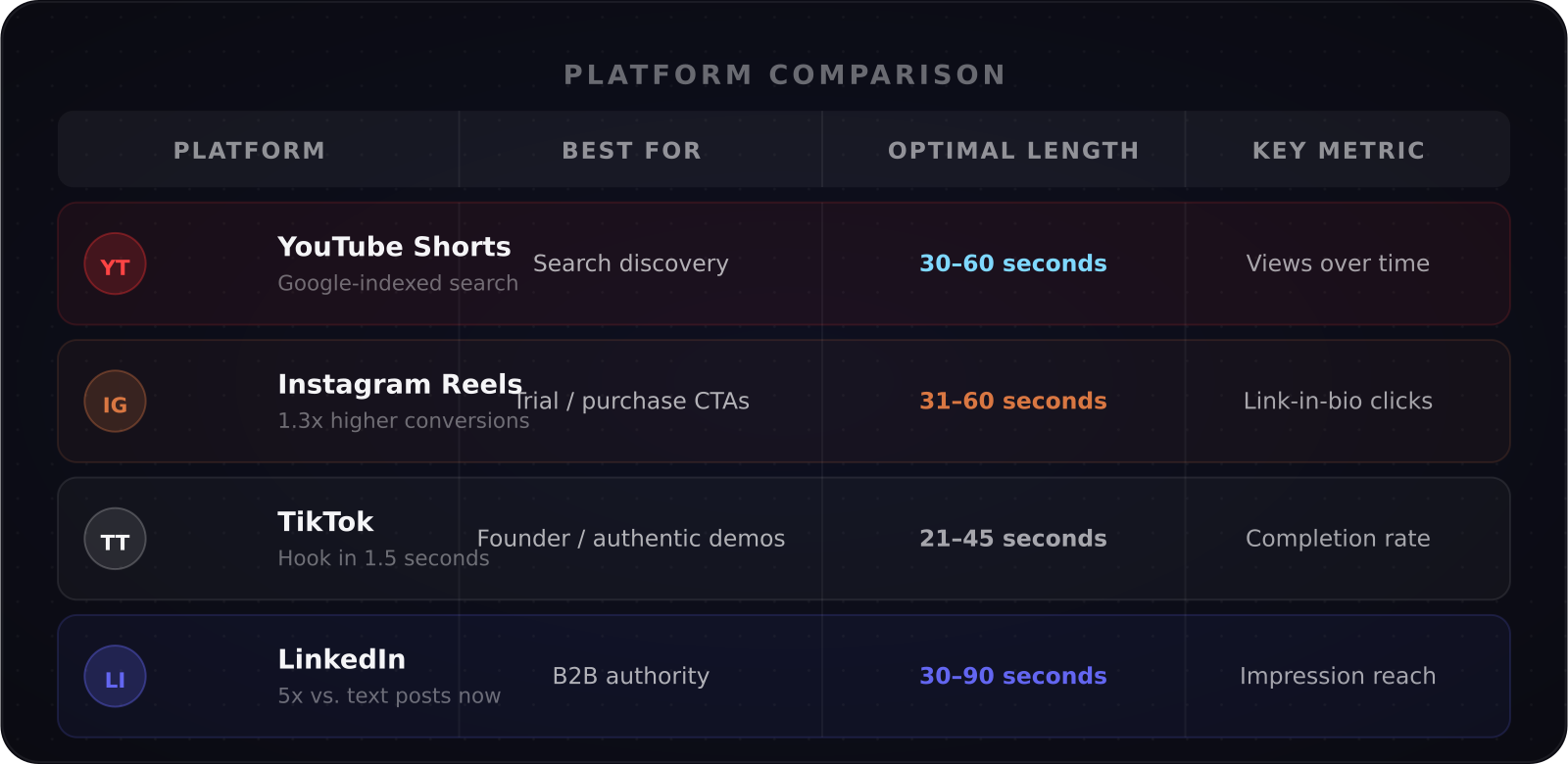
YouTube Shorts is the strongest platform for SaaS discovery for one reason: Google indexing. Shorts appear in Google search results, YouTube search results, and the Shorts shelf simultaneously. A Short you post today can drive views 18 months from now if it targets the right keyword. No other short-form platform offers that compounding search advantage.
The format also bridges naturally into longer YouTube content. Viewers who find a Short can follow through to a full product walkthrough or demo on the same channel. For SaaS teams building a video content system, that connection between short-form discovery and long-form depth is a significant advantage.
Instagram Reels
Reels delivers 1.3x higher conversion rates than TikTok for direct signups and purchases, making it the better platform if your short-form content is explicitly driving trial or purchase. The audience skews slightly older than TikTok, which often means better product-market fit for B2B SaaS.
For software companies, the most effective Reels content pairs screen recording of your product with a voiceover that explains what the viewer is watching in plain language. Captions are essential — over 85% of Reels are watched without sound.
TikTok
TikTok's algorithm prioritizes completion rate above all other signals. Videos that get watched twice get exponentially more distribution. That means your hook needs to land in the first 1.5 seconds — not 3 seconds, not 5. If the opening frame doesn't give someone a reason to keep watching, they're gone and the algorithm treats that as a miss.
For B2B SaaS, TikTok works best for founder content and "did you know [product] can do this?" clips rather than polished product demos. Authenticity outperforms production quality on TikTok in almost every case.
LinkedIn (the overlooked platform)
LinkedIn added native short-form video in 2025 and organic reach is still unusually high because the format is relatively new on the platform. Short-form video posts are outperforming text-only posts by 5x in impression volume. For B2B SaaS companies with a LinkedIn presence, posting 2–3 short-form clips per week right now captures attention at a fraction of the cost it will take once the format matures and competition increases.
The four short-form formats that convert for SaaS
1. The problem-agitate-solve clip
This is the structure most short-form marketers use because it works. Hook (0–5 seconds): name a specific painful problem your buyer has. Agitation (5–30 seconds): make the consequence of that problem vivid. Solve (30–60 seconds): show a quick glimpse of the solution in your product UI.
The key word is "specific." Not "save time on your workflows." Something like: "If you're manually exporting your usage data to a spreadsheet every week, here's what's happening behind the scenes." Specific pain performs better than generic pain in every format, but in short-form it's the difference between 3% and 40% watch-through.
2. The magic moment demo
Pick one high-value action in your product — something that surprises people when they see it. Open with a question ("how long does it take you to do [task]?"), spend 15–20 seconds setting up the before state in your UI, then spend 30 seconds showing the action. Show the result clearly. End with "that's it."
This is the format I recommend most to SaaS companies producing short-form videos for software for the first time. It requires no editorial arc, no storytelling, and minimal production — just a screen recording, a voiceover, and one genuinely impressive thing your product does.
3. The one-tip tutorial
A 45–60 second explainer that teaches one thing. "Most teams set up their dashboard wrong — here's the setting they're missing." This format performs especially well on YouTube Shorts because it answers a search query, and on LinkedIn because it establishes authority.
One-tip tutorials are also the best format for ongoing posting cadence. You don't need to produce a five-minute walkthrough; you need to find one insight per video, every few days. Over time you build a library of short-form content that collectively covers your product from every angle.
4. Social proof and customer outcome clips
A 30–45 second clip that shows a real result: "We set this up for a team of 12, and they cut their weekly reporting time from 4 hours to 20 minutes." Then show the relevant part of the product. These clips work on every platform but perform especially well on Instagram and LinkedIn, where professional credibility matters.
Getting the hook right
Every short-form video lives or dies in its first two seconds. The most reliable hook structure for SaaS: open on the product UI (not a talking head, not a title card), and have your voiceover start with a number or a specific problem. "This one setting in [product] saves our clients 3 hours a week." Cut to the setting.
Numbers in hooks are reliable because they create a specificity signal. "This might save you time" is ignored. "This saves 3 hours a week" makes the viewer want to see if it's true.
For more on how video content fits into a full SaaS marketing system — including how to connect short-form awareness content to demos that close — the complete SaaS video marketing strategy guide covers the full funnel.
Posting cadence and what to measure
Three to five posts per week is the benchmark for meaningful algorithm traction on Reels and Shorts. That number sounds high if you're not already producing video content, but most of it can come from repurposing existing long-form content: a 5-minute walkthrough becomes four 60-second clips.
The metric that matters most is average watch time as a percentage of video length. If viewers are watching 80% or more of your video, the algorithm treats that as a strong signal and pushes it to a larger audience. That's your primary optimization target — not views, not likes.
For teams just starting out: don't try to nail every platform at once. Start with YouTube Shorts if search traffic is your priority, or Instagram Reels if your audience is already there. Get the format right on one platform, then expand.
Frequently asked questions
How long should a SaaS short-form video be?
31–60 seconds is the sweet spot for conversion-focused short-form video. Under 30 seconds can work for awareness clips, but it's usually not enough time to show a meaningful product moment. Avoid going over 90 seconds — that's when watch-through rates drop sharply on every platform.
Do I need a professional production setup to make effective SaaS short-form video?
No. The most effective format for B2B SaaS short-form is screen recording plus voiceover, and that requires nothing more than a screen capture tool and a decent USB microphone. Captions and clean UI are more important than camera quality. TikTok specifically rewards lower-production, authentic content over polished edits.
How do I measure whether short-form video is driving signups?
Use UTM parameters in your link-in-bio and any links in video descriptions. Track landing page visits from those sources in your analytics. For platforms where direct links aren't clickable, watch for branded search volume increases — a meaningful uptick in "[product name]" searches often correlates with short-form campaign activity.
Was this article helpful?
Jorge Aguilar
Founder & Creator, SaaS Master
Producing SaaS and AI product videos since 2019 — 800+ videos for 200+ brands, covering tutorials, demos, walkthroughs, and explainers. Writing here about the tools, trends, and tactics that actually move the needle. LinkedIn · About · Work with me
Need to show users how an automation workflow works in practice?
Client-owned videos that make your product easy to understand — demos, walkthroughs, onboarding, and explainers.
Explore product walkthrough video productionRelated guides
More Automation & No-Code →
n8n vs Zapier vs Make in 2026: Real Pricing, AI Agents, and Which One Fits Your Stack
How I Turned a Boring PDF Into an Interactive Flipbook With Flipsnack (2026 Pricing & Workflow)
Zapier Agents in 2026: What Autonomous AI Teammates Actually Cost and Do