Gemini Enterprise vs Claude Cowork vs ChatGPT Work: Which AI Coworker Should Your SaaS Team Buy in 2026?
In short
Gemini Enterprise, Claude Cowork, and ChatGPT Work compared on real 2026 pricing, features, and fit for small SaaS teams versus large enterprises.
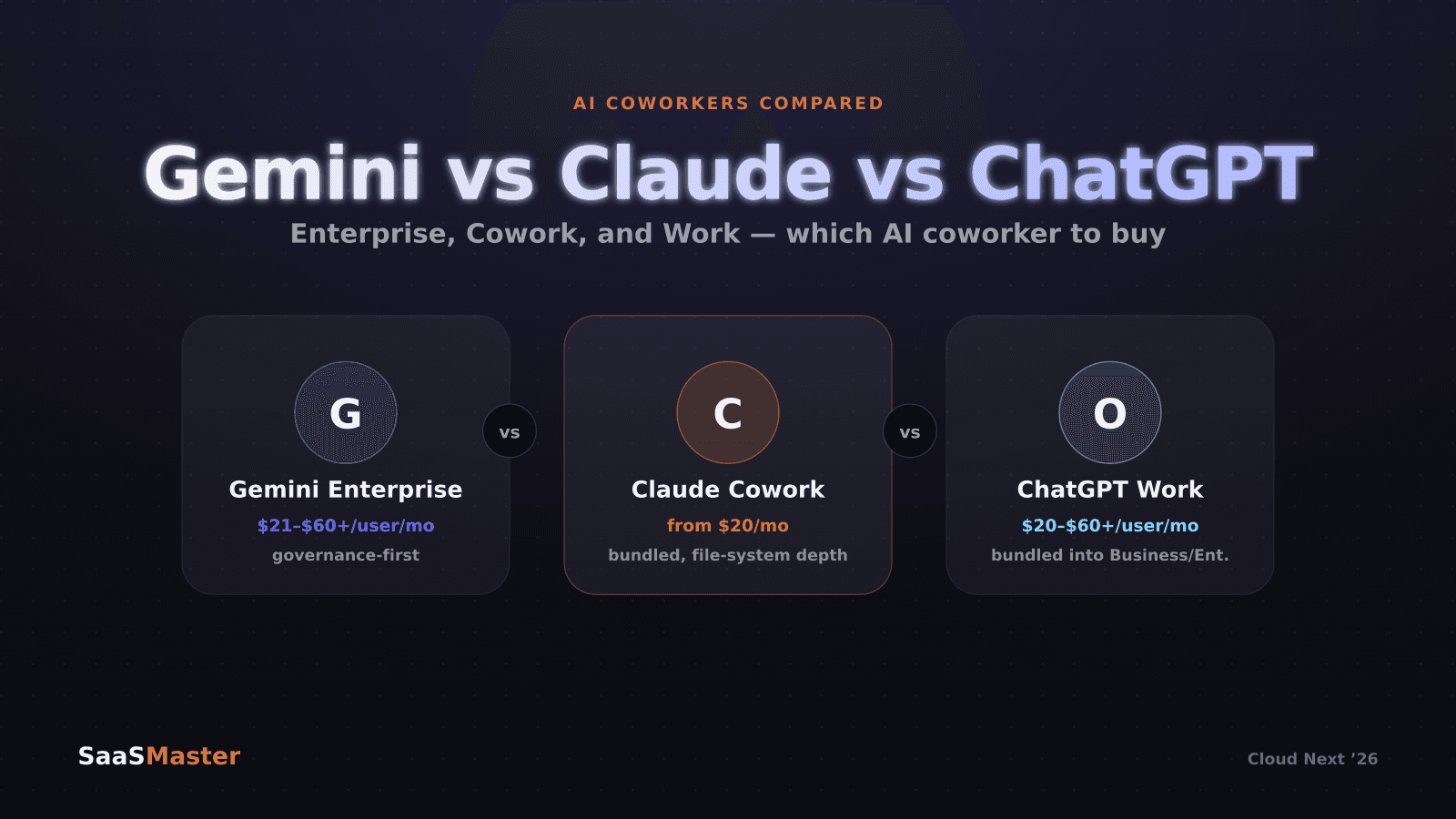
Three of the biggest AI companies now sell nearly the same pitch: an AI coworker that lives in your files, runs tasks while you're in a meeting, and reports back when it's done. Google made it official at Cloud Next '26 with Gemini Enterprise, joining Anthropic's Claude Cowork and OpenAI's ChatGPT Work — and their entry-level pricing differs by close to 3x. Here's what each one actually does and which is worth your SaaS team's money.
Key takeaways
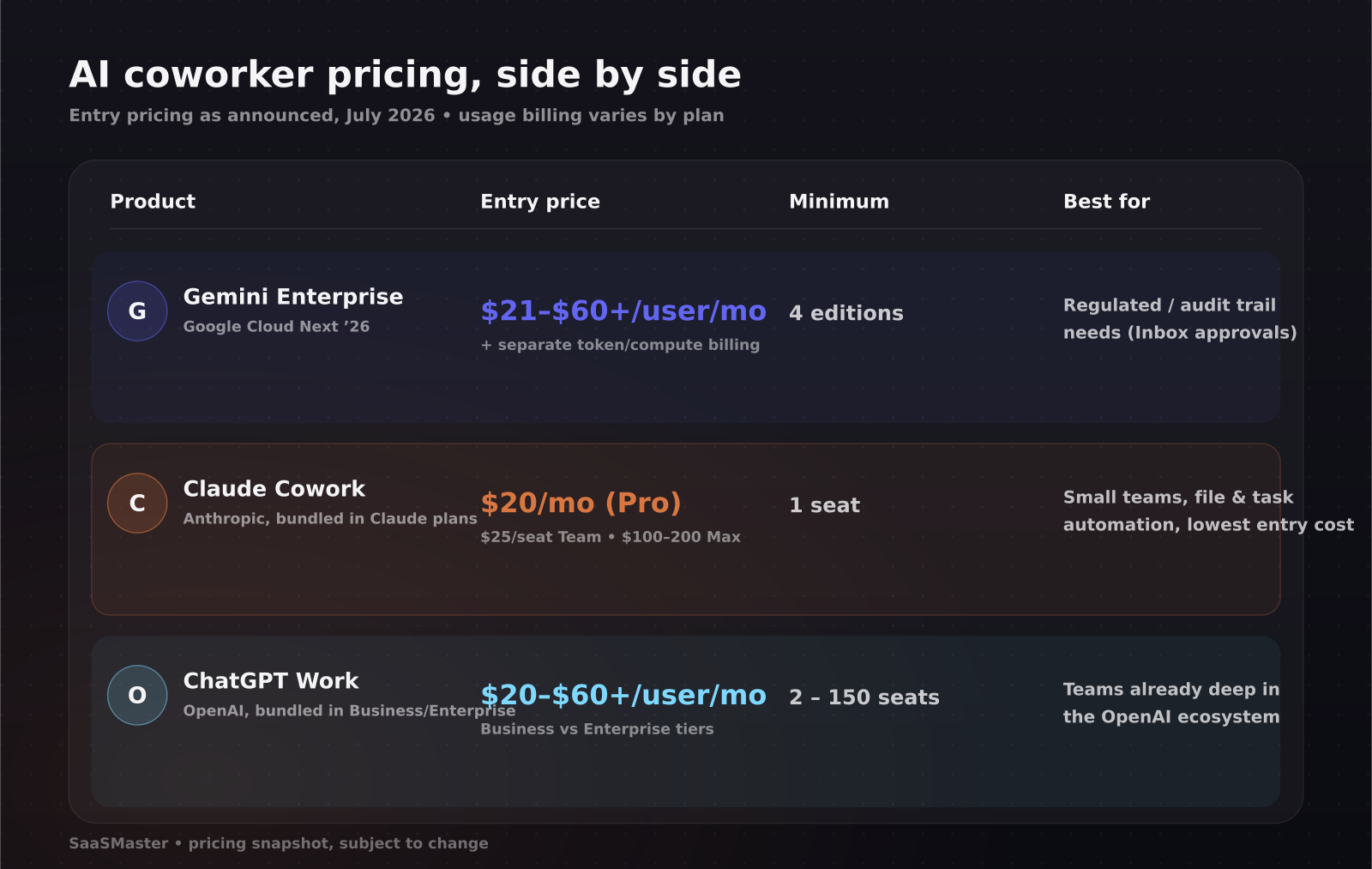
- Gemini Enterprise runs $21 to $60-plus per user monthly across four editions, plus separate token and compute billing for custom agents — the widest and least predictable pricing range of the three.
- Claude Cowork is bundled free into every paid Claude plan starting at $20/month (Pro), with no separate Cowork fee — you pay for the Claude plan, usage is metered on top.
- ChatGPT Work is bundled into ChatGPT Business ($20/user/month annual, 2-seat minimum) and Enterprise (roughly $60/user/month, 150-seat minimum).
- Google's pitch is governance-first: Agent Designer, an Inbox for managing agent activity, and long-running agent support built for IT teams that need oversight.
- Anthropic's pitch is file-system depth: real desktop file access, scheduled recurring tasks, and a plugin marketplace — this article was drafted and published by exactly that kind of scheduled Cowork task.
What is each company actually selling?
All three products answer the same underlying demand: teams want an AI that doesn't just answer questions in a chat window, but can act — read your files, run on a schedule, chain steps together, and hand back a finished result. The three approaches differ more than the marketing suggests.
Gemini Enterprise, unveiled at Google Cloud Next '26, is built around what Google calls the Agent Platform: an Agent Designer for building custom agents, an Inbox that surfaces what agents are doing so someone can review or approve it, support for long-running agents that work over hours rather than minutes, plus Skills and Projects for organizing agent work. It's explicitly positioned as the governance-heavy option, aimed at IT and ops teams that need an audit trail before they'll let an agent touch production systems.
Claude Cowork is the third tab inside Claude Desktop, alongside chat and projects. It reads files on your actual desktop, runs scheduled recurring tasks (this article is one — it was generated by an automated evening Cowork task, not typed by a human at 8pm), keeps global and per-folder instructions, and connects to a plugin marketplace for third-party tools. Anthropic also ships pre-built vertical bundles — Legal, Small Business, and Marketing Ops — aimed at non-developers who want Cowork configured for their specific job instead of building it from scratch.
ChatGPT Work is OpenAI's answer, bundled into the Business and Enterprise tiers rather than sold as a separate product. It leans on ChatGPT's broader consumer-facing feature set and OpenAI's existing enterprise sales motion, which is part of why its entry price sits highest of the three.
Which is cheapest to start with?
Claude Cowork, by a clear margin, if you're a small team. Because Cowork is bundled into the existing Claude Pro plan at $20/month with no separate fee, a single person can start using it today for the price of one AI subscription. Team seats run $25 each. Anthropic's Max tiers ($100/month for 5x usage, $200/month for 20x) exist for heavier users, but the entry point is the lowest of the three.
ChatGPT Work requires ChatGPT Business at minimum, which runs $20/user/month billed annually (or $25 monthly) with a 2-seat minimum — so a solo user can't actually buy in below roughly $40/month for two seats. Enterprise jumps to around $60/user/month with a 150-seat minimum, which puts it out of reach for smaller SaaS teams entirely.
Gemini Enterprise is the hardest to pin down. Google's four editions span $21 to $60-plus per user per month, and that's before token and compute billing for any custom agents you build kick in separately. That structure makes sense for a large org with a dedicated ops budget and less sense for a five-person SaaS team trying to estimate next quarter's software spend.
Which one fits a small SaaS team versus a large enterprise?
If you're a small or mid-size SaaS team, Claude Cowork's file-system access and scheduled tasks solve a real, immediate problem — content pipelines, reporting, and repetitive file work — without a procurement process. That's not a hypothetical; the two blog posts publishing on this site tonight, including this one, ran through a scheduled Cowork task with no human clicking "publish." For a small team, that kind of automation is worth more than a governance dashboard you don't yet have the headcount to manage.
If you're running a larger organization with a compliance or security team that needs to approve every agent action before it touches anything important, Gemini Enterprise's Inbox and approval workflow is the more defensible choice, even at a higher and less predictable price. ChatGPT Work sits in between on capability but currently asks for the highest minimum spend of the three, which mostly makes sense if you're already deep in the OpenAI ecosystem and want one vendor relationship rather than three.
None of this is static — we've tracked how fast the underlying models move in our comparison of Claude Sonnet 5 vs GPT-5.6 Terra, and the coworker products sit on top of models that get replaced every few months. Pricing and feature sets here should be treated as a snapshot, not a permanent ranking.
Does the model underneath actually matter here?
Yes, more than the coworker packaging does. Claude Cowork's day-to-day tasks run on Opus 4.8 within your normal plan limits, no extra metered cost — which is a meaningful value difference versus a product where every agent action bills separately. If you're evaluating any of these platforms, read the fine print on what counts as "included" usage versus what triggers token billing, because that's where the real cost difference shows up over a full quarter, not in the headline per-seat price.
For teams still deciding how AI tools fit into a broader content and growth strategy, our guide on getting your SaaS tool recommended by AI engines covers the other side of this: how these same AI systems decide what to recommend to your prospects. And if your team is trying to figure out where AI actually saves time versus where it's a governance headache, our AI deployment playbook for small SaaS teams is a practical starting point.
If you'd rather show your team or your customers exactly how one of these tools fits into a real workflow than read another comparison chart, that's the kind of video we make — see our SaaS video production work. More comparisons like this live in our AI tools library.
Frequently asked questions
Is Claude Cowork included free with a Claude subscription?
Yes. Cowork has no separate SKU — it's included on every paid Claude plan starting with Pro at $20/month. Usage beyond your plan's included limits is metered separately, but there's no additional fee just to access the Cowork feature itself.
What's the cheapest way to get an AI coworker for a two-person team?
Claude Cowork on two Pro seats at $20/month each ($40/month total) is currently the cheapest entry point among the three. ChatGPT Work requires ChatGPT Business at a 2-seat minimum around $40-50/month depending on billing cycle, and Gemini Enterprise starts around $21/user but adds separate usage billing that makes the real cost harder to predict upfront.
Which of the three is best for regulated industries needing an audit trail?
Gemini Enterprise is positioned most directly at that need, with its Inbox feature built specifically to let IT and compliance teams review and approve agent activity before it happens. If audit and approval workflows are a hard requirement, it's worth evaluating first, even though it costs more than the other two options at the entry tier.
Was this article helpful?
Jorge Aguilar
Founder & Creator, SaaS Master
Producing SaaS and AI product videos since 2019 — 800+ videos for 200+ brands, covering tutorials, demos, walkthroughs, and explainers. Writing here about the tools, trends, and tactics that actually move the needle. LinkedIn · About · Work with me
Building an AI product that needs a clearer onboarding flow?
Client-owned videos that make your product easy to understand — demos, walkthroughs, onboarding, and explainers.
Explore AI product video productionRelated guides
More AI Tools & AI Workflows →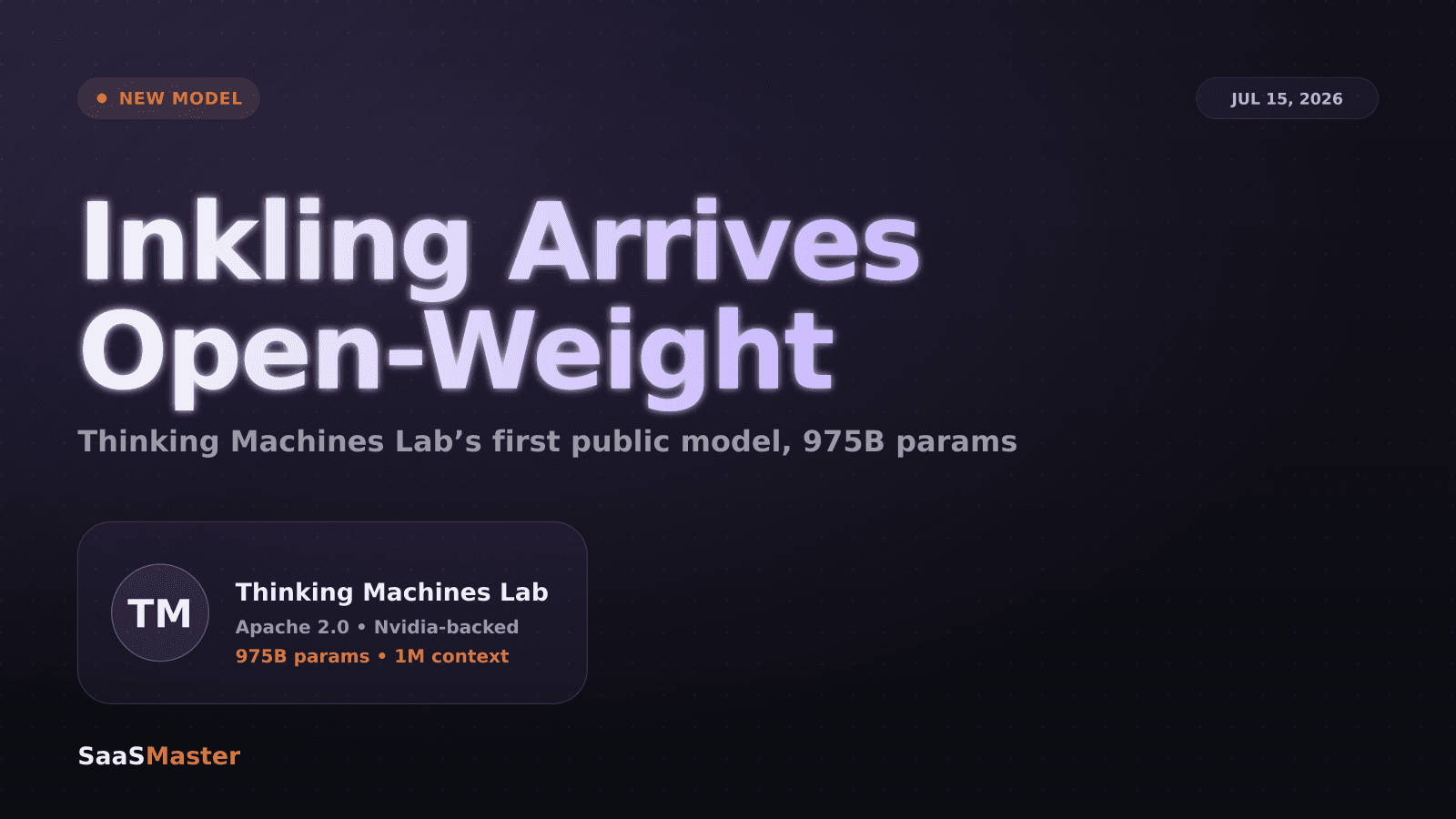
Inkling Is Here: What Mira Murati's First Open-Weight AI Model Means for SaaS Teams
Apple vs OpenAI: What the Trade Secret Lawsuit Means for SaaS Teams Building on GPT
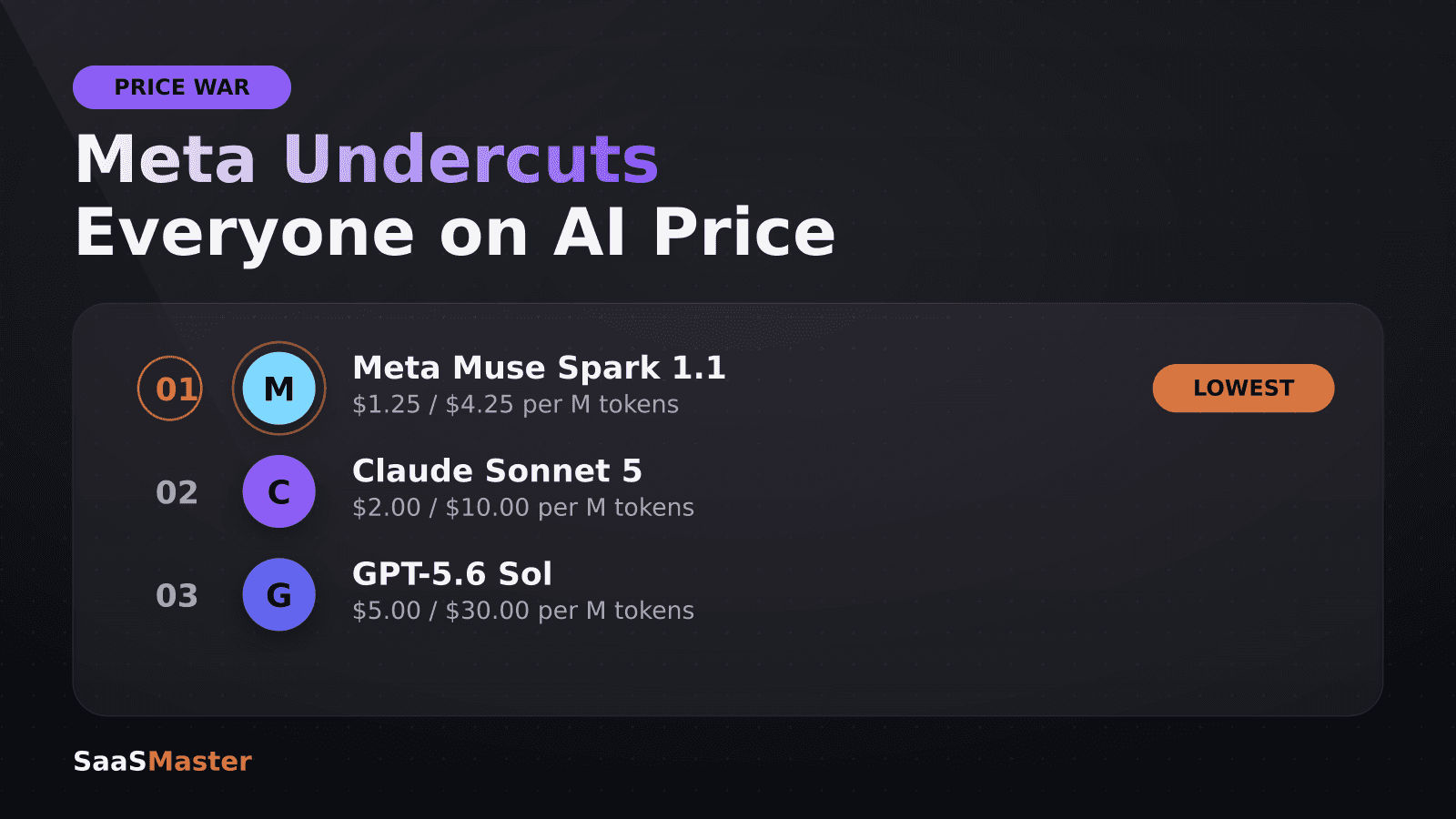
Meta Muse Spark 1.1 vs Claude Sonnet 5 vs GPT-5.6: Meta's $1.25 Model Undercuts Everyone on Price