Inkling Is Here: What Mira Murati's First Open-Weight AI Model Means for SaaS Teams
In short
Thinking Machines Lab released Inkling, a 975B-parameter open-weight AI model under Apache 2.0. Here's what it means for SaaS teams picking AI infrastructure.
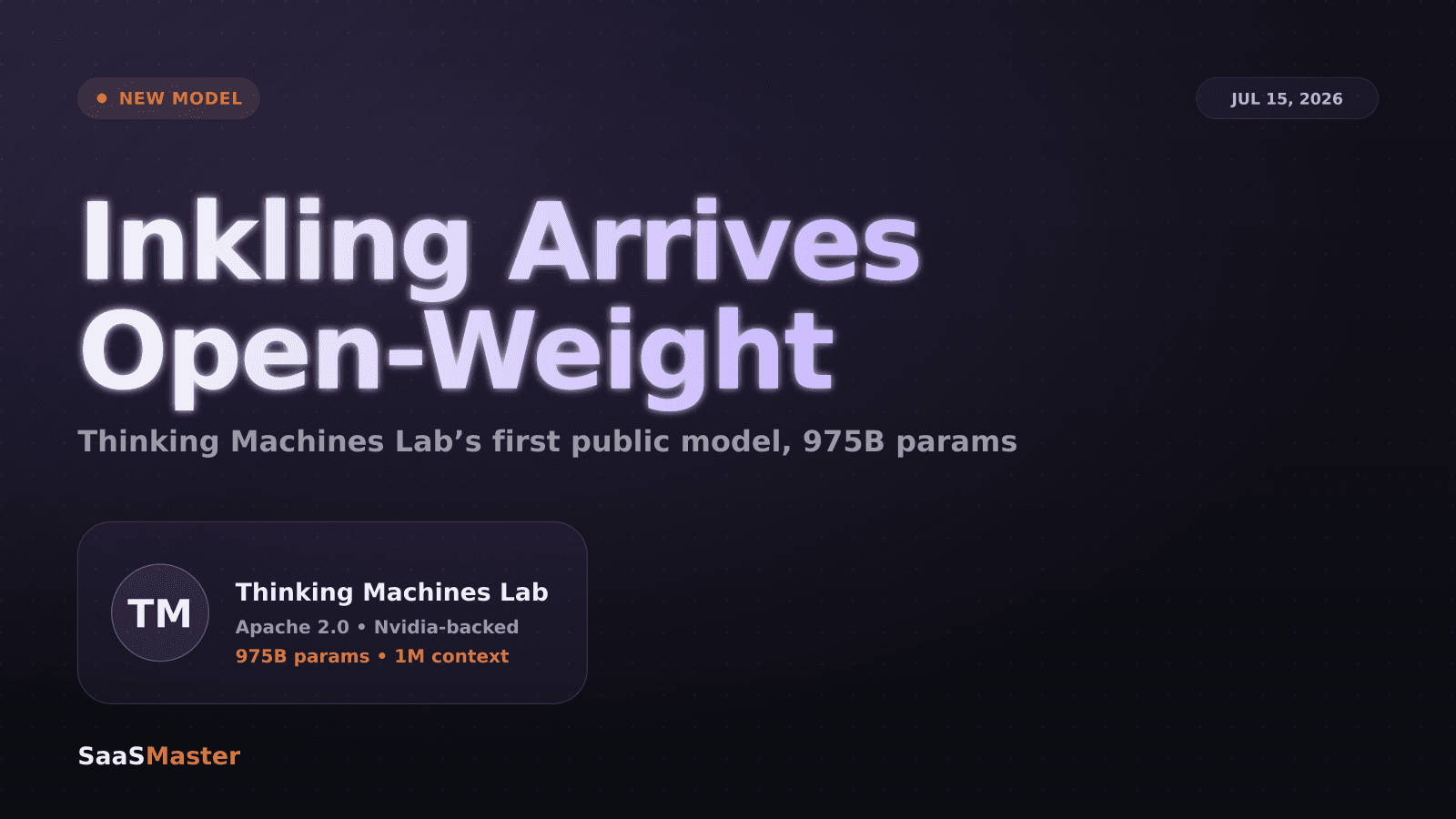
Mira Murati's Thinking Machines Lab released its first public model today, and it's not another chatbot behind a login screen. Inkling is a 975-billion-parameter open-weight model you can download, fine-tune, and run on your own servers under an Apache 2.0 license — no royalties, no seat fees, no usage cap. For SaaS teams who've spent two years renting intelligence by the token, that's a meaningfully different offer.
Key takeaways
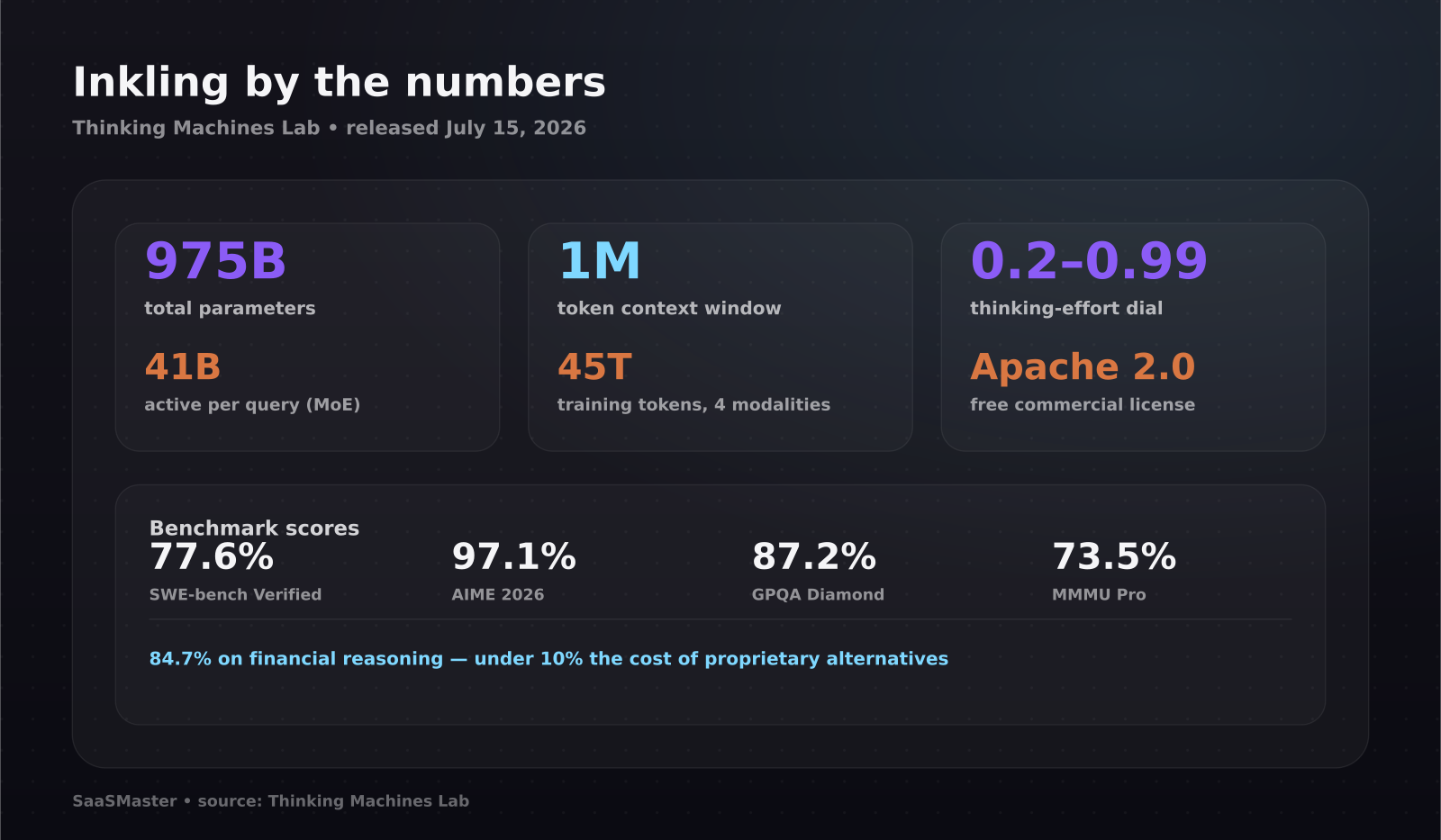
- Inkling is a Mixture-of-Experts model with 975 billion total parameters but only 41 billion active per query, trained from scratch on 45 trillion tokens of text, images, audio, and video.
- It scored 77.6 percent on SWE-bench Verified, 97.1 percent on AIME 2026, and 87.2 percent on GPQA Diamond — benchmark results that sit close to the top proprietary models.
- The full weights are free to download under Apache 2.0, and Thinking Machines is also renting access through its Tinker fine-tuning API at a temporary 50 percent discount.
- A "controllable thinking effort" dial lets developers scale reasoning depth from 0.2 to 0.99, trading speed for accuracy on a per-request basis.
- It's not a plug-and-play SaaS tool. Running Inkling yourself takes real infrastructure — this release matters most to teams with in-house ML capacity or a vendor who can host it for them.
What exactly is Inkling?
Inkling is Thinking Machines Lab's first model built for broad public use, following the company's earlier developer-only Tinker API. It's a Mixture-of-Experts transformer: 975 billion parameters total, but only 41 billion of them switch on for any given request, which is what keeps inference costs manageable despite the model's size. It supports context windows up to one million tokens, and — unusually for a first release — it was trained as a multimodal model from the ground up, handling text, images, audio, and video rather than bolting vision on afterward.
Thinking Machines is backed by Nvidia, and the release ships with checkpoints tuned for that relationship: alongside the original weights, there's an NVFP4 quantized version built specifically for Nvidia's Blackwell chips, which cuts memory and compute requirements for anyone self-hosting on current-generation Nvidia hardware.
How does Inkling actually perform?
Numbers matter more than press-release language here, so here's what Thinking Machines reported and outside outlets have corroborated: 77.6 percent on SWE-bench Verified (the standard test for whether a model can fix real GitHub issues), 97.1 percent on AIME 2026 math problems, 87.2 percent on GPQA Diamond graduate-level science questions, and 73.5 percent on MMMU Pro multimodal reasoning. On a financial-reasoning benchmark, Inkling reportedly hit 84.7 percent, edging out some proprietary alternatives while costing under a tenth as much per token. Thinking Machines also claims Inkling matches Nvidia's Nemotron 3 Ultra on Terminal Bench 2.1 while generating roughly a third as many tokens to get there — a real efficiency claim, not just a raw-score one.
Treat any single-source benchmark with the usual grain of salt. But the fact that an open-weight model is even in the conversation with frontier proprietary systems on coding and math benchmarks is the actual story, not any one percentage point.
What does "controllable thinking effort" mean in practice?
This is Inkling's most interesting product decision. Instead of shipping one fixed reasoning behavior, Thinking Machines built a dial — developers can set a value between 0.2 and 0.99 that scales how much internal reasoning the model does before answering. Low settings behave like a fast, cheap model for simple lookups and classification. High settings let it think longer on harder problems, at a proportional token cost. If you've ever had to choose between a cheap-and-fast model and a slow-and-smart one for different parts of the same product, this collapses that choice into a single model with a runtime knob, which is genuinely useful for teams running mixed workloads — think a support bot that needs to triage quickly but occasionally needs to reason through an edge case.
Is Inkling actually free, or is there a catch?
Both things are true. The weights themselves are Apache 2.0 licensed, meaning you can download, modify, fine-tune, and commercialize them without paying Thinking Machines anything. But downloading 975 billion parameters and running them yourself is not a weekend project — you need serious GPU infrastructure, ideally Nvidia Blackwell hardware if you want the efficiency gains from the NVFP4 checkpoints. For teams that don't want to manage that, Thinking Machines offers hosted access through Tinker, its fine-tuning API, with 64K and 256K context tiers currently at a 50 percent introductory discount.
So the realistic options are: self-host if you have the infrastructure and the licensing freedom matters to you, rent through Tinker if you want managed access without the setup cost, or wait for a cloud provider to package it — which, given the Nvidia backing, seems likely to happen fast.
How does it compare to other open-weight models?
Inkling enters a field that's gotten crowded fast. We've covered several of the open-weight contenders already — see our breakdown of Chinese open-weight models like GLM, DeepSeek, and Kimi and our guide to building a self-hosted AI stack. What sets Inkling apart isn't just the benchmark scores — it's the pedigree and the multimodal-from-scratch training. Most open-weight releases this size come from labs iterating on existing checkpoints. Thinking Machines trained this one fresh, across four modalities, and put a Western AI safety-adjacent lab's name behind an Apache 2.0 license at a size that directly challenges closed frontier models. That's a different signal than another fine-tune of an existing base model.
Should your SaaS team care about this?
Honestly, for most SaaS teams, not urgently — and I say that as someone who spends most of my week testing these tools for video content, not writing marketing copy for them. If your product doesn't need to self-host a model or fine-tune on proprietary data at scale, Inkling doesn't change your Monday morning. You're still choosing between Claude Sonnet 5 and GPT-5.6 Terra or whichever managed API fits your budget and latency needs, and that calculus barely moves.
Where it does matter: if you're building a product where model licensing terms, data residency, or per-token cost at real scale are competitive factors — fintech, healthcare, anything with strict compliance requirements — an Apache 2.0 model with frontier-adjacent benchmarks is now a credible option, not a compromise. It's also worth watching if you're evaluating vendors; ask whether they're planning to offer Inkling as a backend option, because the cost math at scale is compelling enough that some will.
If you're still mapping out which AI tools actually belong in your stack, our running list of the best AI tools for SaaS teams is a reasonable starting point, and it's the kind of landscape that changes fast enough that a quarterly review isn't excessive. For teams that want to actually show viewers or prospects what a tool like this can do inside a real product, that's exactly the kind of walkthrough we build — see our AI tool video production work if that's useful.
You can browse more coverage like this in our AI tools library.
Frequently asked questions
Is Inkling really free to use commercially?
Yes. The model weights are released under an Apache 2.0 license, which permits commercial use, modification, and redistribution without paying Thinking Machines a licensing fee. You still pay for the compute to run it, either your own infrastructure or a hosting provider.
How big is Inkling compared to other frontier models?
Inkling has 975 billion total parameters with 41 billion active per query, making it a large Mixture-of-Experts model. That's roughly comparable in scale to other frontier-class systems, though direct parameter-count comparisons are less meaningful than benchmark results since architectures differ significantly in how they use those parameters.
Do I need special hardware to run Inkling?
You need substantial GPU infrastructure regardless of hardware, but Thinking Machines specifically released an NVFP4 quantized checkpoint optimized for Nvidia's Blackwell architecture, which reduces memory and compute requirements compared to running the full-precision weights. If you don't have that infrastructure, renting access through Thinking Machines' Tinker API is the more practical route.
Was this article helpful?
Jorge Aguilar
Founder & Creator, SaaS Master
Producing SaaS and AI product videos since 2019 — 800+ videos for 200+ brands, covering tutorials, demos, walkthroughs, and explainers. Writing here about the tools, trends, and tactics that actually move the needle. LinkedIn · About · Work with me
Building an AI product that needs a clearer onboarding flow?
Client-owned videos that make your product easy to understand — demos, walkthroughs, onboarding, and explainers.
Explore AI product video productionRelated guides
More AI Tools & AI Workflows →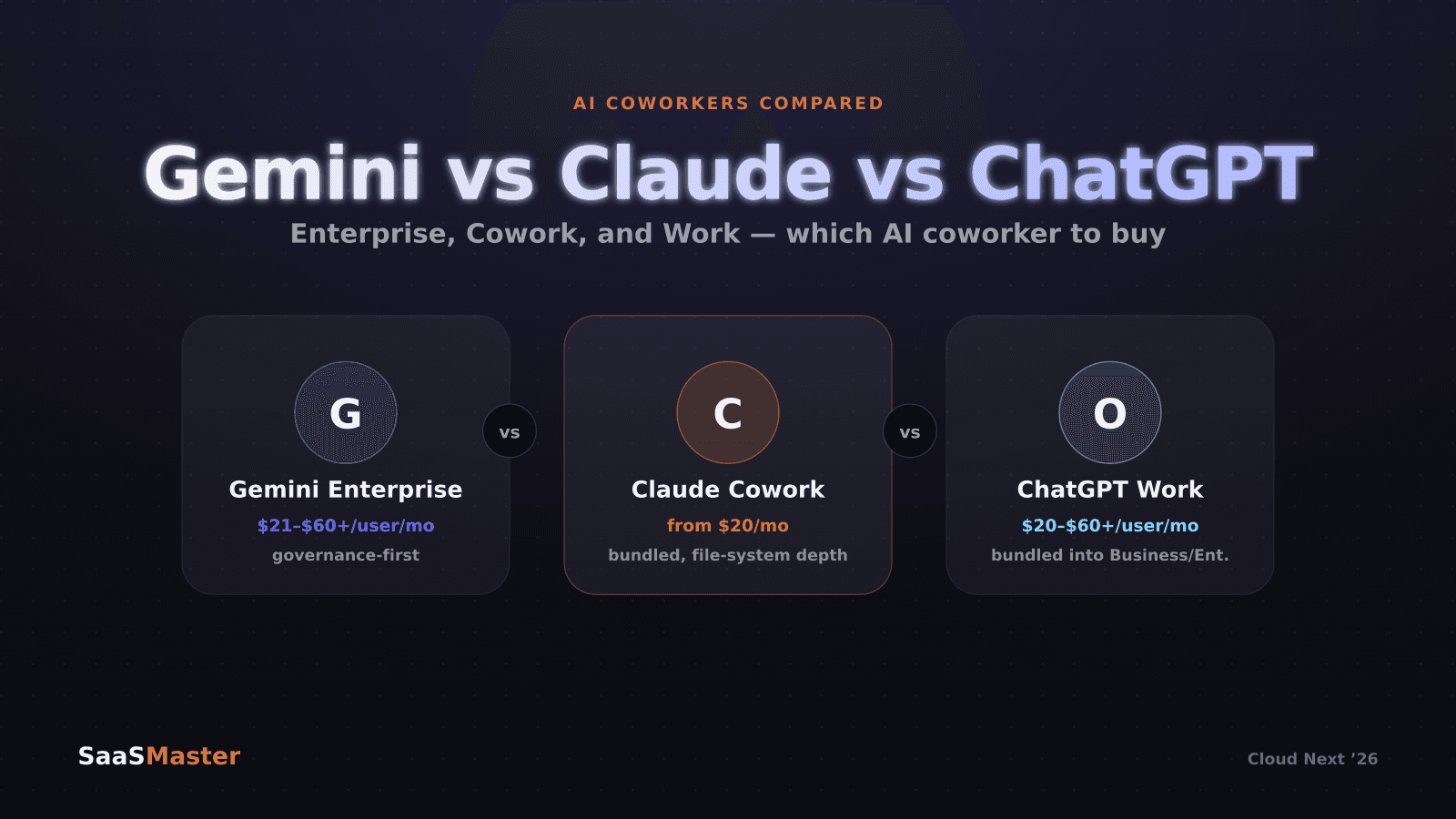
Gemini Enterprise vs Claude Cowork vs ChatGPT Work: Which AI Coworker Should Your SaaS Team Buy in 2026?
Apple vs OpenAI: What the Trade Secret Lawsuit Means for SaaS Teams Building on GPT
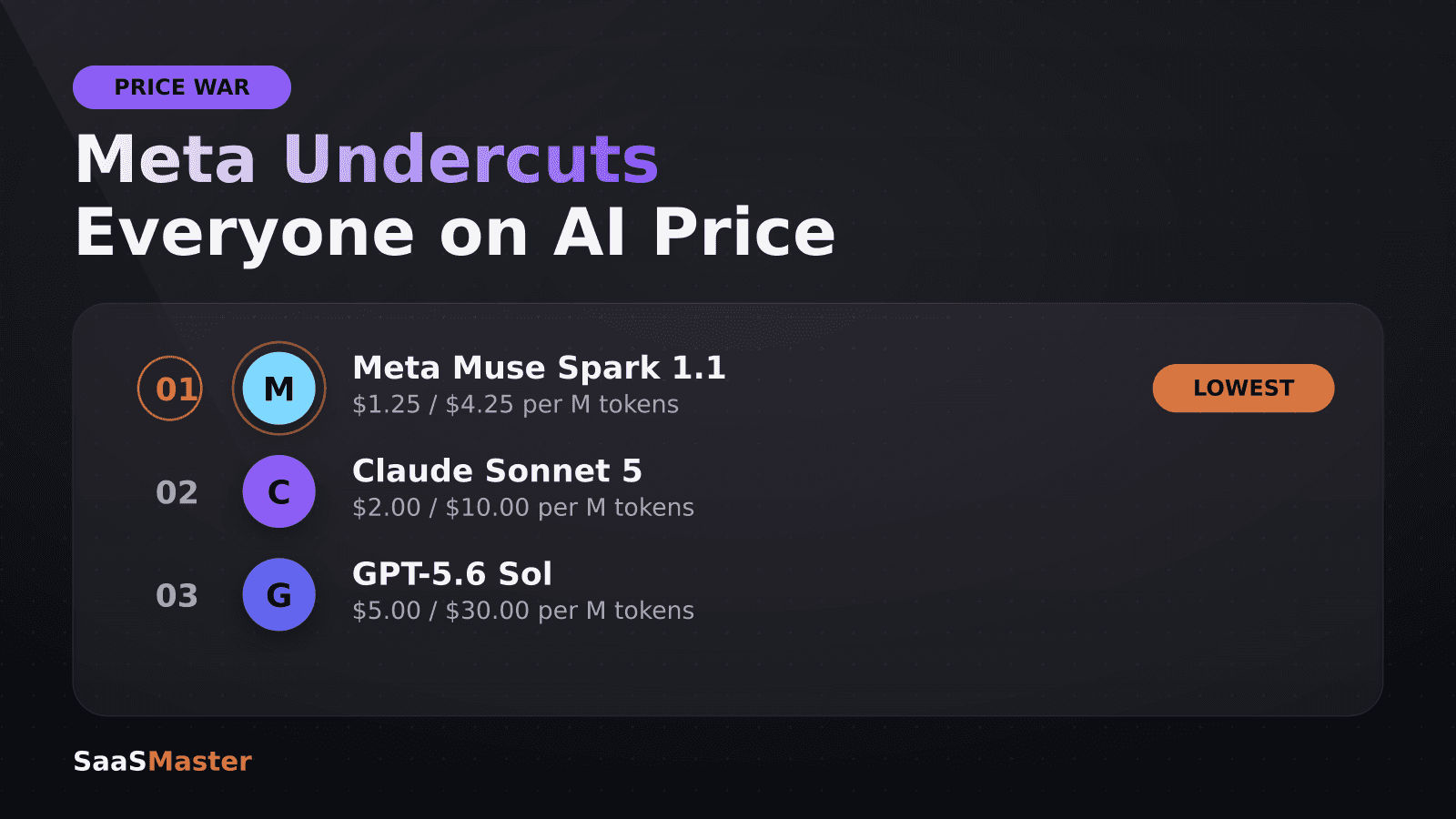
Meta Muse Spark 1.1 vs Claude Sonnet 5 vs GPT-5.6: Meta's $1.25 Model Undercuts Everyone on Price