Zapier Agents in 2026: What Autonomous AI Teammates Actually Cost and Do
In short
Zapier Agents now connect to 9,000+ apps with Copilot checkpoints and a built-in safety layer. Here is the real 2026 pricing and where agents earn their keep.
Zapier Agents are now a mature part of the platform, not a beta feature — goal-oriented AI teammates that connect to more than 9,000 apps and can plan, reason, and take action instead of just following a fixed if-this-then-that rule. In 2026 the bigger change isn't that Agents exist, it's what running them at real scale actually costs once you add Copilot and Chatbots on top of a standard Zaps plan.
Key takeaways: - Zapier Agents reached general availability with enterprise-grade controls and now connect to over 9,000 apps, acting on context rather than fixed trigger-action rules. - Zapier Copilot lets you describe a workflow in plain English and builds it automatically, and in 2026 it now creates a checkpoint every time it edits an agent so you can see exactly what changed. - A built-in safety layer scans for over 30 types of PII, prompt injection attempts, and toxic language before an agent's output reaches your CRM, inbox, or Slack. - Running the full stack — Team Zaps, Agents Pro, and Chatbots Advanced — starts around $169/month before any usage-based task volume is added on top.
What actually changed with Zapier Agents in 2026?
Zapier Agents aren't brand new — they reached general availability with enterprise controls in 2025 — but 2026 is when the platform stopped treating them as a bolt-on and started treating them as core infrastructure. Copilot, the natural-language builder that turns a plain-English description into a working workflow, now checkpoints every edit it makes to an agent, showing exactly what was added, removed, or rewritten before it ships. That single change matters more than it sounds: it's the difference between trusting an AI to touch a live production workflow and having to review a diff every time it does.
Alongside Agents and Copilot, Zapier's 2026 stack includes Tables (an embedded database), Forms, Interfaces (a no-code app builder), Canvas (workflow diagramming), and MCP connectivity that lets tools like Claude and ChatGPT execute actions directly across your connected app stack — turning Zapier from an automation tool into something closer to a lightweight internal operations platform.
How is a Zapier Agent different from a regular Zap?
A traditional Zap runs a fixed sequence: trigger happens, action fires, done. It's reliable, but it can't handle "figure out what to do" — only "do exactly this when that happens."
- Zapier Agents are described as goal-oriented teammates: give one an objective and it can plan multi-step actions, adapt based on context, and take independent action across your connected apps rather than executing one hard-coded path.
- They browse the web and take actions autonomously, running as standalone AI teammates rather than passive triggers waiting for an event.
- A safety layer sits in front of every agent action, scanning for more than 30 categories of PII, prompt injection attempts, and harmful or toxic language, with the ability to automatically block, route, or escalate anything risky before it reaches a live system.
- Copilot's checkpoint system means every change an agent makes to itself is logged and reviewable, closing the trust gap that comes with letting AI modify its own workflow.
What does running Zapier Agents actually cost?
This is where the 2026 pricing picture gets more complicated than a single number, because Agents, Copilot, and Chatbots are all billed as separate layers on top of a base Zaps plan.
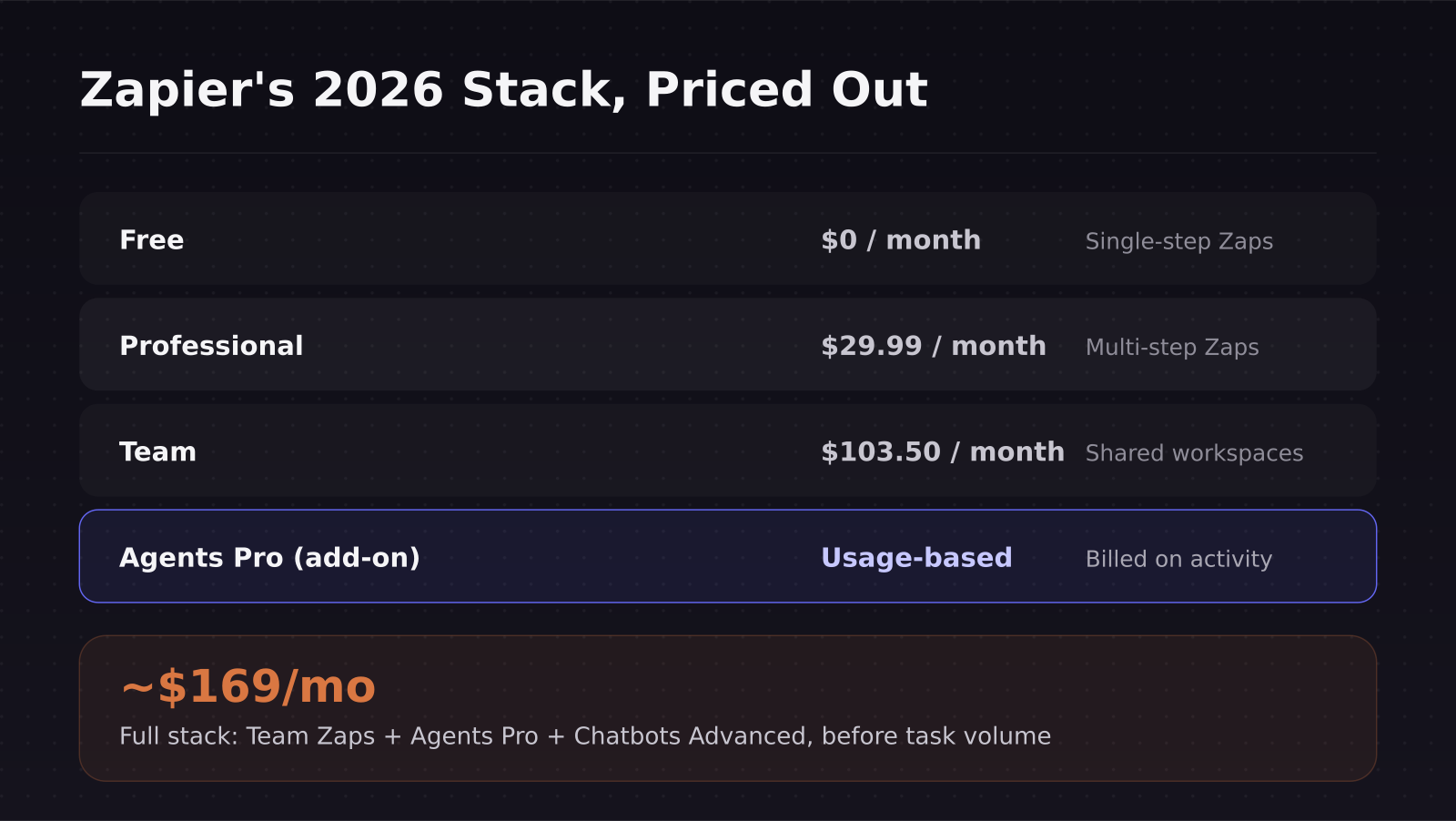
- Free plan: no cost, limited to basic single-step Zaps.
- Professional: $29.99/month for multi-step Zaps and standard automation features.
- Team: roughly $103.50/month for shared workspaces and collaboration features.
- Agents Pro (add-on): custom, usage-based pricing tied to task/activity volume rather than a flat seat price.
- Chatbots Pro (add-on): custom, usage-based pricing similar to Agents Pro.
- A team running the full stack — Team Zaps plus Agents Pro plus Chatbots Advanced — starts around $169/month before any additional task-volume charges kick in.
That "starts around $169" figure is the part worth budgeting for carefully: Agents are billed on an activities model, meaning cost scales with how much autonomous work the agent actually does, not a flat per-seat fee. A lightly used agent might cost far less than that; a genuinely busy one, doing dozens of autonomous actions daily, can cost meaningfully more.
What can a Zapier Agent actually be trusted to do unattended?
The safety layer and checkpoint system exist because "autonomous" and "unsupervised" aren't the same thing, and the honest answer to what an Agent can handle depends heavily on the blast radius of a mistake.
- Low-risk, high-volume tasks are the best fit today: triaging inbound support tickets by category, drafting a first-pass reply for a human to approve, or enriching a new lead record with public information before it hits your CRM.
- Medium-risk tasks work well with the safety layer active: an agent that can send an email or Slack message but has PII scanning and toxic-language detection in front of it, with automatic escalation instead of automatic send when something looks off.
- Higher-risk actions — anything touching billing, refunds, or irreversible data changes — are still better run as a human-approved step inside a Zap than fully delegated to an agent, regardless of how good the underlying model is.
- The checkpoint system in Copilot is specifically useful for the middle category: it lets you audit what an agent changed about its own behavior over time, which matters once an agent has been running for months and quietly drifted from its original configuration.
Is Zapier still the right automation tool, or should you look elsewhere?
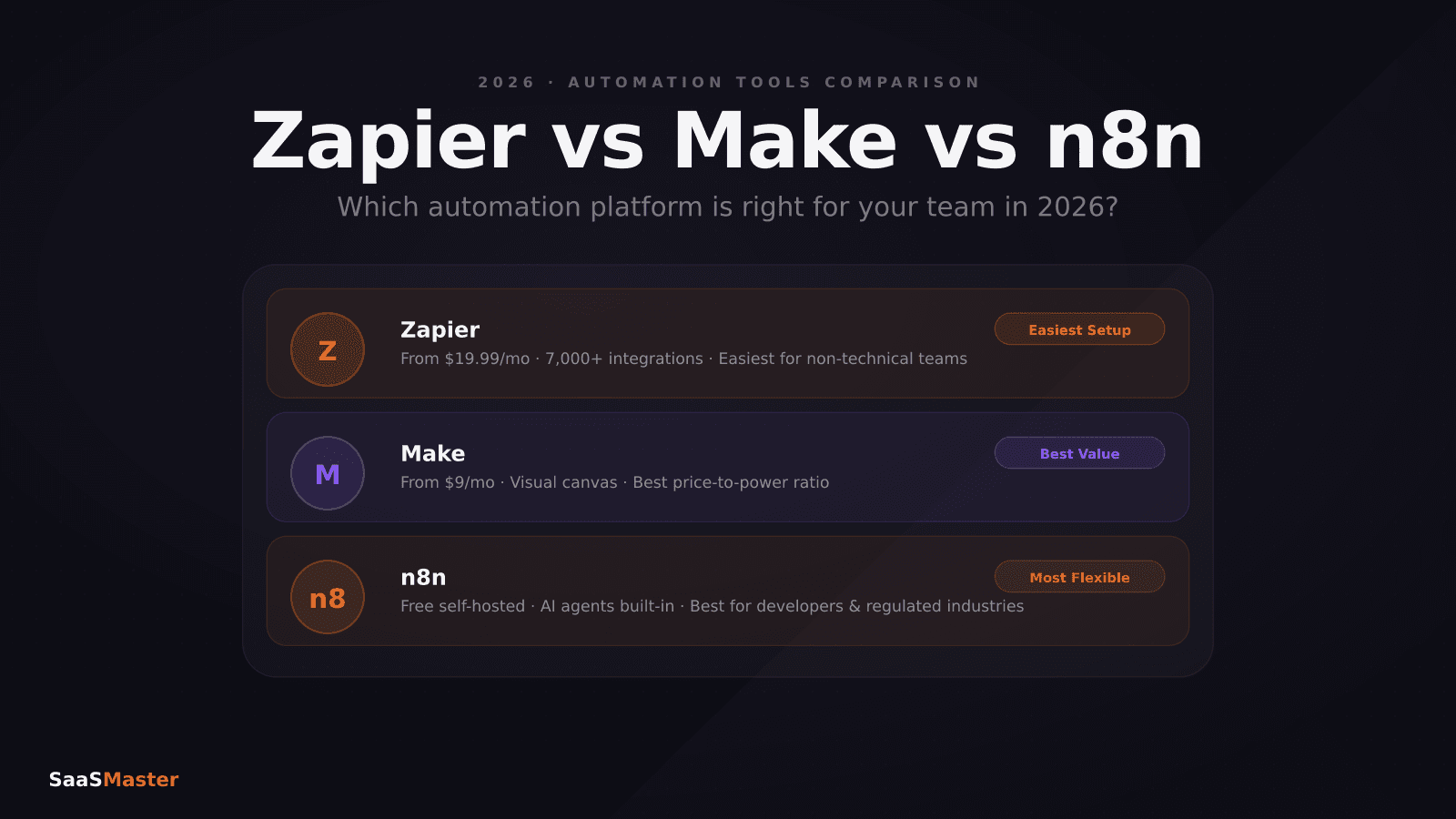
Zapier's core advantage hasn't changed: it connects to the widest app directory of any automation platform, which matters most for non-technical teams that need something working today without engineering support. But it's no longer the only option worth comparing, and the honest picture depends heavily on your workload and technical comfort — which is exactly what the full Zapier vs. Make vs. n8n pricing breakdown digs into at the scenario level, including where self-hosted n8n cuts costs by roughly 80% for technical teams willing to manage their own infrastructure.
Where Zapier Agents specifically earn their keep is the same territory covered in how small SaaS teams are running support, sales, and admin work on autonomous agents — tasks that are repetitive but require judgment calls a rigid Zap can't make, like triaging an inbound lead or drafting a first-pass reply based on context. Before adding another automation layer on top of your existing stack, it's worth running Zapier Agents through the same evaluation lens covered in choosing AI tools that actually pay for themselves, since the activities-based billing model makes it easy to underestimate real monthly cost until an agent is already running at scale.
If your team is building or rolling out a new automated workflow and needs the rest of the company to actually understand how it works, a short walkthrough video tends to get a Copilot-built Zap adopted far faster than a written setup guide buried in a wiki.
One more practical filter before adding Agents Pro to your bill: start with the free plan or Professional tier and build a single agent around your highest-volume, lowest-risk repetitive task first — lead enrichment or ticket triage are usually the easiest wins. Track how many actions it actually performs over two weeks, then price out Agents Pro against that real usage number instead of estimating from a demo. Because pricing is usage-based rather than a flat seat fee, the gap between "looks affordable in the pricing page" and "what our team's actual volume costs" can be wide enough to change whether Zapier, Make, or self-hosted n8n comes out ahead for your specific workload.
Frequently asked questions
How much do Zapier Agents cost?
Agents are billed as a separate add-on called Agents Pro, priced on a usage/activities model rather than a flat fee. A team running Zapier's full stack — Team-tier Zaps, Agents Pro, and Chatbots Advanced — starts around $169/month before task-volume charges are added.
Can Zapier Agents access sensitive customer data safely?
Zapier includes a built-in safety layer that scans agent outputs for more than 30 types of personally identifiable information, prompt injection attempts, and toxic or harmful language, and can automatically block, route, or escalate flagged content before it reaches a connected app like your CRM or inbox.
Do I need Zapier Copilot to use Agents?
No, but Copilot makes building and editing agents significantly faster by letting you describe a workflow in plain English instead of building it step by step. In 2026, Copilot also checkpoints every change it makes to an agent, so you can review exactly what was modified before it goes live.
Was this article helpful?
Jorge Aguilar
Founder & Creator, SaaS Master
Producing SaaS and AI product videos since 2019 — 800+ videos for 200+ brands, covering tutorials, demos, walkthroughs, and explainers. Writing here about the tools, trends, and tactics that actually move the needle. LinkedIn · About · Work with me
Need to show users how an automation workflow works in practice?
Client-owned videos that make your product easy to understand — demos, walkthroughs, onboarding, and explainers.
Explore product walkthrough video productionRelated guides
More Automation & No-Code →
How to Automate LinkedIn Outreach with Lemlist and Claude Without Sounding Like a Bot
Skywork 3.0 Review: Can One Agent Platform Replace Your Whole Workflow Stack?
How to Collect Donations and Sell Products Online Without a Website