Skywork 3.0 Review: Inside the Autonomous Cloud Workforce Replacing OpenClaw
In short
Skywork 3.0 scored 82.42% on the GAIA benchmark and ships SkyBot as a cloud answer to OpenClaw. Here is what it does, what it costs, and who should switch.
Skywork 3.0 is an agentic AI platform that runs research, document creation, and content production as background jobs on a dedicated cloud server, instead of a chat window you have to babysit. Its cloud agent, SkyBot, is Skywork's answer to OpenClaw — the popular open-source personal-assistant framework — and it trades OpenClaw's local, self-hosted control for zero-config setup and 24/7 persistence.
Key takeaways: - Skywork 3.0 launched as a full platform update around April 20, 2026, adding the Skyclaw Autonomous Agent System, which breaks a goal into phases and executes them in parallel. - Skywork's research agent posted an 82.42% score on the GAIA benchmark, currently the top publicly reported result, ahead of OpenAI Deep Research and Manus. - SkyBot runs in the cloud and connects to WhatsApp, Telegram, Discord, and Slack; OpenClaw is free, open-source, and self-hosted with deeper local-system access. - Skywork's Pro plan runs $19.99/month; OpenClaw itself is free under an MIT license, though you pay for your own hosting and model API usage.
[[video:RD8cz13zeQM]]
What does "the end of complex workflows" actually mean?
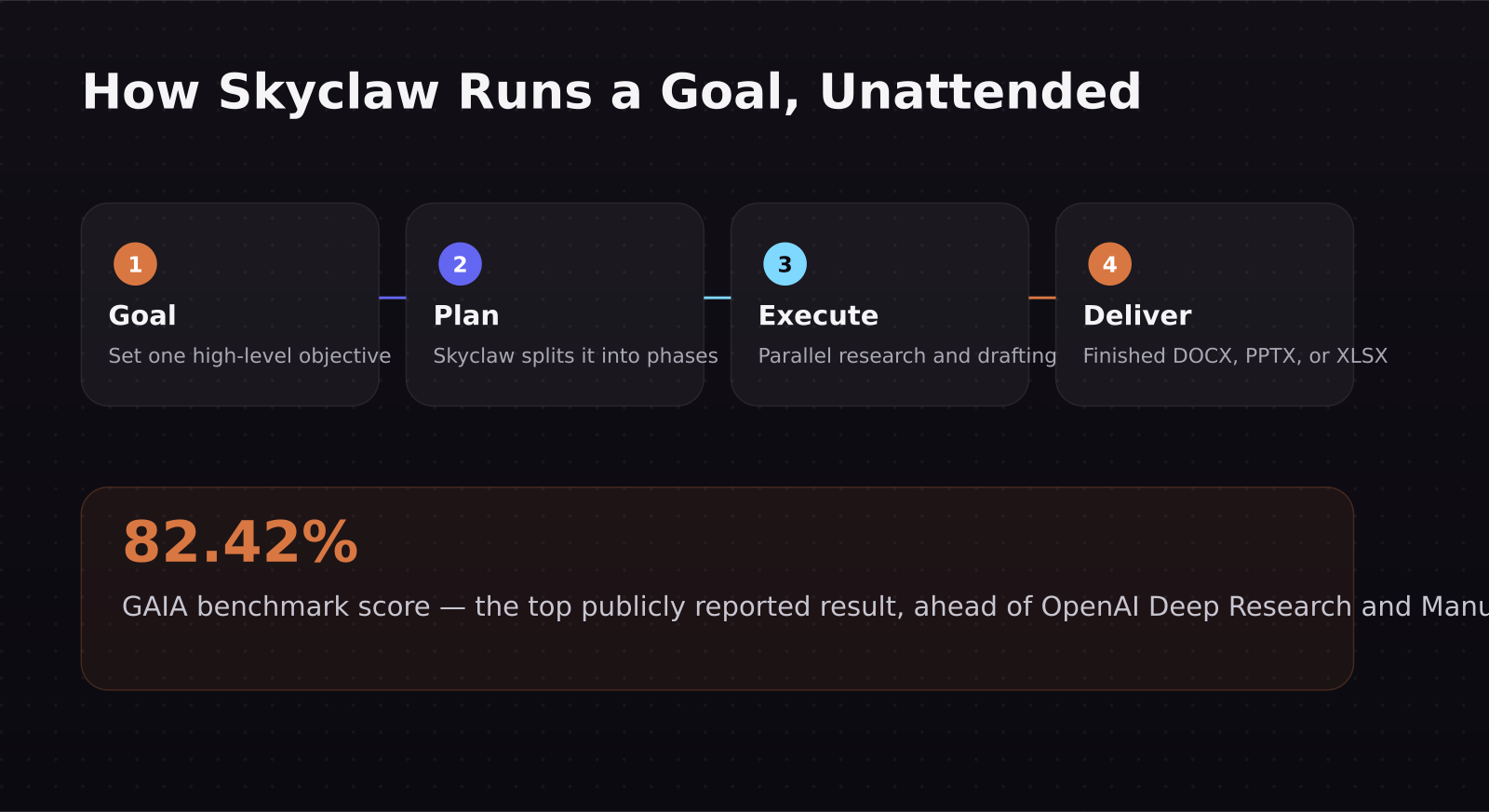
The pitch in Skywork 3.0 is architectural, not cosmetic. Earlier versions of Skywork — and most AI agent tools generally — required you to manually chain together a research step, a writing step, and a formatting step, then babysit each one. Skywork 3.0's Skyclaw Autonomous Agent System takes a single goal, breaks it into phases, and runs research, drafting, and asset generation in parallel on a dedicated cloud instance, without needing the browser tab open.
That's the "goodbye OpenClaw" framing in the title: OpenClaw made autonomous, always-on agents accessible to anyone willing to self-host and configure it. Skywork's argument is that most people don't want to manage a server, so SkyBot does the same job as a managed, cloud-based service you subscribe to instead of install.
How does SkyBot compare to OpenClaw?
The two tools solve the same underlying problem — an AI agent that keeps working when you close the laptop — from opposite ends.
- SkyBot is cloud-managed and workspace-centric, built for 24/7 persistence and quick pairing to chat apps like WhatsApp, Telegram, Discord, and Slack. Setup takes minutes and requires no server of your own.
- OpenClaw is free, open-source, and self-hosted, with deep local-system access: it can run shell commands with your approval, manage files directly, and drive a browser through the Chrome DevTools Protocol.
- SkyBot's cost is folded into your Skywork subscription rather than billed as a separate line item; OpenClaw itself is free under an MIT license, but you're responsible for hosting, uptime, and the API costs of whatever model you connect it to.
- If you want full local control, deep OS-level actions, or strict data locality, OpenClaw is still the stronger fit. If you want to be productive in an afternoon with zero infrastructure to maintain, SkyBot gets there faster.
What can you actually build with Skywork 3.0?
The video above demonstrates the full workflow: prompting the AI to autonomously research the web, structure findings into an actionable report, and generate supporting assets without manual handoffs between steps.
- Set a high-level goal instead of a sequence of prompts — for example, "research the top 5 DM Champ competitors and build a content plan."
- Skywork's DeepResearch engine cross-validates findings across hundreds of sources automatically rather than trusting a single pass.
- Super Agents output the finished deliverable directly — DOCX, PPTX, or XLSX — complete with citations and data visualizations, skipping the usual copy-paste-reformat cycle.
- Schedule reusable "Skills" so the same job — a weekly market analysis, a recurring content brief — runs automatically without you re-prompting it each time.
What does the GAIA benchmark score actually tell you?
Benchmarks get thrown around loosely in AI marketing, so it's worth being specific about what GAIA measures and why an 82.42% score is meaningfully different from a coding or writing benchmark.
- GAIA tests multi-step, tool-using tasks that require an agent to plan a sequence of actions, use tools like web browsing and file handling, and produce a correct final answer — not just generate plausible text.
- Skywork's research agent framework topped the public GAIA leaderboard at 82.42%, ahead of both OpenAI Deep Research and Manus, two of the more established names in the autonomous-research category.
- That specific benchmark matters for Skywork's pitch because it's testing exactly the kind of unattended, multi-step work SkyBot and Skyclaw are designed to run — cross-referencing sources, structuring findings, and delivering a usable output without a human checking each step.
- It's still a narrow signal. A top GAIA score says a lot about research-and-synthesis tasks and comparatively little about coding ability, creative output, or long-running project management, so treat it as evidence for the specific job Skywork is selling, not a general "best AI" claim.
Is Skywork 3.0 worth switching to?
At $19.99/month for the Pro tier, Skywork 3.0 is priced closer to a single-seat SaaS subscription than an enterprise agent platform, which makes it an easy trial for a solo operator or small team already juggling AI agents across their SaaS stack. The GAIA benchmark score matters here specifically because GAIA measures multi-step, tool-using tasks — the same category of work Skywork is pitching SkyBot to handle unattended.
Where it gets more complicated is coding-specific agent work. Tools built for that job — reviewed in the Grok Build vs. Claude Code vs. Codex comparison or the Claude Sonnet 5 computer use guide — are still the stronger choice for engineering teams. Skywork's strength is research-to-deliverable work: reports, briefs, and structured documents, not shipping production code.
For SaaS teams evaluating whether agentic tools are worth the switch at all, it's worth reading how agentic AI is reshaping the broader SaaS spending picture before locking into any single platform, since the category is still moving fast enough that this month's benchmark leader is rarely next quarter's.
A practical way to trial Skywork 3.0 without over-committing: pick one recurring research task your team already does manually — a weekly competitor scan, a monthly market summary, a recurring content brief — and hand only that one task to a saved "Skill" for two or three cycles before deciding whether to expand its role. That mirrors exactly the workflow demonstrated in the video above, where the structured document output and thumbnail concepts are evaluated before being trusted for a larger, ongoing content pipeline. Judging the tool on one well-defined, repeatable job is a far better signal than testing it on a one-off, open-ended prompt.
If your team needs to actually show a client or new hire how an autonomous agent workflow like this fits into daily operations, that's exactly the kind of process a short software demo video tends to explain far faster than a written SOP.
Frequently asked questions
What is Skyclaw in Skywork 3.0?
Skyclaw is the name of Skywork 3.0's Autonomous Agent System — the orchestration layer that takes one high-level goal, splits it into phases, and runs research, drafting, and asset generation in parallel on a dedicated cloud instance instead of requiring step-by-step prompting.
Is SkyBot the same as OpenClaw?
No. They solve a similar problem differently. SkyBot is Skywork's cloud-managed, subscription-based agent with zero setup; OpenClaw is a free, open-source, self-hosted framework that gives you deeper local-system access at the cost of managing your own server and model API bills.
How much does Skywork 3.0 cost?
Skywork's Pro plan is $19.99/month under a freemium model with a free tier available for lighter use. SkyBot's usage is bundled into a Skywork subscription rather than priced as a standalone add-on.
Does Skywork 3.0 replace a coding agent like Claude Code or Cursor?
No. Skywork is built for research-to-deliverable work — reports, briefs, slide decks, and structured documents — not for writing or shipping production code. Teams doing serious engineering work are still better served by a dedicated coding agent, and pairing the two isn't unusual: use Skywork to research and scope a project, then hand the implementation to a coding-focused tool once the plan is set.
Was this article helpful?
Jorge Aguilar
Founder & Creator, SaaS Master
Producing SaaS and AI product videos since 2019 — 800+ videos for 200+ brands, covering tutorials, demos, walkthroughs, and explainers. Writing here about the tools, trends, and tactics that actually move the needle. LinkedIn · About · Work with me
Need to show users how an automation workflow works in practice?
Client-owned videos that make your product easy to understand — demos, walkthroughs, onboarding, and explainers.
Explore product walkthrough video productionRelated guides
More Automation & No-Code →
How to Automate LinkedIn Outreach with Lemlist and Claude Without Sounding Like a Bot
Skywork 3.0 Review: Can One Agent Platform Replace Your Whole Workflow Stack?
How to Collect Donations and Sell Products Online Without a Website